


For a long time, the "boutique agency" was the gold standard for any small business with an ambition to grow. The pitch was simple: you get your own "dedicated team" of specialists (designers, writers, strategists) all working together on your brand. It sounded professional and safe, and signaled that you were a serious business.
But the math of 2026 has fundamentally changed (you guessed it, thanks AI!).
How did the agency model become a burden?
To understand where agencies went wrong, we have to examine how they got their start.
Most agencies start the same way: talented employees at a big firm realize they are doing 100% of the work while the company keeps 80% of the money. So they leave to start their own shop but immediately replicate the exact same broken structure.
Five ways the "team" model fails the small business owner
- The Game of Telephone: You sit on calls with an Account Manager who is rarely an expert in the actual tactics; they are essentially professional note-takers. Every layer between you and the person doing the work acts as a filter where the "vibe" is lost. It’s the classic childhood game: you tell one person what you want, they tell a third person their version of what you want, and by the end, the work you receive bears almost no resemblance to your original vision.
- The Resource Shuffle: Branding thrives on consistency, but agencies are built on turnover. During the pitch, you meet the "star" talent—the veterans who command the highest rates and (theoretically) the best results. But once the contract is signed, those stars are pulled away to handle the agency's massive, high-revenue accounts. Your project gets passed down to a rotating door of people who are just passing through. When a new person is rotated onto your account, they have to "catch up" on your brand's voice and history. This feeds right back into the Game of Telephone: instead of a deep, long-term partnership, you’re stuck in a loop of re-explaining your business to someone who wasn't in the room when the original promises were made.
- The Accountability Gap: Many agencies act as if they are only responsible for "executing a campaign" rather than the actual business result. If the creative looks pretty but the sales don't follow, they often claim they "got the horse to water" and wash their hands of it. Because there are so many layers of people involved, no single person feels the weight of the project's success. In their eyes, as long as the tasks were completed and the billable hours were logged, they’ve done their job. You’re left holding a polished campaign that didn't work.
- The Context Cost: You pay for four specialists to sit in a meeting just to get on the same page, essentially paying the agency to explain your business to its own staff. Because the team is siloed, the writer doesn’t know what the designer is doing, and the strategist is looking at a different set of notes entirely. Every time there is a hand-off, information leaks. You find yourself repeating your goals, your brand history, and your "non-negotiables" over and over again.
- "Not My Lane" Stagnation: In an agency, the project is sliced into departments, which means no one person ever has the complete picture. Because the work is segmented, the designer is solving for aesthetics, the writer for word count, and the developer for code—but no one is operating with the full, unified perspective of the business owner. This fragmentation leads to a "death by a thousand cuts" where small, obvious improvements are missed simply because they fall between the cracks of the various silos.
What has actually changed?
Since AI entered the picture, the rules of creative production have been rewritten. It isn't just about speed; it's about a fundamental shift in who can do the work and how much it costs.
- How the work gets done: You aren't starting from a blank page anymore. You are an editor instead of just a creator, spending your energy directing and refining rather than wrestling ideas into shape.
- Who can do the work: You don’t need to be an expert copywriter; you just need to be an expert on your subject and use AI to translate that knowledge into prose. You don’t need to be a designer; you just need to know what you like and use the tools to make it real.
- The cost of execution: AI has collapsed the cost of making things. One person can now handle projects that used to require an entire department, removing the need for the agency "Bloat Tax".
Be skeptical of the "Anti-AI" pitch
When you talk to an agency, they will likely try to sow doubt about AI because it threatens their billable-hour model. Here is what they will tell you, and why you should be skeptical:
- "It doesn't sound human": Even with an agency, you rarely see the person actually writing your content—they are already mimicking your style. If you’re already paying someone else to speak for you, why not keep control of that process using AI? And yes, there is a guide for that here.
- "People will know you used it": Bad writing is bad writing whether a computer writes it or a person. With AI writing, at least you get it quick and aren’t paying for every revision. You can train AI to understand what you like and don't like; once you do, it doesn't matter who is operating the computer—you get what you’re looking for.
- "It will backfire on your brand": What actually backfires is when you spend all your money on an agency instead of other areas in your business. Paying extra for a broken model hurts your brand way more than adopting efficient tools.
Hiring a freelancer is a great, cost-effective option here, but even better is when you just hire a person to be on your own team who has these AI skills. Bringing that talent in-house means you aren't paying an outsider's markup for overhead, and they will have far more context of your business than any agency.

Why should you get ahead of this now?
Look, I’m not just telling you to embrace AI because it’s the "new thing." I’m telling you because I’ve seen the alternative, and you’re likely living it right now.
You know that feeling of waiting three days for a simple email response from your "dedicated team"? Or that pit in your stomach when you realize you’re paying a $5,000 monthly retainer for a "strategy" that’s really just a bunch of fancy slides?
That is the weight of the old model. Think of AI like a massive computer upgrade for your business. In the old days, your "creative machine" only worked if there was a "butt in a seat" billing you by the hour. If they weren't typing, nothing was happening. But now? That machine can work 24/7. It can pay for itself by removing the friction between your brain and your brand.
The shift isn't just about being cheaper; it’s about being lighter. When you’re lighter, you move faster. You don’t have to wait for a committee to approve a "vibe." You don’t have to pay for the layers, the silos, or the "Game of Telephone." You reduce the distance between your idea and the market to almost zero.
My challenge to you: Just investigate it.
You don't have to fire everyone and move to a bunker with a laptop tomorrow. But you do need to stop believing the lie that there is some "secret sauce" hidden inside a big agency building.
There is no secret sauce. There is only the work.
Take one project—one campaign, one video, one series of posts—and try the "light" way. Hire a specialist who actually uses these tools, or empower someone on your own team to master them. See what happens when you stop paying for the "Bloat Tax" and start paying for actual output.
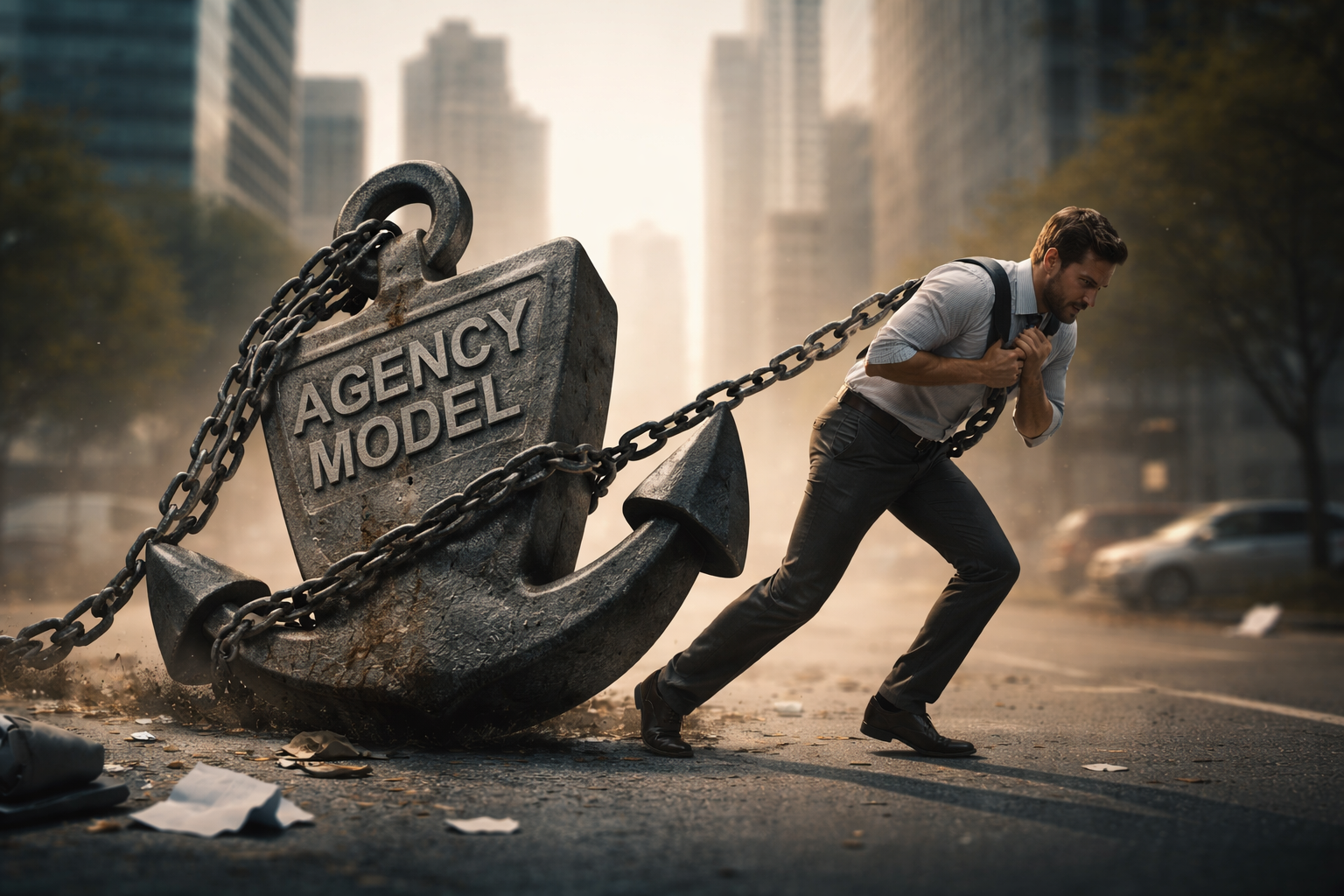
I think you’ll find that the "professional safety" of the big agency was actually just a very expensive anchor. It’s time to cut it loose.