
The guitars are real guitars, sort of. The blast beats hold together for a bar and a half and then smear. A vocal that sounds like a throat arrives somewhere behind the mix, says nothing in particular, and dissolves back into the cymbals. It never stops, and it never repeats, because nobody wrote it down.
That's Dadabots, and it has been playing more or less continuously since 2019.
Dadabots is CJ Carr and Zack Zukowski, two musicians and programmers who met at Berklee. They describe themselves on their own site as "music hackers" working with "diy neural nets." What they built is a system that listens to a metal album until it can hallucinate more of it, then streams the hallucination live.
The technical choice underneath it matters more than it sounds. They generate raw audio rather than notation.
DADABOTS — Coditany of Timeness, generated from Krallice, on Bandcamp
No MIDI, no tabs, just the waveform
Most machine-generated music works with symbols — notes, chords, a grid. Dadabots skipped that layer and pointed the model at the audio file itself.
Their 2018 paper, Generating Albums with SampleRNN to Imitate Metal, Rock, and Punk Bands, states the method in one line: "Raw audio is generated autoregressively in the time-domain using an unconditional SampleRNN. We create six albums this way."
Autoregressive in the time domain means the network predicts the next slice of waveform, then the next, then the next — sample by sample, with no concept of a note. Everything you hear is a byproduct of it guessing what comes next in the audio stream. The distortion, the cymbal wash, the room tone of the original recording all get modeled together, which is why the output has that specific quality of sounding like a bad bootleg of a band that doesn't exist.
Training on a single album, over and over, is the whole method. Coditany of Timeness came from Krallice. Calculating Calculating Infinity came from Dillinger Escape Plan. Inorganimate came from Meshuggah.
DADABOTS — Calculating Calculating Infinity, generated from Dillinger Escape Plan, on Bandcamp
Most of it failed, and they said so
The part of this story that separates it from a demo reel is how openly they've talked about the models that didn't work.
"Most nets we trained made shitty music. Music soup," Carr told VICE in 2019. "The songs would destabilize and fall apart. This one was special though."
The one that was special was trained on technical death metal band Archspire, and Carr's theory about why it held together is a genuinely useful piece of craft knowledge: the tempo is so fast and so relentless that it gives the network less room to drift.
Their paper puts the same idea in gentler language. "While we set out to achieve a realistic recreation of the original data, we were delighted by the aesthetic merit of its imperfections."
The imperfections are the record. A model that perfectly reproduced Archspire would be a copy of Archspire, and useless.
Nobody is curating the stream
The livestream is unsupervised in the literal sense. There is no queue of approved takes.
"It's autonomous, running on a linux server somewhere in South Carolina," Carr told VICE. "You're hearing everything it makes."
Everything, including the parts that fall apart. That's a harder position to hold than it sounds — it means the bad output is part of the published work, permanently, with no edit pass between the model and the listener.
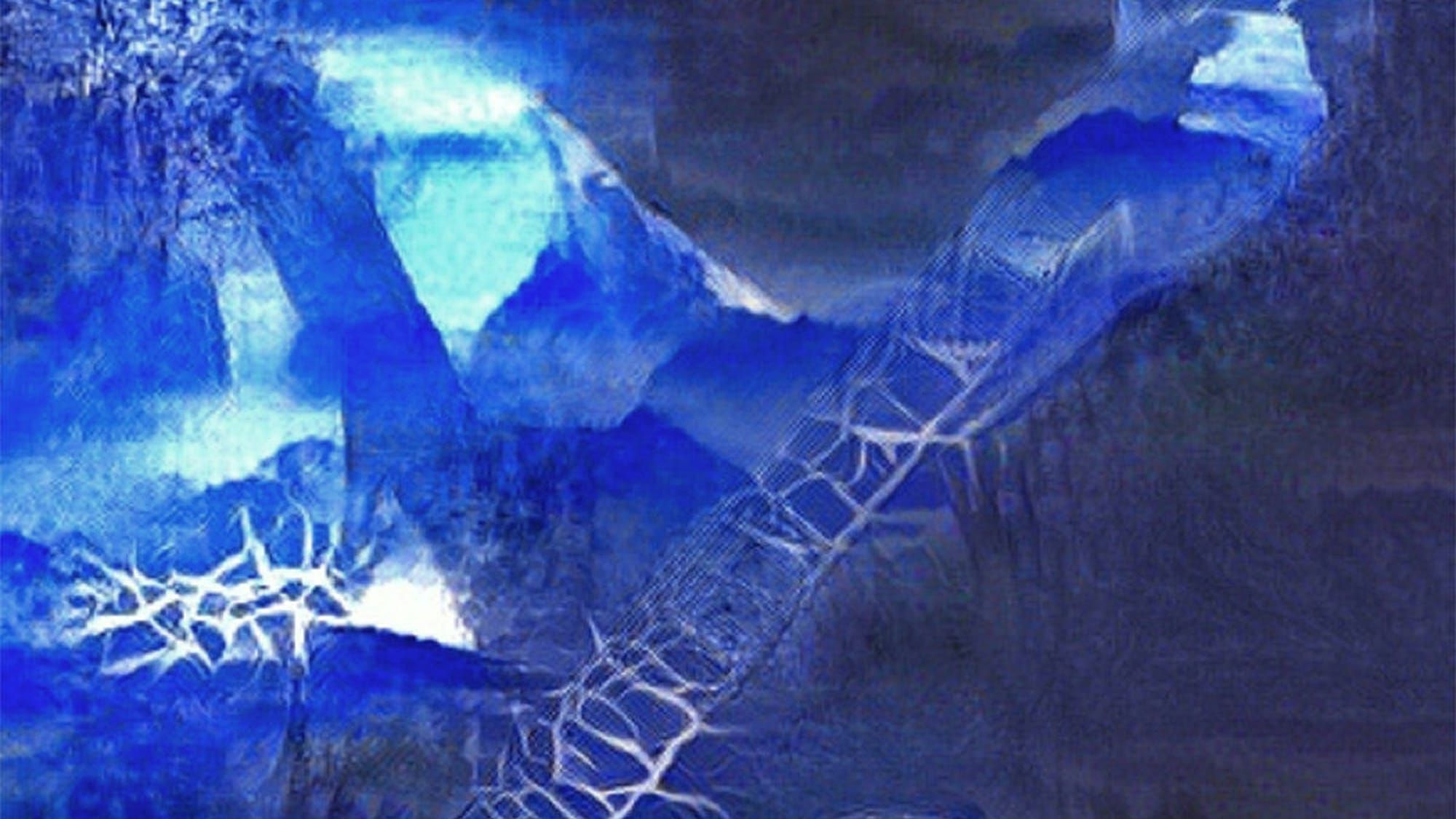
They generated the album art and song titles with models too, trained on the original bands' back catalogs, and tested both fully-automated and human-curated versions of that process.
They kept going
The 2019 death metal stream is the thing people know, but the project didn't stop there. They put out a WOW LOL EP in 2024, described on their own site as kawaii deathcore drill and bass, and released the PIZZAFIRE documentary in 2023. They perform live, using PyTorch, Ableton, and Hydra for visuals.
If you want a neighbor in this territory, the Frog Mage's original music sits in a different genre entirely but shares the willingness to publish the weird result rather than sand it down.
Carr and Zukowski have been running the same experiment for years now: pick a band, train on the raw waveform, publish what the network does with it. The server in South Carolina is still going.