
Most people who make images with AI reach for the word "artist" pretty quickly. The person running The Archive In Between goes the other way. They stay anonymous, sign everything as the "Head Curator," and when the subject of artistry comes up, they draw a hard line down the middle of their own work: the writing is theirs, the images are curated. "I would never attach the title of 'artist' to myself as it relates to the use of AI," they told The Daily Egg — in what is, as far as I can find, the only interview they have ever given.
That's worth pausing on. This is a project with 145,000 YouTube subscribers, roughly 394,000 on TikTok, hundreds of thousands more on Instagram, and a five-thousand-member Discord — and the person behind it has spoken to the press exactly once in four years. The channel description carries their whole public position in one standing sentence: "All images are created with digital illustration and AI, and all words are written by a human hand."
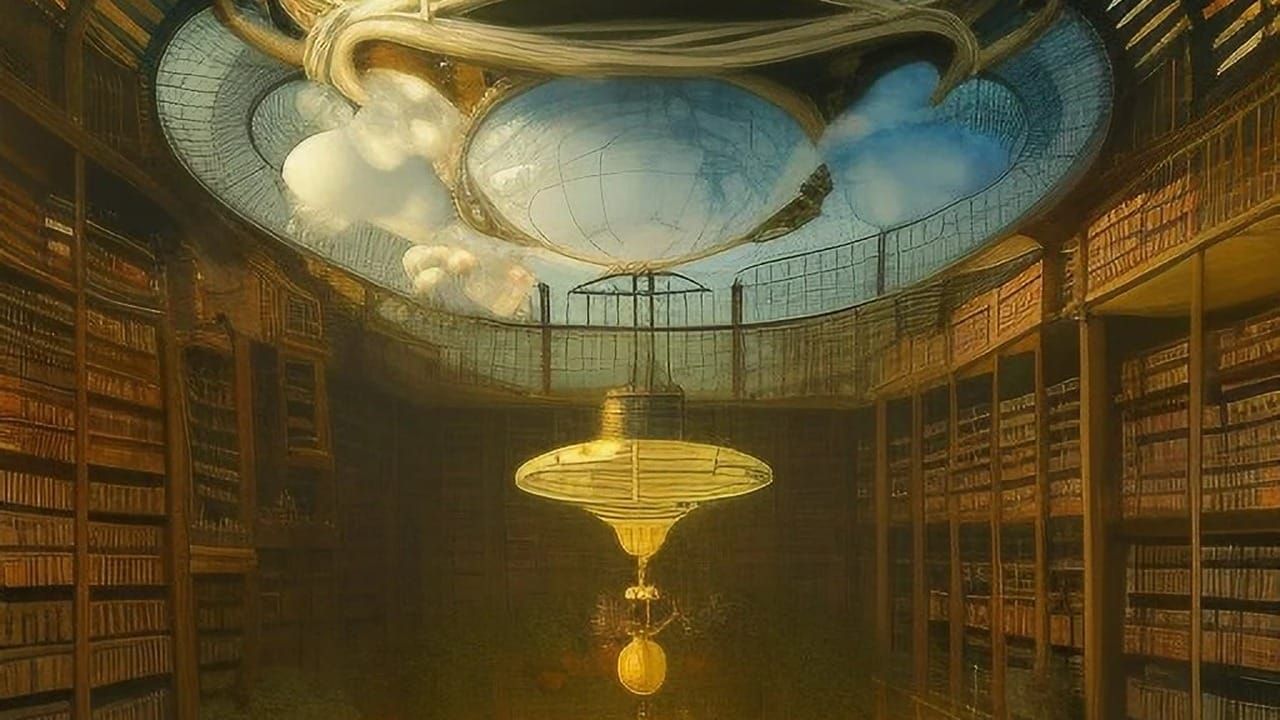
The Archive is a sci-fi, horror, and fantasy anthology — human-written stories paired with AI-generated imagery, all framed as transmissions from a library that sits between worlds. Stories arrive as carousels, short videos, and long-form pieces, stitched into one interconnected universe across TikTok, Instagram, YouTube, Substack, Patreon, and Discord.
It started with propaganda posters about aliens
The Archive began in late 2022 — the YouTube channel was created December 17, the Patreon two days later — and TikTok came first: "TikTok is where I first started posting because I thought it was a better platform at the time."
The first story is a nice little time capsule of the era. "My very first story used Stable Diffusion to generate these images that looked like old 50s-style retro posters. Then I went into Photoshop and added captions to these posters, and it was a series about aliens coming to Earth through the lens of propaganda posters. The first two posters said not to trust these things, like 'Vote against the first contact authorization act, don't engage.' Then the next two said, 'They're here to help: let them help us.'"
The library frame came from a practical problem: a drawer full of unrelated stories. "I had all these little stories written down, and I did not want to box myself into one genre. So I had to create a narrative structure that would allow for all of those stories to exist without feeling completely disorganized. Then the idea came to me that, 'Hey, what if there was this library that sat in the middle of all these universes?'" They describe the moment physically: "I remember sitting in my garden, and I felt like I got hit by a lightning bolt when I thought, 'This is it.'"
The library between worlds
The frame does real work, and four years in it has grown into a genuine mythology. The Archive is a great library residing in the space between dimensions, run by the Head Curator. Every story is a document pulled from its shelves, tagged with an alphanumeric annex code — our own baseline universe is A-0001A, and the further a code drifts from it, the stranger the universe it points to.
Around that spine sit recurring factions. The Pale Lodge — interdimensional adventurers broadcasting safety PSAs from a white stone citadel, whose "Stride safe folks!" sign-off recurs across the Shorts. The Patchwork City Visitation Authority, issuing educational transmissions from a pocket-dimension metropolis. The Interloper Repellent Brigade, running in-world recruitment ads. Entities like the Rain Walkers — mirage-giants on the horizon — and gods inverted by "aspect decay." Fans maintain a whole wiki cataloging it, filed in the analog-horror lineage of Local 58 with a strong dose of SCP-style catalog fiction.
"The Starfall Initiative," the long-form that went up on July 22, 2026, shows the current shape of the machine: a researcher's account from Annex B-9619U, free on YouTube — with its sequel, "The Cost of War," waiting on Patreon. Free story, paid continuation. That funnel is the business model in miniature.
Four stories a week, written by hand
The part of the process the Curator will claim is the prose, and it's all theirs. "The writing is 100% human-done. I write every word myself. I will say though, ChatGPT is the best thesaurus in the entire world. That is the extent of my use of AI in the writing."
That held until August 2026. The Archive's 10-part animated graphic novel with @Lore_Machine, which started with Who built the Construct? on August 13, is credited as "Written by the Head Curator and B. Earl," with the Curator narrating. Four parts were up as of September 17.
The cadence is fixed and self-imposed: "I just have to post four stories a week. I have to post one long-form story per week. If I'm rocking it, I get those done a week in advance." Before a vacation: "I will lock myself in my office and not come out for five days straight, hammering these things out."
The ideas come from somewhere deliberately analog. "I truly think that your best resource is your own lived experience," they said, along with a habit of getting to places without cell reception. "Learning how to look at what's in front of you, even if it's just outside your front door, and twisting it from a slightly different perspective, is invaluable."
Script first, then images, then layout
The pipeline never starts with a generation. "I always start with the script, and then I create the images after that. I drop it all into a Google Slide. Then I pull it all into InDesign and do the actual design, make sure the text is aligned properly so it's sitting nicely within the image and it's not obscuring the subject of the image." A carousel takes two and a half to five hours; a video runs one to two, because "the editing workflow on Premiere is a bit easier than what I do in InDesign."
The image tool has changed over the years. They ran Stable Diffusion for a long time, and their explanation for leaving is the most businesslike tool review you'll read: "Stable Diffusion took a bit of a shit as a business. They didn't monetize... They stopped maintaining their website. They stopped adding new models. It wasn't working for me anymore, so I moved over to Midjourney." The turning point on the new tool was specific: "There's a feature called SREF Codes. The minute I learned to use those was the minute I figured out how to use Midjourney."
The newest videos carry a fuller credit line — "The Starfall Initiative" discloses it was made with Midjourney, ElevenLabs, Runway, Adobe Audition, and Premiere. That answers a question I had going in: the narration on the standalone videos is an ElevenLabs voice. The Lore Machine series is the exception, and the Curator narrates it. There's an audio side to the world, too — an in-universe ambient music series called Interdimensional Radio, plus a curated "Auditory Annex" playlist on Spotify.
"Less like an artist and more like a curator"
The stance that gives this profile its title is not a throwaway line — they've reasoned it through. On generating: "When I use AI, I feel less like an artist and more like a curator. It's like I'm sifting through shit because there's a lot of it and I'm picking out what looks passable and enhances the storytelling."
Their cleanest version of the argument involves a kitten: "I made no conscious choice that this kitten is an orange tabby, a gray tabby, a tuxedo cat, and a black cat. I didn't choose what the rug looks like... There is a level of decision-making that is not happening."
And then, in the same conversation, the counterweight — because this isn't someone dismissing craft: "While I stand by not really viewing myself as an artist for creating AI imagery, I would be remiss not to mention that one of the reasons I've been able to create pretty compelling imagery is because I have an informed background as an artist. I know the language."
The illustrator behind the Curator
That background is professional. Before the Archive, they spent about four years as an illustrator and designer at a digital marketing agency, plus a stretch at a Southern California apparel company. When generative imagery arrived, they watched it go from joke to threat in real time: "Everybody was making those awful little images of, like, Will Smith eating spaghetti... It was such a joke. And then all of a sudden it wasn't." The response was characteristic: "I thought this could be an existential threat, as an illustrator. But I wouldn't be doing my job as an artist or as an entrepreneur if I didn't investigate this technology before I cast judgment upon it."
Asked why the project worked, they split the credit evenly: "I think it's 50% luck in timing and 50% my perspective. I was really lucky to be one of the first people that did it. The space is saturated now." And beneath the entrepreneur read, something simpler: "I never lost that little kid in me who was trying to play make-believe. He slept for a while, but he was always there."
Reader-funded, and full-time
The Archive pays the bills, and it does it without ads. Ranked in their own words: "Patreon. Purely by the fact that it's more familiar to most people than Substack right now. I was a little late to the Substack game. Behind that is direct sales. I sell collected volumes of these short stories and expanded versions in these books... I use Amazon as a print publisher because people really want paperbacks."
The Patreon — running since December 2022, starting at $2 a month — carries exclusive stories in print and audio, wallpapers, and behind-the-scenes material, with a little over two thousand paying members by public tracker estimates. The catalog now includes two print Compendium volumes (April and November 2023), eBooks sold directly, and — the part I didn't expect — a solo tabletop RPG: the "Deep Space Explorer Handbook & Mission Log," which turns the universe into something you can play alone. There's a gift shop with a Pale Lodge collection and an in-world poster series.
It replaced a career, though not instantly: "I'm not making as much as I was when I worked in marketing. But I am steadily climbing back towards that." The freelance clients got let go — with an exception "for close friends or people who want to pay me, like, a lot of money."
The pricing philosophy gets stated with unusual care: "I'm still finding the right balance because I don't want to box people out. I don't want the people who have been loyal readers, but for whatever reason can't afford it, to feel like they're left out. But I need to meet my needs, and I need to grow as a storyteller."
@thearchiveinbetween
One interview in four years
For an operation this size, the public record is strikingly small. The Daily Egg interview — granted on condition of anonymity — is the entire press footprint. No podcasts, no AMAs, no follow-ups. The interviewer reportedly approached other AI creators who all declined; the Curator was the one who said yes, once, and then went back to posting.
What fills the space instead is the community: the fan-maintained lore wiki, the Discord, a fan-compiled ambient playlist. The Curator declines to be a spokesperson even when handed the microphone: "I refuse to speak for the rest of the people making this kind of content."
The advice they do offer is the least gatekept version possible: "YouTube is the best thing. YouTube and Reddit. You can learn almost anything you want using those two platforms."
Four years in, the machine keeps its rhythm — four stories a week, one long-form, 347 videos and counting, every one of them carrying the same standing sentence about human words and generated images. "I have big, big dreams for this," they told their one interviewer. "I have a vision for this that extends beyond posting stories on Instagram."
For an adjacent register of AI horror built on a completely different bet — leaning into the machine's errors instead of curating past them — see our cursejourney deconstruction. The Archive's own transmissions are at thearchiveinbetween.com, the long-form stories on their Substack, and the reporting here draws throughout on "The Honest AI Artist" in The Daily Egg.