
A man in a suit stands up in the aisle of a commercial airliner and puts a hand against the overhead bin to steady himself. A few rows back, a woman watches him. He wipes his mouth and his fingers come away red, and the woman next to him goes very still.
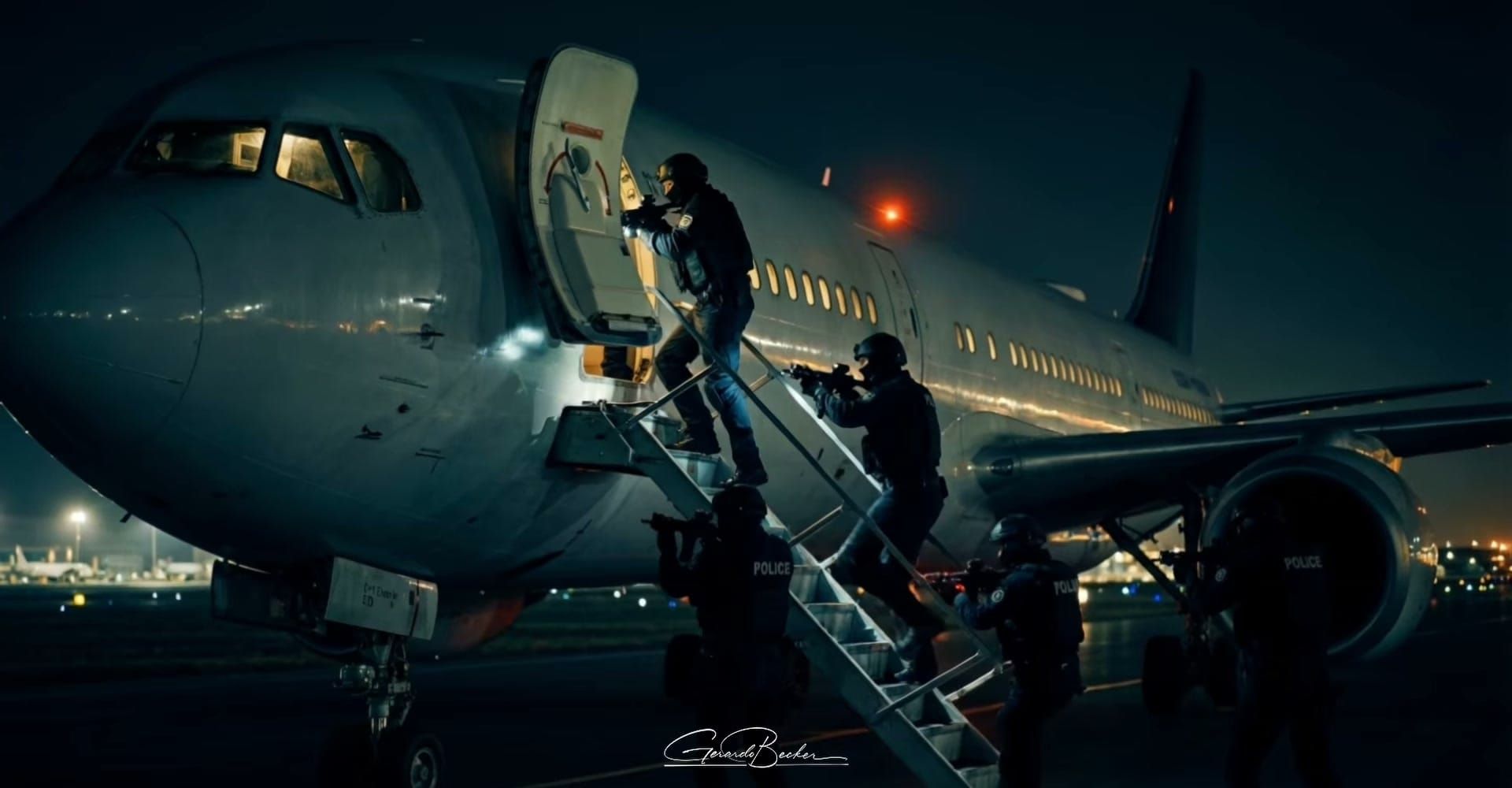
By the end of the five minutes there are tactical officers climbing the airstairs at night with rifles up, a pilot screaming in the cockpit, and a local news package with a Channel 7 lower-third explaining what happened.
That's "Cabin Zero," and Gerardo Becker did all of it himself.
The film is built shot by shot in the grammar of a studio thriller — cool cabin fluorescents, shallow depth, faces held a beat longer than is comfortable. Passengers glance at each other before anyone says the thing out loud. The camera stays low in the aisle so the plane feels like a corridor with no doors. Becker signs each frame with a small script signature in the lower center, the way a painter would.
Gerardo Becker — "Cabin Zero," via Instagram (@gerardobeckera)
What the Film Did
"Cabin Zero" went into the World AI Film Festival's Road to Cannes contest, run with CapCut as an official sponsor. Becker's own caption describes it as a horror-thriller developed as a narrative, visual and technical exploration in AI filmmaking, made with CapCut's AI tools. The film's title card carries the WAIFF 2026 official selection laurel.
Milenio reported that the contest drew more than 3,000 creators from over 80 countries, that Becker reached the top 60 finalists, and that he took the festival's Excellence Award — a distinction for pieces that stand out on quality, innovation and narrative execution. His Instagram bio puts it more plainly: Excellence Award, WAIFF 2026, Mexico's first nominee.
He is also, per that same Milenio profile, a sitting Magistrate in the State of Mexico. The filmmaking happens around that. Voice acting is in there too, which he describes as a personal outlet.
Every Job on the Call Sheet
The part worth sitting with is the credit list, because there isn't one.
Milenio lists what Becker handled on "Cabin Zero" personally: concept, script, cinematographic direction, character design, image generation with detailed prompts, animation, editing, sound design, color correction and final post. On a live-action version of that same five minutes you'd be staffing a few dozen people, an airport, and a location permit.
He has been direct about not wanting the shortcut read on this. As he told Milenio:
"La inteligencia artificial no viene a reemplazar el cine, viene a potenciarlo."
Artificial intelligence isn't here to replace cinema, it's here to amplify it. He pairs that with the point that creating this way asks for technical precision and a lot of iteration, rather than being automatic.
You can see the iteration in the consistency. Across "Cabin Zero" the same businessman is the same businessman in the aisle, on the gurney, and in the news footage — which is the hard part of this medium and the thing most AI shorts quietly give up on.
The Lost Tapes, and the Fast Stuff
Outside the festival work, his feed runs a series called The Lost Tapes — Aztecs, Dragons, Odyssey, Ice Age — staged as recovered footage of things nobody filmed. The Aztec one carries a disclaimer in the caption saying the piece is fiction made with AI for artistic and cinematic purposes, and doesn't intend to glorify or justify acts of violence. Writing that line yourself, before anyone asks, is a choice.
Gerardo Becker — "Lost Tapes: Aztecs," via Instagram (@gerardobeckera)
Then there's the short stuff he throws off between the bigger pieces. "The Hum" is thirty seconds of alien-encounter suspense, captioned as a disruptive 30-second short story and credited to OpenArt. A goblin reel gets a two-word caption and a Magnific credit, and the comments spend their time arguing about whether the creature looks like a hairless cat in a wig.
Gerardo Becker — "The Hum," a 30-second short, via Instagram (@gerardobeckera)
The range is the point. A festival-grade five-minute thriller and a goblin gag live on the same feed, a few days apart, and both get finished.
Gerardo Becker — "Goblin Alert!", via Instagram (@gerardobeckera)
The Tools He Credits
Becker names his stack in public, in his profile bio and in the post captions, which makes it checkable.
Tools Gerardo Becker credits himself
- CapCut — the AI tools he credits on "Cabin Zero," and a partner listed in his bio
- Magnific AI — credited as "Powered by" on the goblin reel; also listed in his bio
- Higgsfield — listed alongside the others in his profile bio
- OpenArt — credited as "Powered by" on "The Hum"
If you want the other end of this territory, our profile of YZA Voku's award-winning AI short films covers a director working the same festival circuit out of Andalucía, in black and white instead of studio-thriller color.
Where He Goes Next
Becker posts about the collaborations as they form. In one recent photo caption he writes about a conversation with two friends in Australia, Glenn and Amelia, about where AI and traditional filmmaking are starting to meet, and about projects they may develop together.
He keeps the day job. He keeps signing the frames.