
Hoyt Dwyer had already directed 2D cel animation the old way, with no AI, when he set himself a test. He wanted to make a cartoon entirely with AI "that nobody could tell was made with AI," he told the Hallucinea Film Festival in an email interview.
The result is Pexote Jack: Ohio!, a five-minute pilot in the style of 1930s rubber-hose cartoons, the bendy, noodle-limbed look of early Mickey Mouse. He worked on it all day, every day, from June 1 to the end of September 2025.
He's worth studying because he showed how he did it, step by step, with stills from each stage. That interview is most of what follows. He's also Creative Director on On This Day…1776, the AI-animated Revolutionary War series TIME Studios has been releasing on YouTube all year.
He posts as @hoytdwyer on YouTube and on X, and as @hoyt_dwyer on Instagram. His films live on his Vimeo page and his own site.
The cartoon
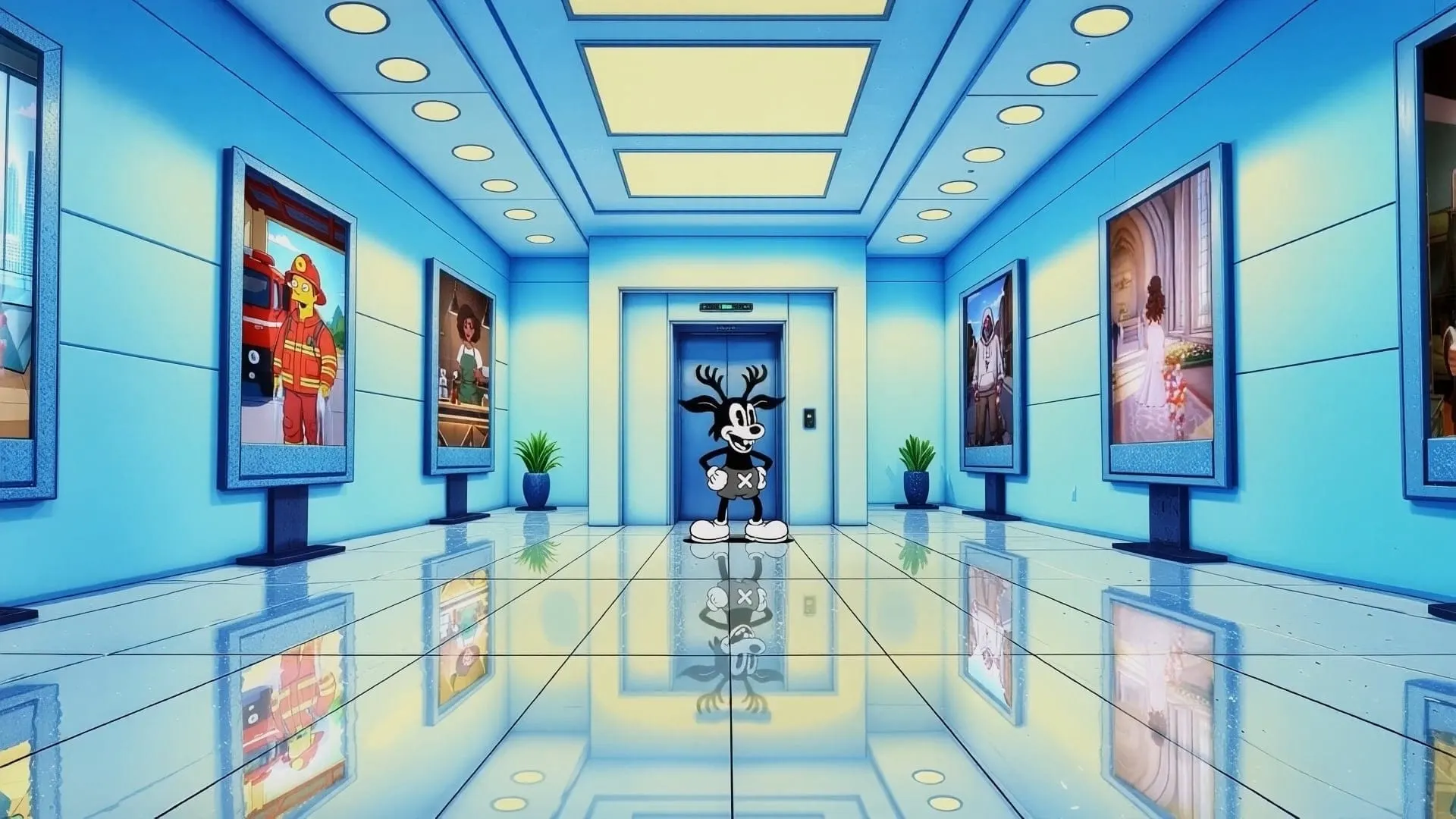
Jack is a black-and-white jackalope with antlers, white gloves and an X on his shorts. He's a washed-up cartoon star who keeps showing up for work in 2026. Per the show's page on his site, the studios keep picking a glossy, full-color copy of him instead.
The pilot takes place in one polished Hollywood office. Jack finds out the studio has a new, shinier version of him. The executive he's dealing with talks in social-media-strategy buzzwords and Gen Z slang.
The pilot premiered at AI Film Fest Japan in Tokyo on November 2, 2025, per his site. It's now on his Vimeo.
Where Jack came from
The idea is old. On a hike in Joshua Tree years ago, he saw a jackrabbit and thought of a southwestern Alice in Wonderland, with a jackalope in place of the rabbit. Instead of falling down a rabbit hole, maybe the jackalope eats peyote and falls into a wormhole of his own consciousness.
He tried it first as a 3D short in Unreal Engine, a video game engine, in early 2024. He said he loved that version but it "felt kinda limited." It's on his YouTube as the first of a set of weekly shorts.
The AI version gave Jack his backstory. He was thinking about how AI tends to "hallucinate," and he "landed on the idea of Jack being public domain, since he was a rubber hose animation anyway."
He picked the 1930s on purpose. "There was something kinda dark about early rubber hose animation. It was all for adults initially, and so it explored darker themes specific to its era," he said. He tied those cartoons to the Great Depression, and Jack to a new version of the Industrial Age, where workers get thrown out completely.
Jack started as a sketch
Jack went through four versions. Dwyer drew a rough sketch first. That became a 3D model generated with AI, then a textured 3D model, and then he turned it back into a clean 2D rubber-hose character.
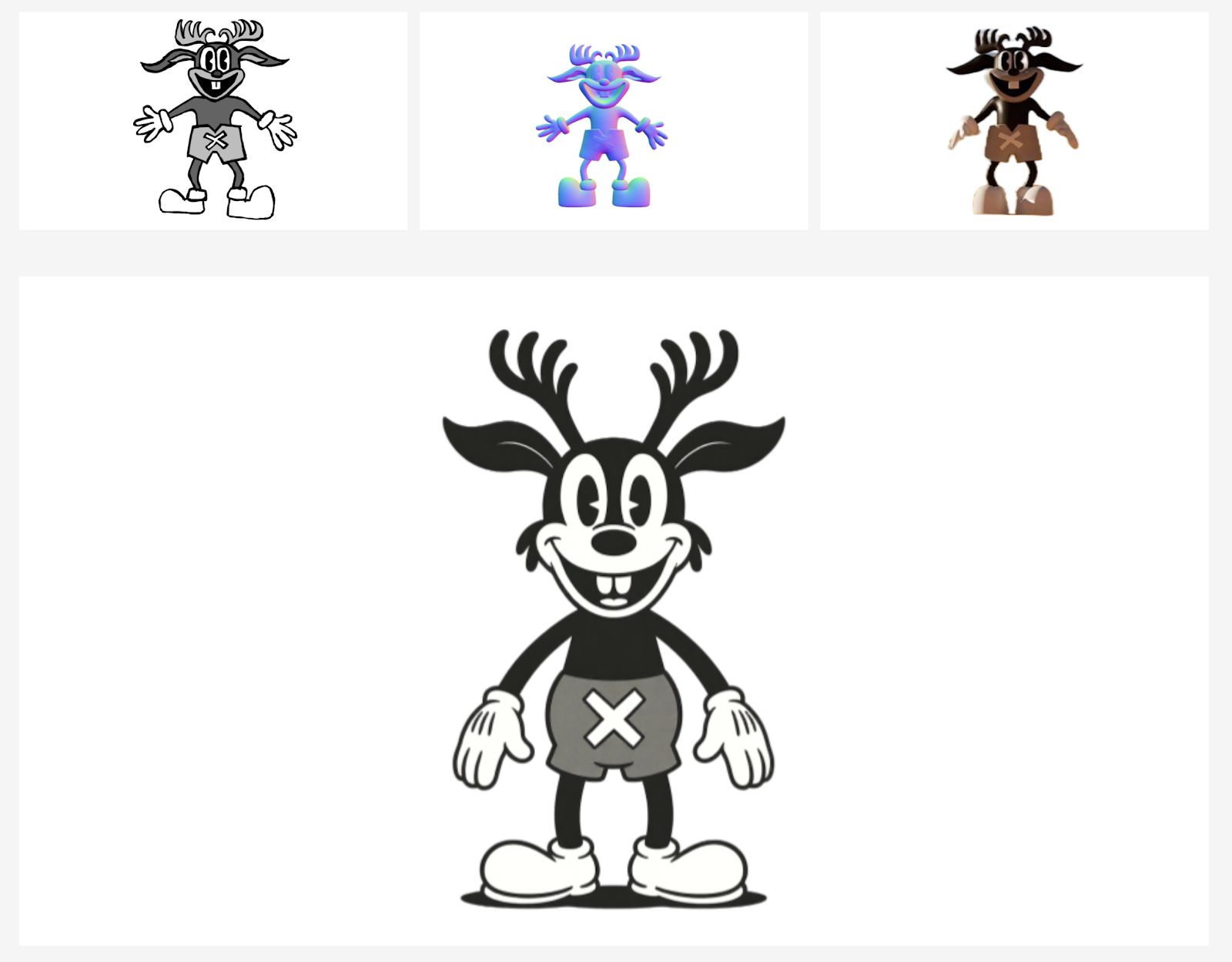
He made concept art in ComfyUI, a free node-based tool for running image models, using Flux Kontext and Canny control nets. A control net locks a new image to the shapes of a reference image. Canny is the version that traces the edges.
Most of the four months went to learning. "So much of that time was spent learning this new process, like Comfy UI, open source models, etc.," he said. Now that the character and the background style exist, he guessed the next episode would take him about three weeks.
Painted backgrounds from photos
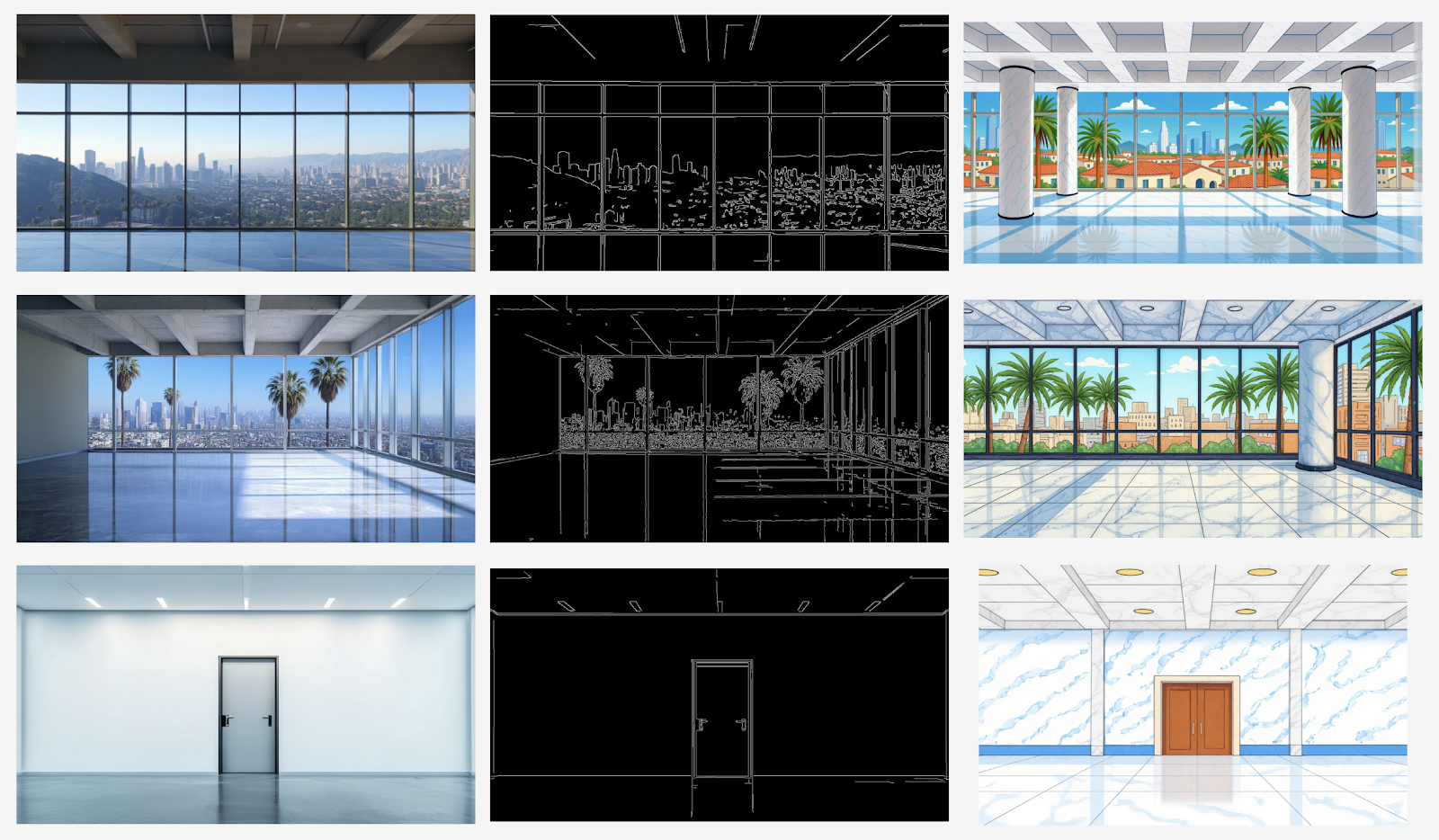
The hardest part was the backgrounds. They needed to look painted. "Ensuring that the backgrounds looked like they were made with watercolor and gouache was a massive challenge. Thousands of images were created, and multiple composites made to achieve the shadow directions, reflections, etc."
He started with realistic photos of empty offices made in Midjourney. Each photo became an edge map, a white-on-black outline of the room. He used that outline as a control net, so the next pass repainted the room as a 2D cartoon background with the walls, windows and doors in the same places. That took "many, many iterations to get to final pixel backgrounds," he wrote.
Animating on green
The characters were animated separately from the rooms. "Characters were animated with JSON prompts in Google Veo 3 on chroma key backgrounds," he wrote. JSON prompts are instructions written as structured data, field by field, instead of a paragraph. Chroma key is a flat green screen that can be cut out later.
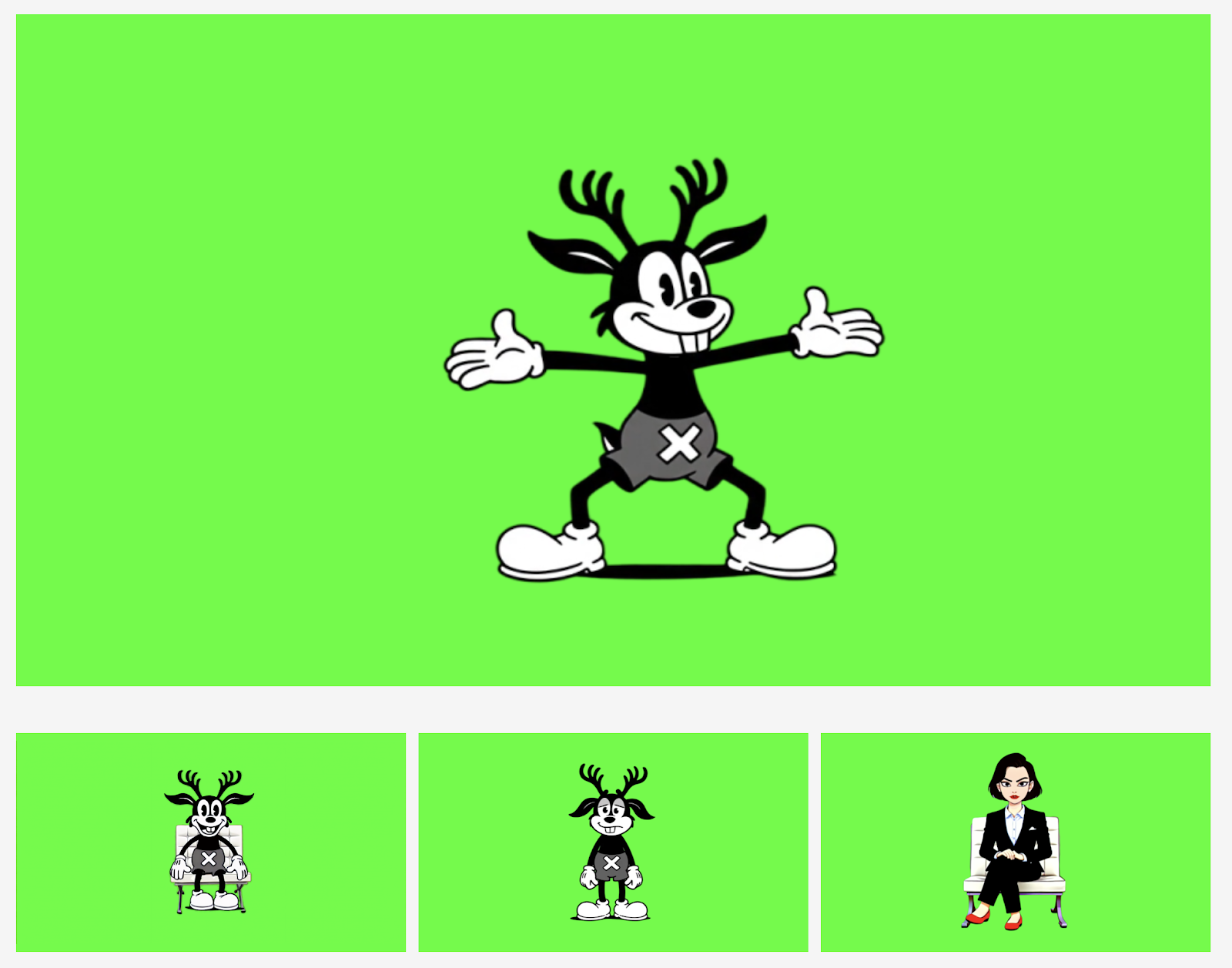
From there:
- The animations were upscaled with Topaz Astra.
- Everything was composited together in DaVinci Resolve, laying the green-screen characters over the painted rooms.
- The voices were designed in ElevenLabs.
He described the whole thing as a new kind of craft with nothing to hold. "The most challenging part of working with AI is that it is essentially mediumless," he said. No blocking actors, no lighting, no pen on a drawing tablet. "You just have to patiently iterate until you get to where you want to be."
The script still came first
He used AI on the writing too. "I assigned different LLMs the personas of Charlie Kaufman, the Coen Brothers, and Dan Harmon, then let them critique my first draft, then rewrite it, then critique each other's drafts before distilling their chaos into the finished script," he said.
"Probably around 3 to 4 lines of dialogue came directly from this process," he said. He called that a lot for a script that short.
He still puts the story above everything else. Of all the parts where AI helps, "the script - or story - is still the most important aspect."
The pilot is also about the thing he used to make it. "Like many filmmakers, my biggest fear with AI is that it will eliminate the need for a creator," he said. Jack is a public-domain character with no legal rights. The executive has a shinier copy. "The algorithm creating the algorithm, in a sense."
Before AI
Dwyer is an Atlanta-based writer and director. He trained at FAMU International in Prague and came up through Apple TV Creative and the agencies Media Arts Lab, BBH LA and Publicis NY, per his about page. His FilmFreeway bio says that agency work won Cannes Lions, Clios and AICP awards.
He started as a writer, then taught himself CGI to get his scripts made, first in Cinema 4D and then in Unreal Engine. He started trying out AI image tools on TikTok in early 2022, making short sketches. "It's funny though, because all of those filmic experiments look like ancient relics now, just 3 years later," he said.
On This Day…1776
On This Day…1776 is a weekly series of short episodes, each one released close to the 250th anniversary of the event it shows. It comes from Primordial Soup, the AI studio founded by Darren Aronofsky, who executive produced it. TIME Studios distributes it on TIME's YouTube channel.
TIME's January 29, 2026 announcement says the episodes are animated by artists using generative AI tools, voiced by SAG actors, with an original score. It says the series was made in part with AI from Google DeepMind and that the writers' room is led by Lucas Sussman. That announcement doesn't name Dwyer.
Here's what Dwyer himself says, on his 1776 page:
- He's Creative Director across the series.
- He works in the weekly writers' room.
- He wrote two of the released episodes: The Siren Song: A Hessian Soldier Haunted at Sea and How Ordinary Men Were Forced Into the King's War.
- 21 episodes were out as of October 2026.
His FilmFreeway bio describes the job as Creative Director at Primordial Soup.
The end credits of The Siren Song list him twice, as Creative Director and as Writer, with Lucas Sussman as Head Writer. It follows a young Hessian soldier, one of the German troops the British hired, crossing the Atlantic in 1776 and hearing a mermaid call him into the sea.
You can watch the rest of the series in TIME's On This Day…1776 playlist. The tools below are the ones he named for Pexote Jack.
Tools he credits himself (Pexote Jack: Ohio!)
Google Veo 3 · ComfyUI · Flux Kontext · Midjourney · Topaz Astra · DaVinci Resolve · ElevenLabs · unnamed LLMs for script notes
From the captions on his process stills in the Hallucinea Film Festival interview.
What's next for Jack
In October 2025 he hadn't decided what Pexote Jack would become. "Whether it's released as a series and this short is the pilot, or it'll all become a feature film, is still up in the air," he said. He's written more of Jack's story since the pilot, and his site now calls it a comedy series.
Asked whether he plans to work only with AI, he said no. "I can't wait to collaborate with other talented humans again."
For another animator who brought years of hand-drawn work into AI filmmaking, see our profile of TrashCanRoxanne and her four decades of 2D animation.