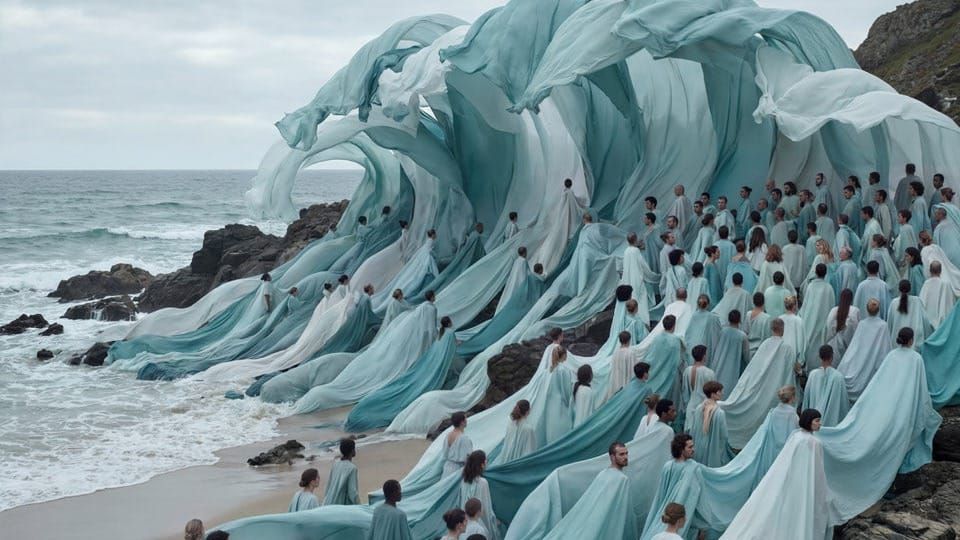

A crowd walks up a beach in pale blue robes, and the robes keep going. They lift off the shoulders, gather, stack, and pile into a wave three stories high that curls over the rocks at the edge of the frame. Half of it reads as fabric. Half of it reads as water.
Nobody in the picture is looking at it. They're just walking.
That one is called The Human Tide, and it went up in the Summer 2026 print release on Jonas Peterson's shop, alongside a cowboy, a cowgirl, a set of roller girls and a reef. Peterson made it with AI. He'll tell you that much, and then he'd rather talk about something else.
The old people are the heroes
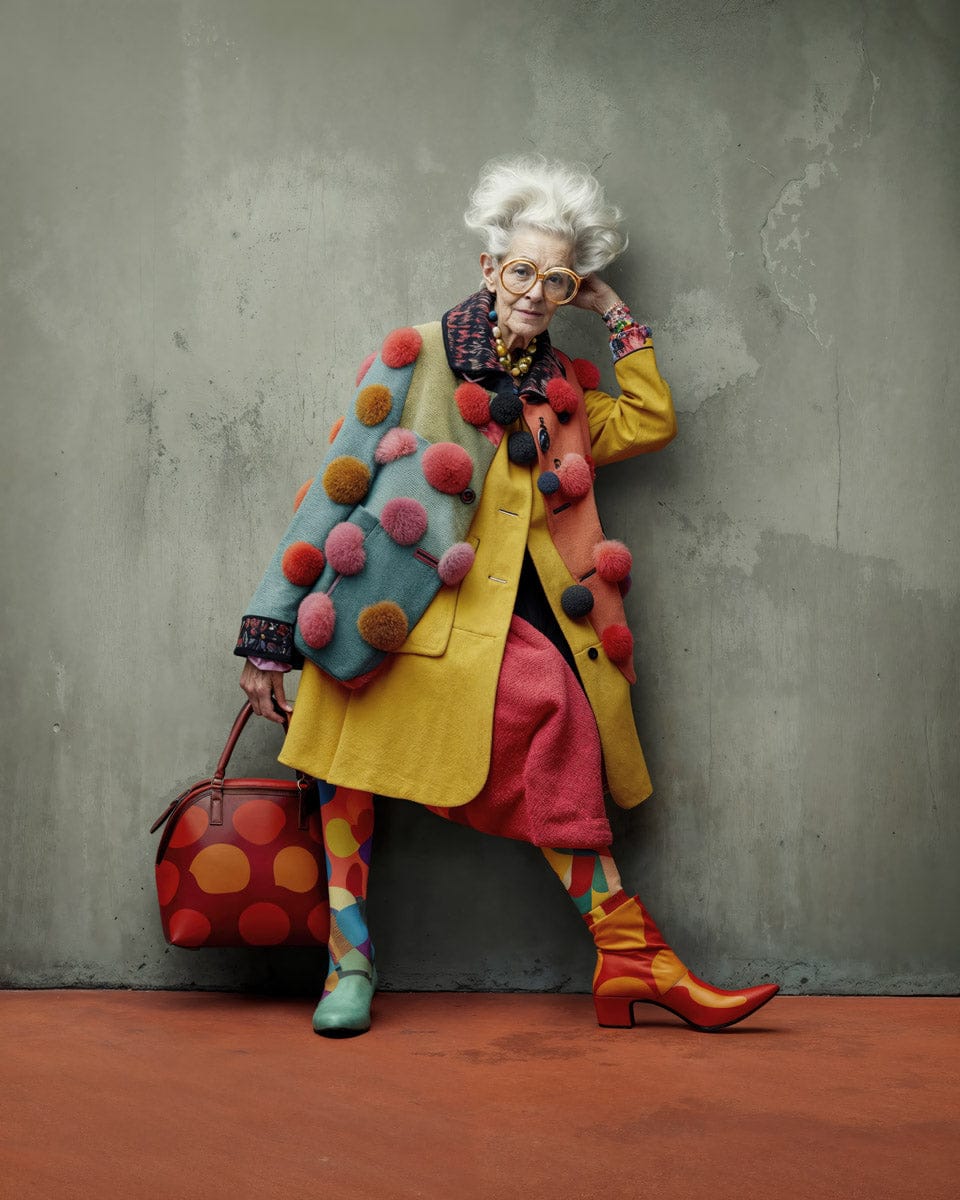
The series that got him noticed is Youth Is Wasted On The Young: elderly people photographed like a fashion campaign. A woman with a white halo of hair stands against a cracked concrete wall in a mustard coat, a second coat over her shoulder covered in pom-poms, harlequin tights, one orange cowboy boot forward, amber glasses the size of saucers. Her hand is in her hair and her expression says she has done this before and is a little bored of it.
The clothes don't exist. Neither does she.
"The idea behind 'Youth is wasted on the young' was to celebrate the so called old, a comment on ageism if you want. A positive quiet homage to people who've seen more than us, been there, done that and I wanted their confidence and pride to be seen. I used fashion to show off their personalities, their attitude and inner rebels shining through the facade of age."
That's Peterson on the process page of his print shop, where he also puts it flatly: "these are not actual photos and the clothes are not real."
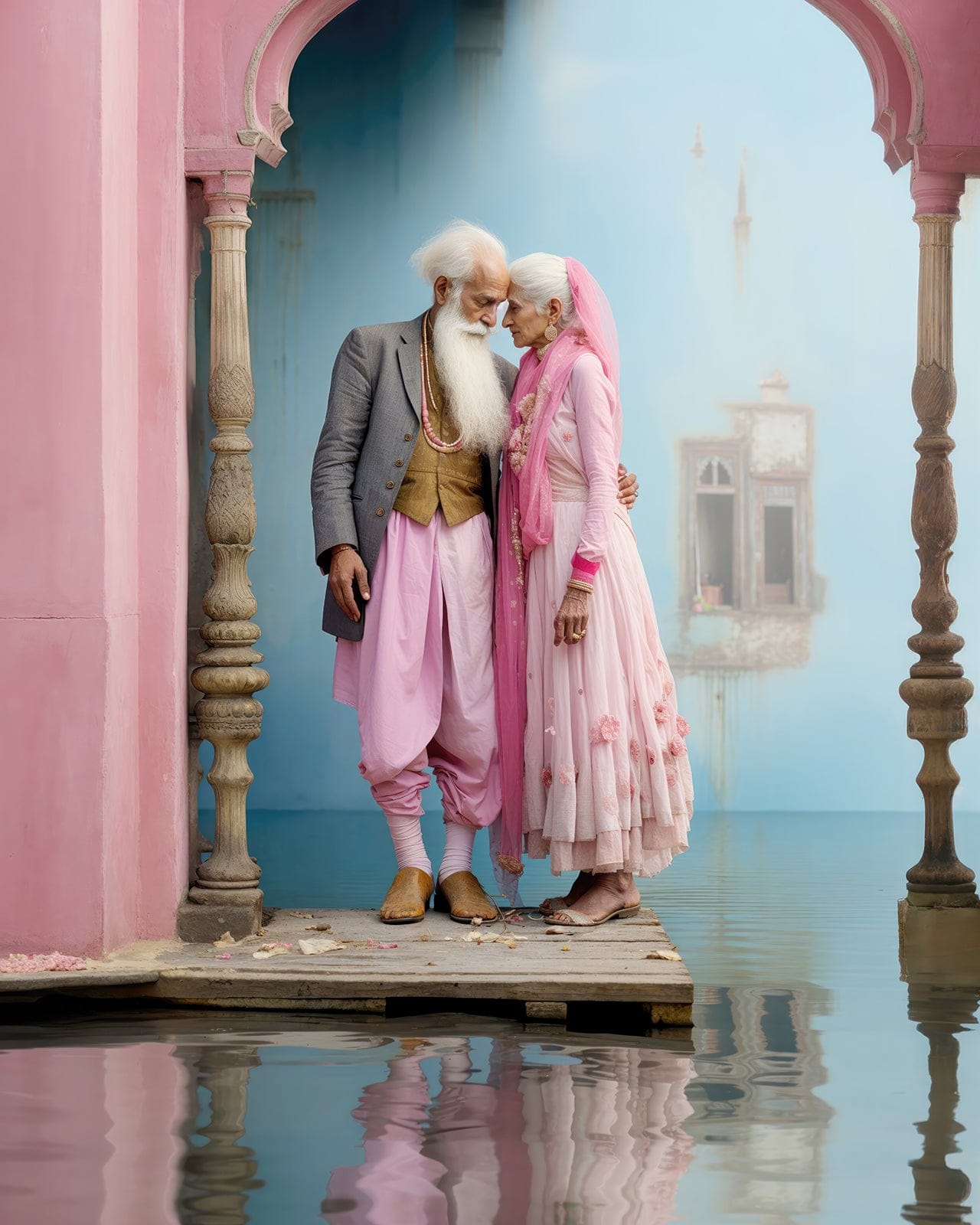
His artist bio says the limited edition prints from that first series sold out in a few hours. The shop has kept going since: This Desert Bloom, Varanasi, Aye, Aye, captain?, To Protect Me, Bon Voyage, Salt, 22 Mermaids, Guardians, Cat Ladies, Havana Yogis. Some of them run to forty prints.
He gives it direction, and it comes back wrong
Here is the whole method, in his words:
"I give specific direction using words only to a program, lenses, angles, camera choice, color theme, colors, styling, backgrounds, attitude and overall look and the artificial intelligence goes to work, it sends back suggestions and more often than not it's completely wrong, so I try other ways to describe what I'm after, change wording, move phrases around and try to get the AI to understand the mood."
Then the part that most people skip when they quote him:
"It's frustrating mostly, the AI is still learning, but getting any collaborator to understand you can be difficult no matter if it's a human or a machine."
He calls the next stage curation — picking the renders that belong together until a series exists. Then a pass through other software to finish them. "To me the process is similar to that of a film director's, I direct the AI the same way they would talk to an actor or set designer, it's a process, we try over and over again until we get it right."
Asked whether he should get the credit, he answers his own question: "God, no, the AI creates with my help and direction, it's a collaboration between a real brain and an artificial one."
He stopped answering the how question
The tool never gets named — no model, no version, no list of the apps he finishes in. That's deliberate, and he's said why more than once.
"I've answered so many questions about this, but no matter how many times I said it was created using artificial intelligence, other people asked the exact same thing over and over again, so I've simply stopped. I'm not here to debate the process, I'm a professional photographer, writer and artist myself, I understand the implications, how this will affect many creative fields in the future. I'm simply using a tool available to me to tell stories, the same way I've always told stories — to move people. To me that is the point of this, not how I did it."
The process page ends on one line by itself: "Dissecting something will almost always kill it."
He gave Dolce Magazine a warmer version of the same position in April 2023: "I combine everything I've learned and put it to use, but I'm not interested in lifting the veil and sharing exactly what it is I do." And then the line that explains the whole stance in one image: "I want people to enjoy what they're eating — sharing what pan I used to fry the fish isn't interesting to me."
Plenty of AI artists publish their prompts. He's picked the opposite house rule and stuck to it for years, which at least makes him easy to read: the work is the argument, and there's no appendix.
Twenty-five years of pointing a camera at real people
Before any of this, Peterson was a photographer, and he still is. His wedding portfolio is a destination photography site full of real couples in Big Sur and Sicily and the Maasai Mara, with a line on it that sounds like the same person who made the elders: "I believe in the healing power of having your story told."
He's Swedish, and he lives in Austin, Texas. His bio counts twenty-five years across writing, filmmaking, creative direction and photography, and it shows up in how he talks about the AI work — in lenses, angles, camera choice, styling, attitude. That's a shot list. He's still calling the shots he was calling before, at people who happen not to exist.
That background is why the pictures hold together as series instead of as a feed of one-offs. Which is a pattern worth watching across this whole scene: what a photographer brings to AI art tends to be the part that prompts alone don't cover.
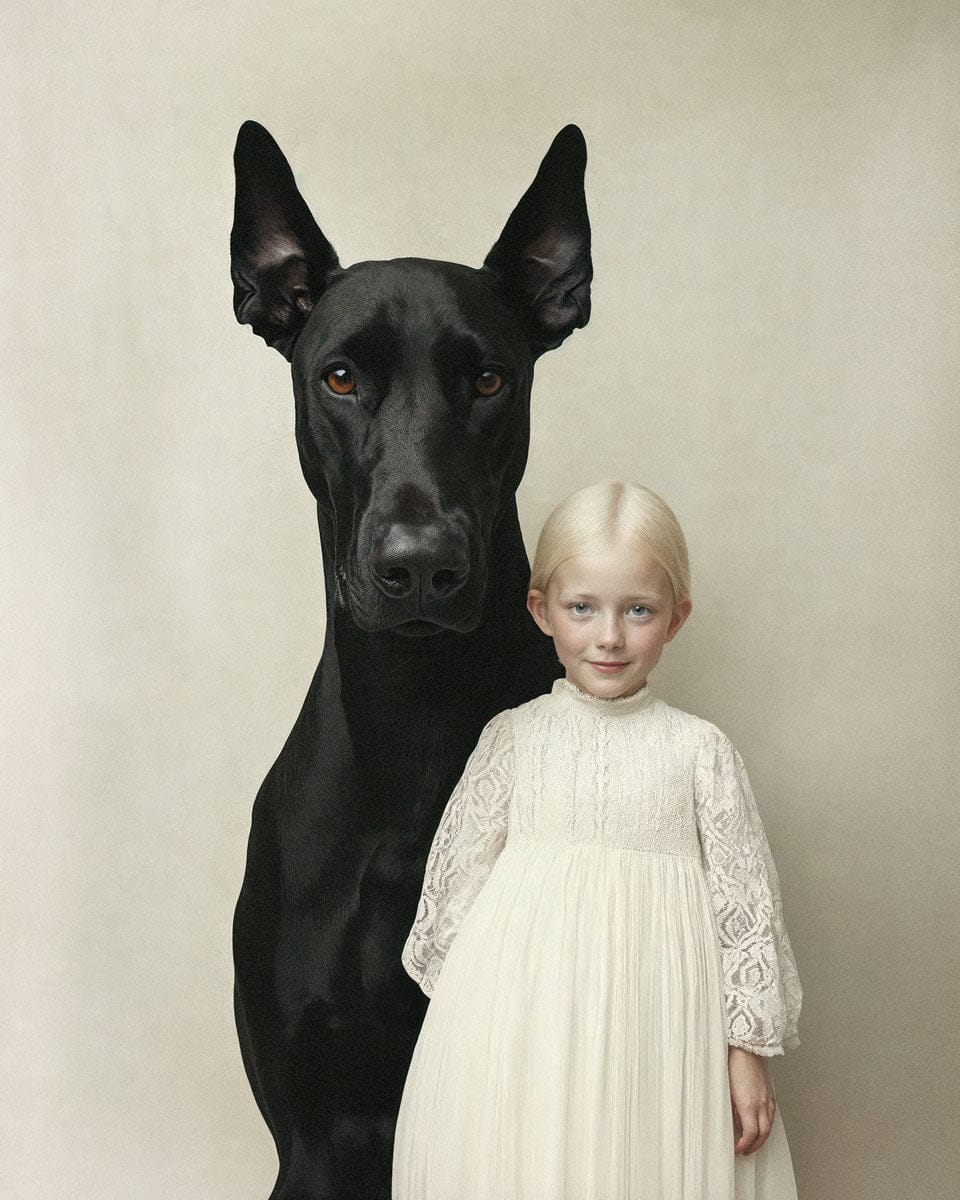
Guardians is children and dogs, mostly enormous dogs, shot against studio backdrops in a soft cream light that makes them look like plates from a book nobody printed. His bio says the series has been viewed more than seven million times. Bon Voyage was shown to the public in Milan.
The shop is still moving. Collections went up in November 2025, in the spring, and again this summer, and the archive behind them runs past a hundred and thirty prints. Next month there will probably be more cowboys.