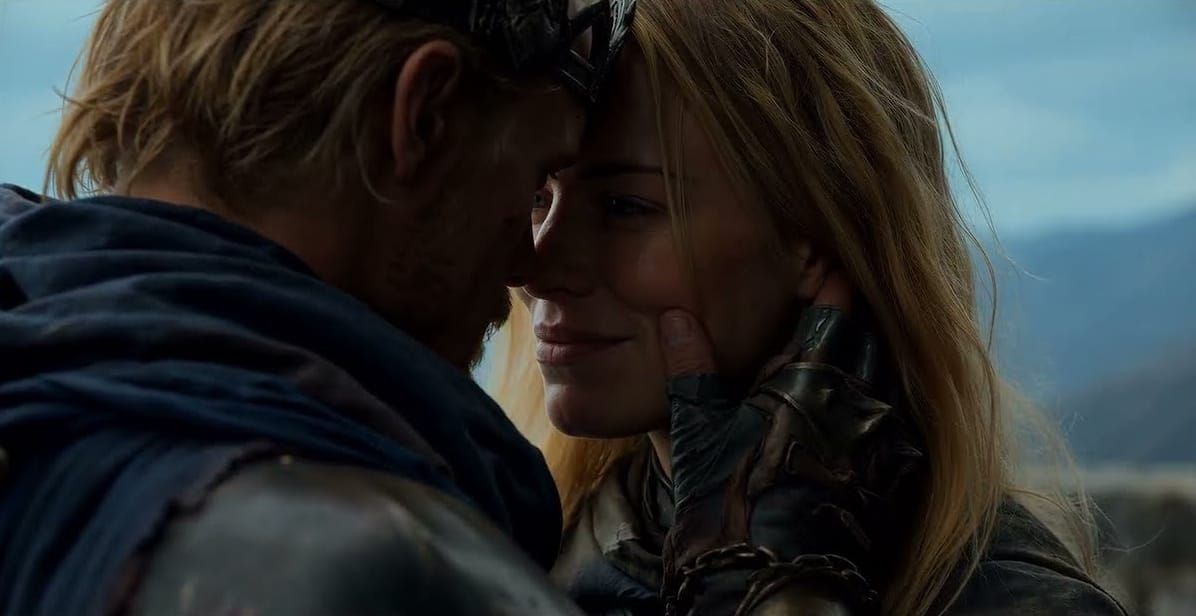

A knight stands on a ridge in bad weather, dirt streaked down one side of his face, holding a woman's cheek in an armored glove. The sky behind them is doing that heavy pre-storm thing. It plays like a scene from a mid-budget fantasy film — two people, a held beat, a camera that knows where to sit.
Nobody stood on that ridge. There is no ridge.
That shot is from Chapter Two of The Chronicles of Bone, which Kavan the Kid has been putting out on YouTube at roughly one episode a month since late 2025. Episodes run ten to fifteen minutes. The series pulls Robin Hood, King Arthur, Captain Hook, Captain Nemo and the Lost Boys into one collapsed world run by vampires — and his vampires don't want blood, they want control. A bite makes you theirs permanently.
He's written five seasons of it. Every major beat, start to finish, before the first episode shipped.
Kavan the Kid — "The Chronicles of Bone," Chapter One: A Vengeful Fairy, via YouTube (@kavanthekid)
The Masks Are Real
Here's the part I hadn't seen anyone else do.
Before a frame gets generated, Kavan puts on a costume he actually owns, photographs himself in it, and feeds that photo in as the starting point. The masks his characters wear exist. He built or bought them, he wore them, and the AI works from a real object under real light rather than from a description of one.
From there he tags the details through Freepik's NanoBanana and iterates until the character locks. Then that character gets a visual reference sheet, which is what keeps a face consistent across a fifteen-minute episode instead of drifting into somebody else by the third act.
It's a strange inversion. The tool most people reach for to skip the physical part of production, and he's smuggling the physical part back in through the front door.
Scripts First, Generation After
The order of operations is old-fashioned on purpose. Script, then storyboards, then blocking, then generation, then a normal post workflow — Premiere Pro to cut, DaVinci Resolve to grade, After Effects and Blender for effects.
His way of putting it, talking to Creative Bloq about the rules of cinema: "AI is basically the set. The pre- and post-production still follow the same rules. You still need storyboards, blocking, continuity, editing rhythm."
He goes further than that when pushed on what the tools can't do. "AI doesn't replace filmmaking. It replaces the physical shoot. Everything else — writing, editing, story, performance — that's still human-led." On Freepik specifically: "It's a creative toolkit, not a writer or director. The story, the shots, the emotional beats, that's all us."
And the line that explains why so much of this stuff looks the way it looks: "If you don't understand the basics, AI visuals look like student films."
He is, by the way, doing all of it himself. Writing, directing, animation, sound design, music. One person, monthly, at episode length.
Ten Years of Making $20,000 Look Like $80,000
Kavan Cardoza went to film school in Florida and then spent years in Los Angeles shooting music videos for indie and hip-hop artists, which is where the relevant skill actually got built.
"I became known as the guy who could take a $20,000 or $30,000 budget and make it look three or four times bigger," he says. "I had a house in South Central where I'd literally build set pieces from scratch."
That's the same job he's doing now with different equipment. Stretch a small budget across a big-looking frame by knowing exactly where to spend and where to cheat. Lighting, camera placement, production design, editing — the stuff that decides whether a shot lands, none of which a model has an opinion about.
His start was as rough as anyone's. Early Midjourney, trying to get a recognizable character out of it: "I remember generating Deadpool and thinking, 'I can kind of see Deadpool in this blob.'" In 2024 he made a ten-minute Batman fan film — long, for AI video at the time — which went viral and then got taken down on copyright. Public domain characters make a lot more sense after that happens to you once.
Kavan the Kid — "Echo Hunter: A Memory Too Far," via YouTube (@kavanthekid)
The SAG-AFTRA One
Echo Hunter: A Memory Too Far is the one people bring up first, because it went through SAG-AFTRA. Actors' likenesses were digitally replicated with consent, which made it the first AI film cleared that way and gave everyone downstream a template to point at. It stars King Bach and Carlye Tamaren, was presented by Kling AI, and was produced under Kavan's own studio, Phantom X.
The story is standard-issue good sci-fi: the wealthy harvest clones for parts, an enforcer starts asking why, it goes badly.
What matters for anyone trying to work this way is the paperwork, not the plot. A real union process, real consent from real performers, on a film with no physical shoot. That existed as an argument before Echo Hunter; afterward it existed as a credit.
Somebody Bought the Universe
In 2026, Freepik acquired the remaining prologues and all of Season 1 of The Chronicles of Bone, running through November.
That's a distribution deal for an original IP built by one person at a desk. Not a brand partnership, not a sponsored short — a company buying a season of a serialized show. His other recent film, Last Recall, was made for Beyond The Loop Season 2 at Wonder Studios with invideo as executive producer.
If you want to know what "AI filmmaker" means as a job rather than a hobby, that's the shape of it right now: own the IP, ship on a schedule, sell the season.
Kavan the Kid — "Last Recall," a Wonder Studios original, via YouTube (@kavanthekid)
Where the Craft Argument Lands
There's a version of Kavan's position that comes off as gatekeeping, and he doesn't quite go there. His claim is narrower and more useful: the tools generate shots, and shots are not a film. "AI can generate shots. But it doesn't understand story, pacing, or emotion."
You can hear that as "learn the rules first," which would be discouraging, or as "the part you already know how to do still counts," which is closer to what his own path shows. He learned blocking on a $20,000 music video, not in a prompt window. The blocking is what transferred.
YZA Voku's award-winning short films come out of a similar place — directing instincts first, generation second.
Chapter Three went up in July. The Chronicles of Bone episodes keep landing about monthly, and the rest of his work — including a Nike spec ad and a Star Wars fan film — sits on his films page.
Tools Kavan credits himself
- Freepik and its NanoBanana image model — character design and world-building
- Kling AI — presenting partner on Echo Hunter
- Adobe Premiere Pro — editing
- DaVinci Resolve — color grading
- Adobe After Effects and Blender — effects
- Suno — music
Adobe, Freepik and NanoBanana are named unlinked — their sites block automated checks, so we couldn't confirm the destination.