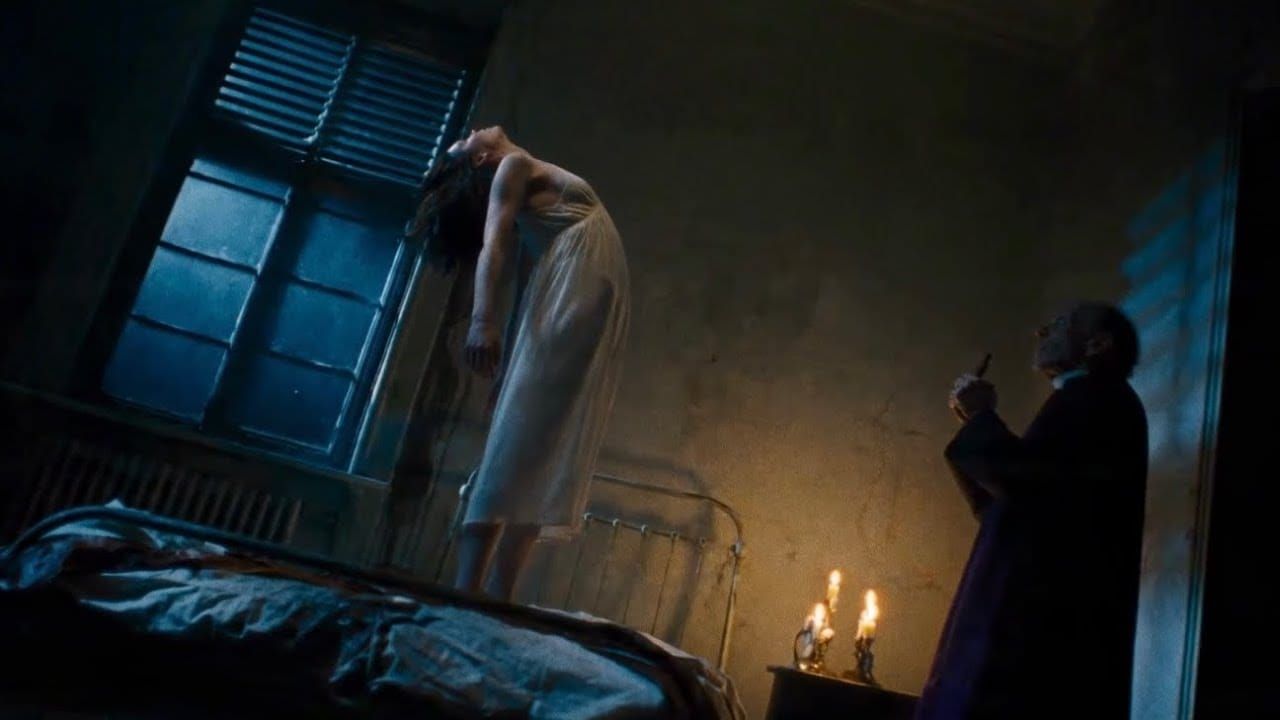

RECÉDE spends most of its ninety seconds too close to things. There's one wide shot to establish the room — iron bed, shuttered window, two candles, a priest with something raised in his hand — and then it goes in and stays in.
A patch of skin fills the frame with something moving under it. Fingers on a bedsheet, the nails gone black. An eye rolled so far back that only white is left. The camera has a tremor on it throughout, and between the close-ups the picture drops to near-black, where you're listening rather than watching.
It's an exorcism going badly.
The face doing most of the reacting is the same face every time it appears, which for a generated film of this length is impressive.
Visionaist wrote it, directed it, generated it, and cut it. Then, in the description under the video, said how: about sixty of those ninety seconds came out of one generation.
Visionaist — "RECÉDE | AI Horror Short (Seedance 2.5)," on YouTube
Sixty seconds out of a single generation
The description is specific about it. RECÉDE was "built almost entirely with Seedance 2.5's new long-form generation on Dreamina — about 60 of the 90 seconds come from a single native multishot generation, with the rest edited in from additional generated scenes." Visionaist calls it the "first real test of the model at this length, pushing continuity, transformation, and consistency across internal cuts."
That's a different job than the way most AI shorts get assembled. The usual build is a few seconds at a time, dozens of separate clips, then a lot of work in the edit keeping the same face on the same person from shot to shot. We've watched Delphi Motion Pictures wrestle with character consistency from the other direction entirely.
A minute of continuous generation with cuts inside it moves that problem upstream, into the prompt.
Then it goes through the boring part: upscaled in Topaz, finished in Premiere, film grain added on top.
Why the genre fits the tooling
Horror gives this medium somewhere comfortable to stand, and RECÉDE leans on it hard.
The failure modes of generated video are well known by now — a texture that crawls, a hand that resolves wrong, an expression that shifts a few degrees between shots. In most genres those are defects to be hidden or graded out. Point the camera at skin at RECÉDE's magnification, in a film about a body being taken over by something, and the instability is carrying the scene. The macro shot of a hand with blackened nails works because you can't quite tell where the hand stops.
The rest of the run sits in the same territory: THE SHEPHERD puts something in a pasture that shouldn't be in it; NOTHING PERSONAL and HOLD both turn on dread rather than event. The darkness helps as well — a frame that spends half its time near-black is a frame with less in it to come out wrong.
The tool list is under every film
Visionaist posts the stack. Not as a flex, more like a credits roll. THE SHEPHERD — an old man alone with his flock in the Italian Alps, and something in the pasture that shouldn't be there — carries a labeled "Tools used" block: Seedance 2.0 for video, Nano Banana Pro for images and assets, Topaz Video AI for upscaling, Premiere Pro for edit, color and sound design.
Visionaist — "THE SHEPHERD | AI Short Film," on YouTube
The list moves around film to film, which is the interesting part. The Wrong Duel, from March, credits Seedance 2.0, Luma UNI 1, Higgsfield Cinema, Nano Banana Pro and Kling 3.0. The music video SHED runs Seedance 2.0 on Higgsfield with Soul 2.0 and Nano Banana 2 for images, and Suno for the track. Same director, different rig, every couple of months.
Seedance keeps showing up in these profiles — we counted four creators reaching Seedance through four different apps a while back, and Visionaist alone has used it through both Higgsfield and Dreamina.
Tools Visionaist credits in their own descriptions
- Seedance 2.0 / 2.5 — video generation, run through Dreamina and Higgsfield
- Nano Banana Pro, Soul 2.0, Kling 3.0, Luma UNI 1 — image and shot generation
- Topaz Video AI — upscaling and enhancement
- Adobe Premiere Pro — edit, color grade, sound design
- Suno — music · ElevenLabs — voice (credited on SLOP)
SLOP is a film about the argument over films like SLOP
In May they posted SLOP, a horror-comedy where an AI hater invites an AI artist to dinner. It escalates into a kidnapping and a manifesto, shot in the visual language of 1970s Italian giallo — warm light, deep shadows, a question left open at the end.
The description does not pretend to be neutral about it: "Made with AI. About AI. The irony was always the point."
And then, plainly: "The villain has a point. The hero has better instincts."
Visionaist put the case for the other side inside the movie and let it stand there being reasonable, which is a strange thing to do in a film you made to defend your own medium.
Visionaist — "SLOP — Seedance 2.0 Short Film (2026)," on YouTube
One person, and a client list
The Visionaist site describes a one-person creative studio founded in 2024, doing direction, concept, generative film and brand campaigns. It credits a 2025 Chroma Awards win in the short-form category for a film called Caught At Work. The awards site is behind a bot check, so that one comes from Visionaist's own page rather than a source I could open.
The client work listed there is not all personal shorts. Two social commercials for Gin & Juice by Dre and Snoop, through Rosewood Agency. A FIFA Arabian Cup promo for Qatar FIFA through The Spark Agency, with each player reimagined as a superhero. A brand film for CapCut called Imagination, shot from a kid's point of view.
There's also a Christmas campaign concept for The North Face, and the site labels it "unsolicited brand concept" and "self-initiated" right in the entry. Nobody makes you do that. Plenty of portfolios would have left the word off and let you assume.
The note under HOLD
HOLD is ninety seconds about two elderly people and a tsunami, posted in May. The description spells out the workflow — "Characters, environments, lighting, movement — all created through prompts and iteration. No camera. No set. No actors." — and then adds a line about the part of it that wasn't a prompt:
"What wasn't generated: the instinct for what matters. The decision to tell a story about ordinary love instead of spectacle."
That instinct shows up as constraint more than style. NOTHING PERSONAL, from April, was deliberately built with no time jumps at all: "everything unfolds on the same temporal plane," which Visionaist says made it harder to manage, because every moment has to carry the tension into the next without ever resetting the scene.
The channel started in November 2024 and there are around 160 videos on it now. Under RECÉDE, the last line of the description says more AI horror is coming.
You can follow the films on the Visionaist YouTube channel or their Instagram, where the process clips go up between the shorts.