


// SYSTEM: DIGEST // LIVE
AI WORKFLOW
OPINION
TUTORIALS
ChatGPT
ChatGPT
William Smith
William
CONVERSATIONS WITH CODE

You Don't Owe Skeptics a Debate

The skeptics aren't protecting anyone. They're just mad someone built something without asking permission first.

Article Details Transparency Protocol v3.0
William 50%
Personal experience, editing, final polish.
AI 50%
Structural formatting, initial prose drafting, synthesis from source material.
Stack: Claude Opus 4.6

I posted something on Threads yesterday. Pretty simple stuff — I built my own content pipeline using AI and it works better for me than anything I found off the shelf. That's it. That's the whole post. A statement about how you can use AI to build custom tools that fit the way you actually work.

And here comes the drive-by.

Some guy — someone I was following at the time — drops into the replies with a skeptics energy. His argument? "80% of people think AI is fucking terrible, so why bother?"

First of all, that had nothing to do with what I posted.

I wasn't making a case for AI adoption rates. I was saying I built a thing that works for me.

But that's what skeptics do — they don't engage with what you said, they engage with what they wish you'd said so they can knock it down.

I asked for a source.

Because when someone throws a number like "80%" at you, I want to see where that came from.

He fires back within 22 seconds — "I could've given you 100 other links" — and drops a single link to some eMarketer blog post. Setting aside that the source is coming from bias, it also doesn't matter.

I'm not creating stuff for skeptics. You shouldn't either.

If someone reads what you write (or create) and don't like it because the writing isn't good, the ideas don't land, the storytelling falls flat — that's real feedback.

But dismissing what you made because they don't like how you made it? Let's not care about that opinion anymore.

The Gatekeeping Thing Is Getting Old

The day before, I had a whole separate exchange with someone about gatekeeping. I posted something about how gatekeeping is harmful, which I think is pretty uncontroversial.

This person responds with: "I don't understand why all you pro-AI people talk about gatekeeping. We're not telling you that you can't pick up a pencil. We're not saying you can't learn to play an instrument."

That IS gatekeeping. You just proved my point.

Nobody has to ask for permission to decide how they learn or what tools they use. It doesn't matter what anyone thinks. The outcome is what matters. The idea that there's a correct path to being creative is an arbitrary construct that exists to protect people's egos.

I'm Losing Patience and I'm Fine With That

Look, maybe I deserve some of this.

I've been pretty vocal about the fact that if you're an agency in 2026 and you're not using AI, what kind of agency are you?

If you're a content creator or producer and you're not even exploring these tools — yeah, I have questions. I've said that out loud and I stand by it.

We spend all this energy making excuses for people who refuse to engage with the technology.

"Oh, they're worried about their jobs." "They're worried about the artistry."

At some point, I think we have to be honest — some of them just don't want to learn something new. And I'm getting less interested in having that argument every single time I post something positive about what I've built.

I'm not saying people have to use AI. I'm saying when someone shares something they're excited about — something that's working for them — and your instinct is to jump in with negativity and junk statistics, the problem isn't AI. The problem is you.

The Consumer Skepticism Myth

Here's the thing about that "80% of people don't like AI" stat, even if we take it at face value: consumers are skeptical of everything new until they're not.

People were skeptical of online shopping. People were skeptical of streaming. People were skeptical of smartphones replacing cameras. Consumer skepticism doesn't always "win out."

I'm not building for the 80% who are supposedly skeptical.

I'm building for the 20% of people who are curious, who are experimenting, who are trying to figure out how this technology fits into the way they work.

Those are the people I care about reaching. And those people don't need a random thread reply from a guy who Googled a stat in 22 seconds to tell them whether their curiosity is valid.

Your curiosity is valid. Build the thing. If it works for you, that's enough.

← Back to Digest

You Don't Owe Skeptics a Debate

The skeptics aren't protecting anyone. They're just mad someone built something without asking permission first.

You Don't Owe Skeptics a Debate
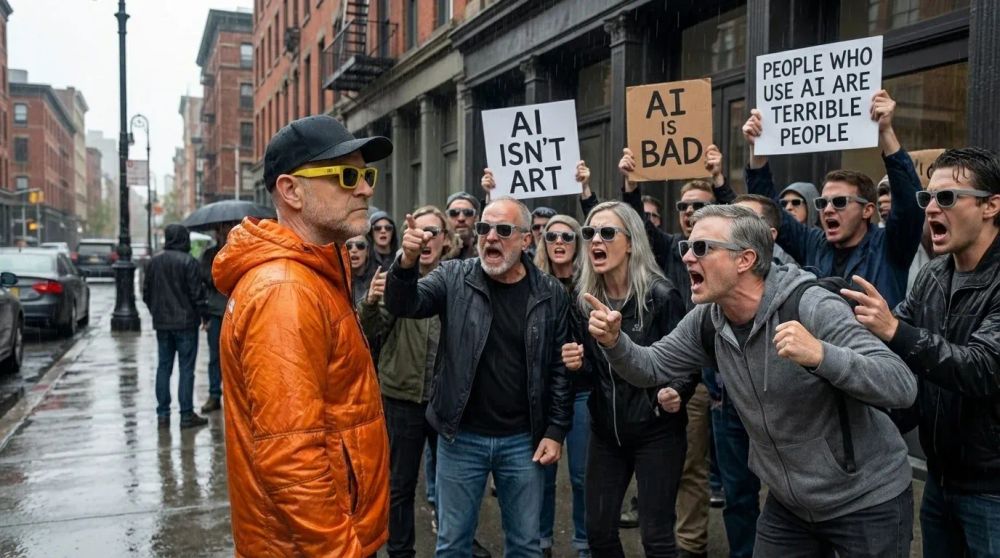
A man wearing a bright orange jacket, black cap, and yellow sunglasses stands calmly on a wet city sidewalk. He is being aggressively yelled at and pointed at by a dense crowd of angry people, many of whom are wearing dark sunglasses. The crowd is holding up protest signs that clearly read "AI ISN'T ART," "AI IS BAD," and "PEOPLE WHO USE AI ARE TERRIBLE PEOPLE."
Article Details Transparency Protocol v3.0
William 50%
Personal experience, editing, final polish.
AI 50%
Structural formatting, initial prose drafting, synthesis from source material.
Stack: Claude Opus 4.6

I posted something on Threads yesterday. Pretty simple stuff — I built my own content pipeline using AI and it works better for me than anything I found off the shelf. That's it. That's the whole post. A statement about how you can use AI to build custom tools that fit the way you actually work.

And here comes the drive-by.

Some guy — someone I was following at the time — drops into the replies with a skeptics energy. His argument? "80% of people think AI is fucking terrible, so why bother?"

First of all, that had nothing to do with what I posted.

I wasn't making a case for AI adoption rates. I was saying I built a thing that works for me.

But that's what skeptics do — they don't engage with what you said, they engage with what they wish you'd said so they can knock it down.

I asked for a source.

Because when someone throws a number like "80%" at you, I want to see where that came from.

He fires back within 22 seconds — "I could've given you 100 other links" — and drops a single link to some eMarketer blog post. Setting aside that the source is coming from bias, it also doesn't matter.

I'm not creating stuff for skeptics. You shouldn't either.

If someone reads what you write (or create) and don't like it because the writing isn't good, the ideas don't land, the storytelling falls flat — that's real feedback.

But dismissing what you made because they don't like how you made it? Let's not care about that opinion anymore.

The Gatekeeping Thing Is Getting Old

The day before, I had a whole separate exchange with someone about gatekeeping. I posted something about how gatekeeping is harmful, which I think is pretty uncontroversial.

This person responds with: "I don't understand why all you pro-AI people talk about gatekeeping. We're not telling you that you can't pick up a pencil. We're not saying you can't learn to play an instrument."

That IS gatekeeping. You just proved my point.

Nobody has to ask for permission to decide how they learn or what tools they use. It doesn't matter what anyone thinks. The outcome is what matters. The idea that there's a correct path to being creative is an arbitrary construct that exists to protect people's egos.

I'm Losing Patience and I'm Fine With That

Look, maybe I deserve some of this.

I've been pretty vocal about the fact that if you're an agency in 2026 and you're not using AI, what kind of agency are you?

If you're a content creator or producer and you're not even exploring these tools — yeah, I have questions. I've said that out loud and I stand by it.

We spend all this energy making excuses for people who refuse to engage with the technology.

"Oh, they're worried about their jobs." "They're worried about the artistry."

At some point, I think we have to be honest — some of them just don't want to learn something new. And I'm getting less interested in having that argument every single time I post something positive about what I've built.

I'm not saying people have to use AI. I'm saying when someone shares something they're excited about — something that's working for them — and your instinct is to jump in with negativity and junk statistics, the problem isn't AI. The problem is you.

The Consumer Skepticism Myth

Here's the thing about that "80% of people don't like AI" stat, even if we take it at face value: consumers are skeptical of everything new until they're not.

People were skeptical of online shopping. People were skeptical of streaming. People were skeptical of smartphones replacing cameras. Consumer skepticism doesn't always "win out."

I'm not building for the 80% who are supposedly skeptical.

I'm building for the 20% of people who are curious, who are experimenting, who are trying to figure out how this technology fits into the way they work.

Those are the people I care about reaching. And those people don't need a random thread reply from a guy who Googled a stat in 22 seconds to tell them whether their curiosity is valid.

Your curiosity is valid. Build the thing. If it works for you, that's enough.

// LEXICON_CITY_DISPATCH_REQ
// STATUS: CONNECTION_STABLE
// SOURCE: CENTRAL_DISPATCH_HQ

SHERMAN UPLINK: "I'm at HQ holding down Central Dispatch. Enter your query below to pull relevant data records and I'll see what data cards we've recovered!"