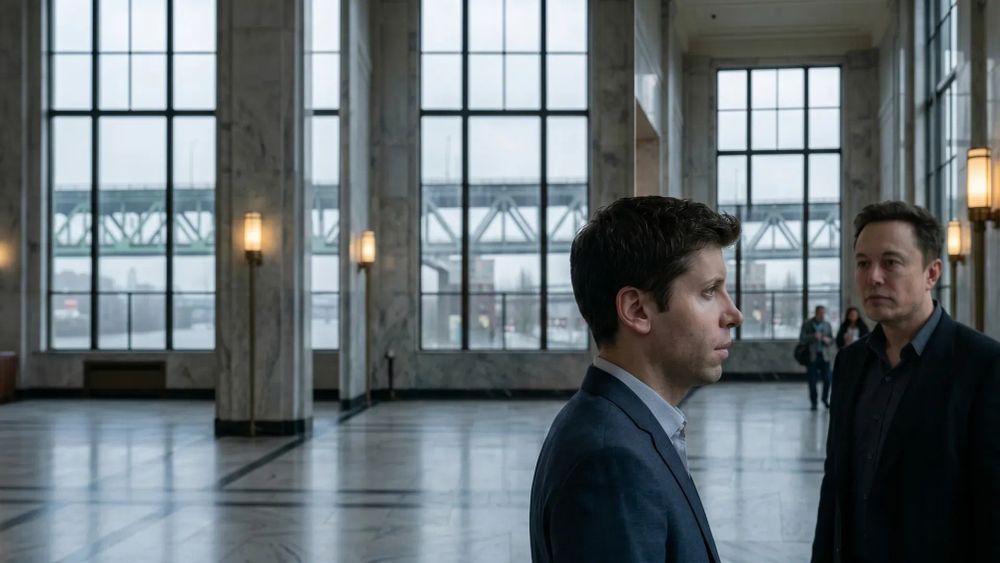
Elon Musk and Sam Altman are about to spend the next few months airing their dirty laundry in an Oakland courthouse, and honestly, I'm here for it. The trial starts April 27th, and according to The Verge, it's going to be "messy."
Musk co-founded OpenAI back when it was supposed to be a nonprofit focused on building AI for everyone. Then he wanted to be CEO, didn't get it, and flounced off in what The Verge diplomatically calls "a huff."
Now he's back with xAI and a lawsuit claiming OpenAI betrayed its original mission by going commercial with Microsoft.
The legal details matter less than what this fight reveals about who gets to control the future of AI development.
What's Actually Happening
Musk's argument boils down to this.
OpenAI was supposed to remain open. The clue was in the name.
Instead, they took billions from Microsoft, built ChatGPT behind closed doors, and turned into exactly the kind of AI monopoly they originally said they wanted to prevent.
Altman's counter-argument is essentially: "Grow up, Elon."
Building frontier AI requires enormous resources. The nonprofit model couldn't scale. They did what they had to do to stay competitive with Google and everyone else throwing billions at this problem.
Both of them have a point, which is why this is going to get ugly in court.
The timing is particularly interesting because of what else is happening right now. DeepSeek just dropped V4, claiming their open-source model can compete with the best closed-source systems from US companies. Meanwhile, OpenAI is rolling out GPT-5.5 and talking about AI "super apps."
We're moving from the "let's all build AI together" era to the "winner takes all" era. This lawsuit is just the most dramatic example of that shift.
The Real Stakes
Neither Musk nor Altman is wrong about the fundamental problem. Building cutting-edge AI really does require massive resources. But keeping those capabilities locked behind corporate walls really does create the exact concentration of power that early OpenAI said it wanted to prevent.
The question isn't whether Musk or Altman wins in court. The question is what happens to everyone else who's building things with AI.
Right now, if you're working on creative projects with AI, you're mostly dependent on a handful of companies.
OpenAI, Anthropic, Google, maybe a few others.
Your access to the good models depends on their pricing decisions, their content policies, their API limits. When Anthropic briefly tested removing Claude Code from the Pro plan earlier this week, developers lost their shit. That's the fragility we're talking about.
The promise of truly open AI development was that you wouldn't have to worry about any of that. You'd run your own models, set your own policies, build whatever you wanted without asking permission.
DeepSeek's V4 release suggests that promise isn't completely dead. Chinese researchers are apparently willing to give away frontier-level capabilities for free. But even that comes with its own dependencies and geopolitical complications.
What This Means for Creators
If you're using AI in your creative work, this fight matters more than you might think.
The question of whether AI development stays open or goes fully proprietary will determine what tools you have access to and how much control you maintain over your own creative process.
The closed model gives you ChatGPT and Claude and Gemini, all of which are genuinely impressive. But you're always one policy change away from losing access to the specific capabilities you've built your workflow around. Remember when OpenAI briefly restricted DALL-E for certain kinds of artistic content? Or when they changed their content policies and suddenly your perfectly reasonable creative prompts stopped working?
The open model gives you models you can run yourself, modify, and use however you want. But it requires more technical knowledge and computational resources. And there's no guarantee that open models will keep pace with the closed ones, especially if companies like OpenAI and Anthropic keep hoarding their best research.
What's frustrating is that this feels like a false choice. There's no technical reason why we can't have both powerful AI capabilities and genuine user control.
The Bigger Picture
I don't really care which billionaire wins this particular pissing contest (I root for neither). What I care about is whether the tools that help people make interesting things remain accessible and under their control.
The irony is that both Musk and Altman probably agree with that goal in theory. Musk talks constantly about democratizing technology. Altman has said repeatedly that OpenAI wants to put powerful AI tools in everyone's hands.
But their actions suggest they're more interested in controlling the market than empowering users. Musk isn't pushing for truly open AI development - he's building xAI as another closed competitor. Altman isn't arguing that OpenAI's current approach serves users better - he's arguing that it was necessary for survival.
Maybe they're both right about the competitive dynamics. Maybe the AI market really is winner-take-all, and the only choice is between American monopolies and Chinese ones.
But I suspect there's still room for something messier and more interesting. Models that are good enough for most creative work, truly open, and maintained by communities rather than corporations. Tools that you can understand, modify, and depend on without worrying about corporate strategy changes.
The Musk-Altman fight is going to generate a lot of headlines and probably some entertaining courtroom drama. But the more important story is what happens to everyone else who just wants to build cool shit with AI while this plays out.
## Generated Images
> Seven variants below — three standard compositions, one documentary (foreground bokeh), and three dynamic-angle "spatial" compositions for parallax video.
> To request a fix on any one, add a checkbox under `## Image Touch-ups` like:
> `- [ ] spatial-square: remove the random hand on the right`
**landscape** — 1920×1080

**portrait** — 1080×1920

**square** — 1080×1080

**documentary** — 1920×1080

**spatial-square** — 1080×1080

**spatial-landscape** — 1920×1080

**spatial-portrait** — 1080×1920
