

Article Details
Think about what a SaaS company actually is. Stripped down to its studs, it is a business that provides a highly specific software solution and charges you rent to use it. Forever.
For a long time, this was a fair trade. Building custom software was slow, expensive, and required a team of specialized engineers. So, we all made the "SaaS Compromise." We looked for an off-the-shelf solution that was "close enough" to what we actually needed, paid the monthly subscription, and bent our own workflows to fit the limitations of their tool.
But AI has changed all that.
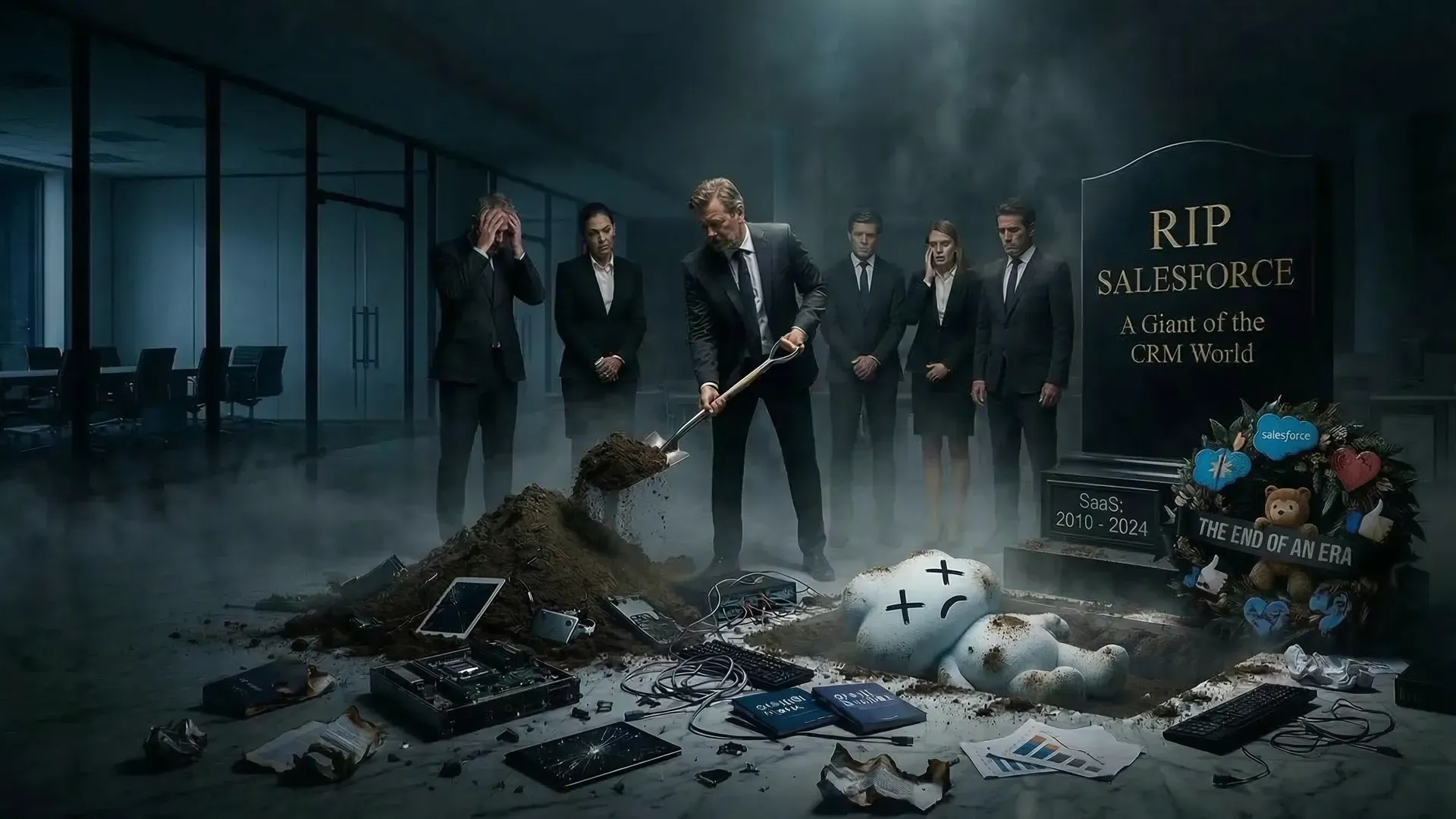
If you are a SaaS founder sitting on a generic "workflow optimizer" or a basic CRM, you should be very, very nervous. I believe SaaS companies are at the absolute top of the list of industries AI is going to render obsolete. And it’s going to happen faster than they want to believe.
In the first week of February 2026, we saw a massive “SaaS-pocalypse” sell-off that erased over $1 trillion in market capitalization from software stocks in just seven days. Investors see the writing on the wall: traditional per-seat models are becoming obsolete, and the moat of "proprietary code" is being drained by AI-driven development.

The Vibe Coding Revolution
We’ve talked about Vibe Coding before—the act of building software through conversation rather than syntax. Andrej Karpathy famously said that the hottest new programming language is English, and we are seeing the proof of that every day.
While traditional SaaS growth endurance has plummeted from 80% to roughly 65% over the last two years, AI-native companies are reaching “Centaur” status ($100M ARR) in just 5.7 years—nearly two years faster than the previous generation.
Right now, I can sit down with a terminal agent or a model like Claude or Gemini and build a functional tool in a few days. My first project was a simple tool to bridge my iOS contacts and a Wix database. It took me less time to "vibe" that app into existence than it would have taken me to research, purchase, and set up a $50-a-month SaaS alternative.
If a "Company of One" can build a bespoke CRM tailored exactly to their own messy, specific needs, why would they pay rent for a generic one that only hits 80% of the mark?
We are already seeing mid-market AI early adopters cutting their project management software allocation by as much as 50% as they shift budget toward core AI platforms.
The "Data Jail" Strategy
So, what do these companies do when their primary product—the code—is suddenly commoditized?
They adopt a defensive posture.
We are seeing this play out in real-time as the giants restructure. In March 2026, Atlassian cut 10% of its workforce—1,600 roles—to redirect capital toward AI development. Salesforce and Oracle have followed suit with similar thousands-deep job cuts. These aren't just "efficiency" plays; they are desperate attempts to fund the pivot before their traditional revenue streams evaporate.
As the new user flow dries up, these companies will turn to the only leverage they have left: your data. We are entering the era of "Data Jail." They will make it increasingly difficult to export your history, raise prices on legacy users (like the 6% across-the-board hike we saw from major CRM vendors last year), and pivot from being "service providers" to being "data hostages."
The True Moat: The "Outsourced Headache"
Now, to be fair, there is one reason SaaS won't disappear entirely tomorrow: Maintenance.
Building your own tool is one thing; keeping it alive is another. A custom-vibe-coded CRM is amazing until the API for your email provider updates and breaks your connection at 2 AM. SaaS companies have historically been "outsourced headache" managers. You pay them so that they are the ones who have to wake up and fix the code.
The SaaS companies that survive will be the ones that stop selling "features" and start selling infrastructure and peace of mind.
They will realize that in a world where anyone can build a tool, the real value is in providing the secure, compliant, and stable playground where those tools can run. I also think that they will be expected to innovate much faster than they are today.
Stop Asking for Permission
The shift isn't just about saving $20 a month. It’s about Autonomy.
For years, the software we used dictated the limits of our creativity. We couldn't build that because the tool didn't have that button. AI has flipped that script. We are moving from a world of "off-the-shelf" to a world of "bespoke-on-demand."
If you’re a creative or a small business owner, the takeaway is simple: stop waiting for a developer to build the tool you need. Don't beg a SaaS company for a new feature in their support forum.
Go build your own room. Start small. Vibe-code a single-purpose tool that solves one specific friction point in your day. Once you realize you can create exactly what you want, paying rent for something that "almost fits" starts to feel like a very expensive anchor.
It’s time to cut it loose.