

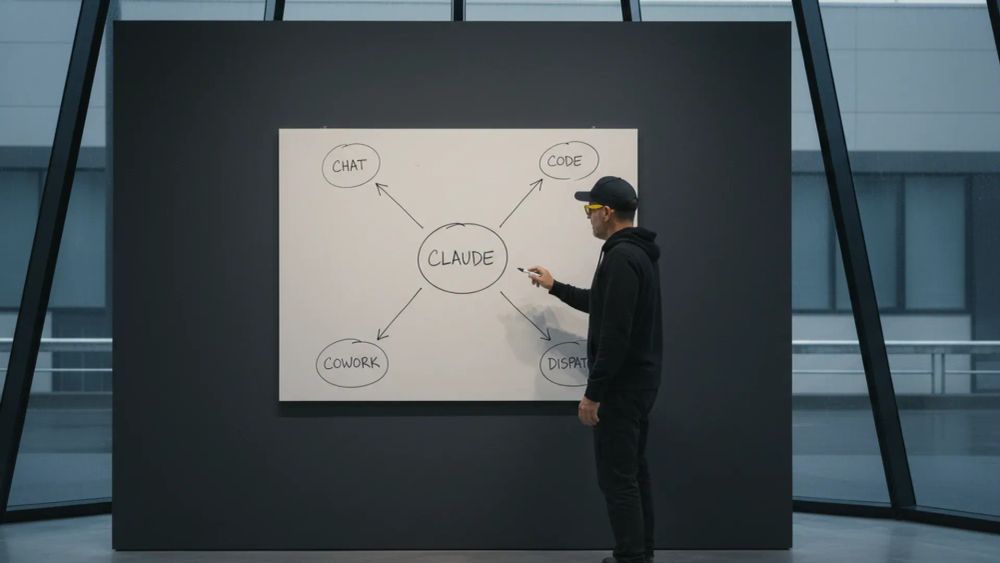
Claude isn't one thing. It's four, depending on where you need the work to happen. Chat, Cowork, Code, and Dispatch. They're not competitors. They're four different shapes of the same collaborator, and once you stop thinking of them as products to pick between, the whole thing gets a lot more useful.
Here's how Anthropic frames each one, and here's how I actually use them to support The Daring Creatives.
Chat — the day-to-day thinking partner
Anthropic's pitch for claude.ai is a place to think, write, research, and work through ideas. No setup, no files, just a conversation.
That's pretty much how I use it. Chat is my daily driver now. Quick and dirty stuff. I'll paste in a half-formed thought and ask Claude to take a stab at organizing it. I'll work through an idea out loud. I'll generate something fast when I just need a rough version in front of me to react to.
If the question is "what do I think about this" or "give me a quick draft so I can react to it" — chat.
Cowork — the desktop collaborator that runs my social
Cowork is the one most people haven't wrapped their head around yet. Anthropic's framing: it gives Claude access to a folder on your computer so it can read, write, and organize files alongside you. Built for people who live in documents, not terminals.
This is where most of my social media management lives. Cowork works hand-in-hand with Claude in Chrome to automate the stuff I used to dread — pulling analytics off each platform, analyzing followers, posting conversation starters, keeping the content calendar honest. Files on disk, browser doing the clicking, Claude tying it together.
The other piece that makes Cowork actually work for me is Obsidian. My whole project directory — The Daring Creatives vault — is an Obsidian workspace, and that same folder is what Cowork reads and writes into. Obsidian is the context space. Notes, drafts, transcripts, pipeline folders. Cowork (and Code) live inside it.
If your work involves manipulating or creating real files you want to keep — documents, content, a vault you actually care about — try Cowork.
Code — the terminal partner for building the site
Claude Code is for, well, coding. Anthropic built it for developers who want to delegate coding from the terminal. Reads your repo, runs tests, edits files, opens PRs.
I'm not a traditional dev. I still use Code constantly. For me it's how I build features of the website and how I create the scheduled cron jobs that keep things running. The Ghost publishing script that takes approved drafts and pushes them to the site — Code wrote that. The analytics script that pulls GA4 and Ghost data into one report — same. Anything that touches the Daring Casper theme, anything that has to live in a repo, Code handles.
And like Cowork, Code runs inside my Obsidian vault. Same project directory, same context. That's not a small detail — it means the code I'm writing has the same ground truth as the content I'm writing, because they live in the same folder.
If you can describe what you want, you can build a small thing that saves you an hour a day. I'm living proof.
Dispatch — the agent that runs my Mac when I'm not there
Dispatch is all about triage, and is how I control my Mac when I'm away from it. I have a chat I can talk to from anywhere, and that chat decides when to dispatch work to Cowork or to Code on the machine at home. If something needs a file touched, Cowork picks it up. If something needs a script run, Code picks it up. I'm just saying what I want and dispatch routes it.
The experience is more like talking on a walkie talkie to a partner back at HQ.
It's also the thing that makes The Daring Creatives feel less like a workflow and more like a small company. Every morning Sherman (what I named my agent) runs a content pipeline check — clears the drop zone, drafts anything new, applies feedback on revisions, preps approved posts for publishing. I wake up and the work has already been done.
If the work is "something I want to happen on a clock, or something I want to send to my machine from across town" — Dispatch.
Note: Using Dispatch seems to use many more tokens, so use wisely. The first days after this came out, it was the only way I'd talk to Claude. After hitting my limit a few times though, I use it just for quick check ins when I am AFK.
How they fit together
The thing I didn't expect is how much they overlap. A single piece of content at TDC might touch all four: I voice-transcribe an idea into the vault from my phone, a scheduled dispatch picks it up overnight, Sherman drafts it in Cowork using files in that same Obsidian folder, and a Code-written script that runs on a schedule publishes the approved version to Ghost.
That's not four tools. That's one collaborator wearing four different hats depending on where I need the work to happen — and one vault holding all of the context.
The question isn't which to pick. It's: where is this particular piece of work happening? In my head? In a folder? In a repo? Or on a schedule while I'm asleep? Pick the shape that matches the work.