

Adam Chau has worked in clay for most of his life, and his hands learned the job before that, in his family's bakery in Connecticut. For the last few years he has added Midjourney to the process. He uses it to imagine a Ming-dynasty world where two men in love were a normal thing to paint on a plate. Then he made it real in porcelain.
He's worth studying because he's unusually open about how it works. He has written the process down step by step on his own site, argued it out in a long essay for Studio Potter, and talked through it on his own podcast. He posts the work as @adamcharleschau on Instagram.
A baker's kid who went digital early
Chau grew up in Greenwich, Connecticut, and spent years learning to mould, bake and decorate in the family bakery, according to CT Mirror. When the bakery closed in 2025 he wrote on Instagram about doing "homework on flour bags and helping out every Christmas until I was 30," and that "I quite literally wouldn't even exist without it" (his post).
He has a BFA from Maine College of Art and a master's in design from the School of the Art Institute of Chicago, where he learned 3D printers and lasers. Since 2025 he has run the gallery at Hartford Art School, his about page says, and he hosts a podcast about art and craft called Trade Secret.
The digital side of his work goes back well before AI. His shows have names like Screenshot (2018), Digital Calligraphy (2016) and Messenger, a 2021 series of porcelain phones carrying messages to the man who's now his husband. Most of it is blue and white. "I produce blue-and-white porcelain objects using cobalt as a pigment, drawing parallels with both historic craft as well as a material used in the tech industry," he writes on his about page.
How the AI part started: a podcast with Carole Epp
Chau's AI work started with an interview. On Trade Secret episode 24 his guest was the Canadian ceramicist Carole Epp (@musingaboutmud), who had started designing pots in Midjourney during a stretch when she couldn't work in her studio. CT Mirror reports her experience is what got him to try it.
We also profiled Carole Epp and the 30 potters who made her Midjourney pots in clay.
You can hear it start to happen on the episode. "When I saw your pots, your AI generated pots, I said, I want to make that," Chau tells her. Then he stops himself, because they were her prompts and her images.
Epp's answer was to go ahead and make one.
Generated Love: Ming-dynasty plates with men in love
His first AI series is called Generated Love. Chau describes it on the project page: "I wondered what the globalized world would have looked like without homophobia and what our objects would look like if it had celebrated gay culture."
So he uses Midjourney to make scenes of men in Ming-dynasty clothes, kissing, holding each other, sitting together in gardens. They're drawn in the style of historic Chinese blue-and-white pottery. The images go onto ready-made porcelain blanks as custom decals, printed transfers that are fired onto the glaze. "No image is repeated twice," he writes.
Adam Chau — "Generated Love" stacked as a champagne-tower pyramid at the University of Northern Colorado, via Instagram (@adamcharleschau)
The installation above was, in his words, "My biggest installation of queer AI plates." The room was a former home economics classroom used to teach table service. He stacked the plates like a champagne tower "to ask the question of what queer celebrations would look like throughout history" (his post). The series has also been shown at the Stonewall National Museum and Archives in Fort Lauderdale.
How he writes the prompts
Chau is specific about his wording. Literal words like "two men" get him literal pictures, he explains on the project page. Then he adds feeling on purpose: "I add subjective language to investigate how a non-human source would process it by using phrases like: 'two gay men in love'."
He also keeps some of the mistakes. In his Studio Potter essay, "Our Obsession with Reality", he writes that he is "keen on using quirks of the software, which include extra appendages such as fingers or arms, though often subtle." The extra finger makes a viewer look twice at a plate that otherwise passes for a museum piece.
The same essay explains how he thinks about the tool. "I believe that AI is an extension of collage," he writes, and he puts it next to Howard Kottler, a gay ceramic artist who made satirical plates from cut-up commercial decals. Chau has never met Kottler, but CT Mirror reports he included Kottler's plates in the Stonewall show to honor him.
Adam Chau — an AI-generated image on porcelain, set into a Lego piece he found in his back yard, via Instagram (@adamcharleschau)
Billie: the son he and his husband imagined
Billie started years before AI. "In 2018 I was invited to an exhibition called Queer Craft," Chau writes on the Billie page. He used "a clunky program to create a fictional child, named Billie, using photos of myself and my husband, wondering what a biological child would look like from a same-sex couple." The result was a low-resolution, pixelated blue-and-white image on porcelain.
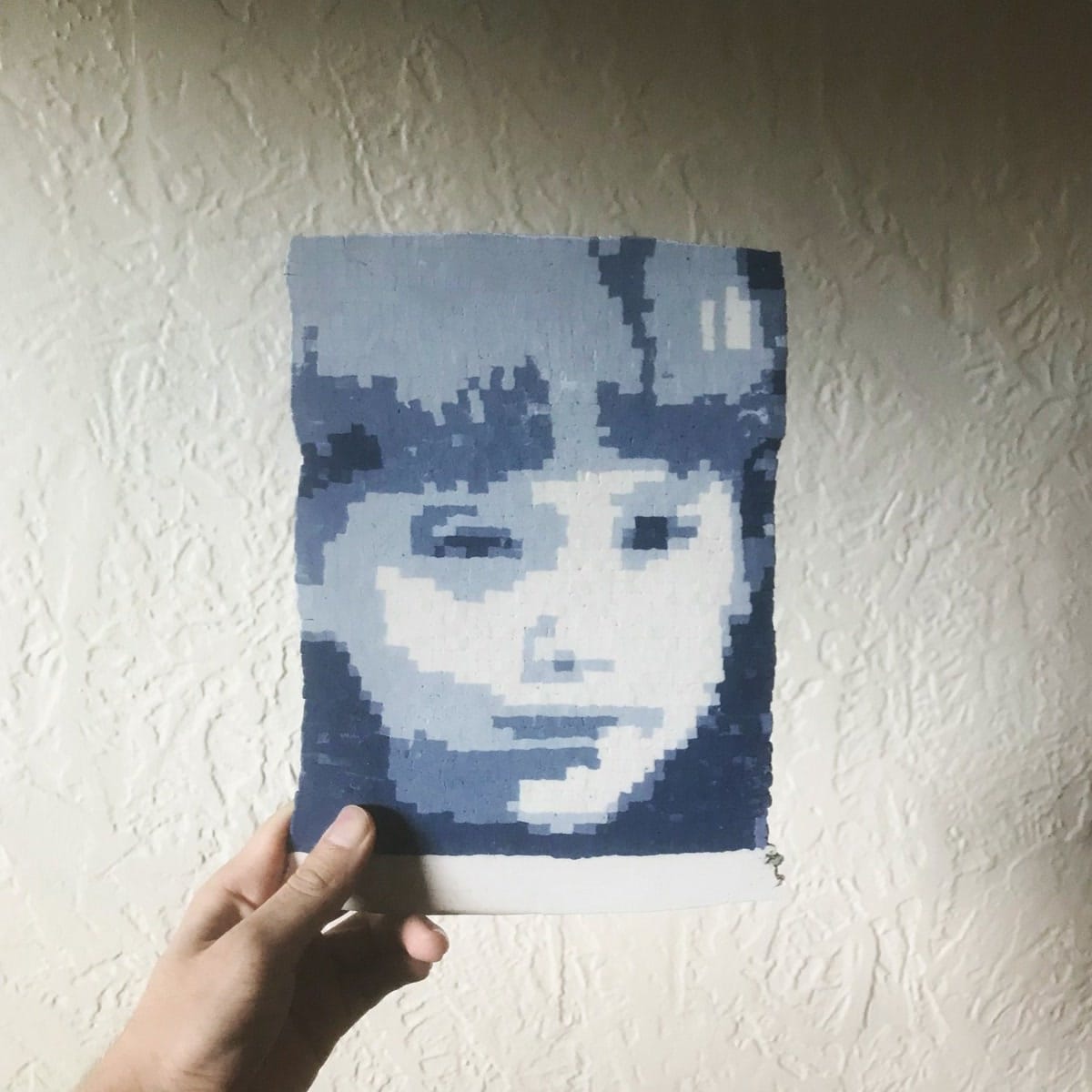
With Midjourney he went back to it. CT Mirror reports he blended childhood photos of himself and his husband to make Billie's face. From there it took several more people and a lot of clay work. His own description, from the Billie page:
- The 3D model. "A designer was hired to build a 3d model." He had it made without hair so it would be easier to sculpt in clay.
- The print. A 3D printing service printed a mask-like head in plastic. He scaled it up so the finished head would be the size of a 6-year-old's after the porcelain shrinks in the kiln.
- The mould. A urethane mould was made from the print, and he pressed porcelain into it.
- The clay. He chose a porcelain that turns almost glassy without glaze, which gives "a very skin-like appearance."
CT Mirror adds that he then shaped and dried the clay and painted it piece by piece. Every finished face has blue eyes and its own hat, and some carry more blue on the skin, like freckles or the words "papa" and "daddy" on the cheeks.
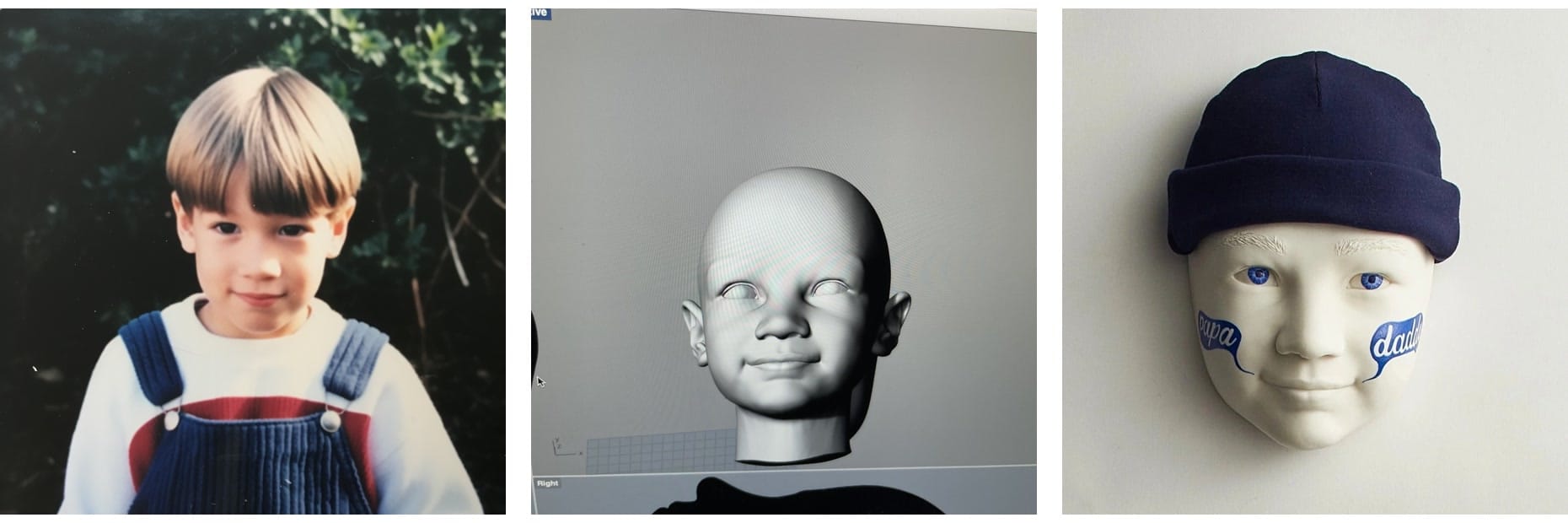
He posted Billie on Instagram in July 2025 with a one-line caption describing it as porcelain sculpted from AI-generated data.
Adam Chau — "Billie" (2025), porcelain, via Instagram (@adamcharleschau)
The Joy and Sorrow of Imagining
Billie got his own show this fall. The Joy and Sorrow of Imagining ran at Northern Clay Center in Minneapolis from September to November 2026. Chau built the room to look like a child's bedroom, with a bed, a table and an old CRT TV. The quilt on the bed was sewn from children's clothes he found at second-hand shops. The porcelain heads hang along the walls.
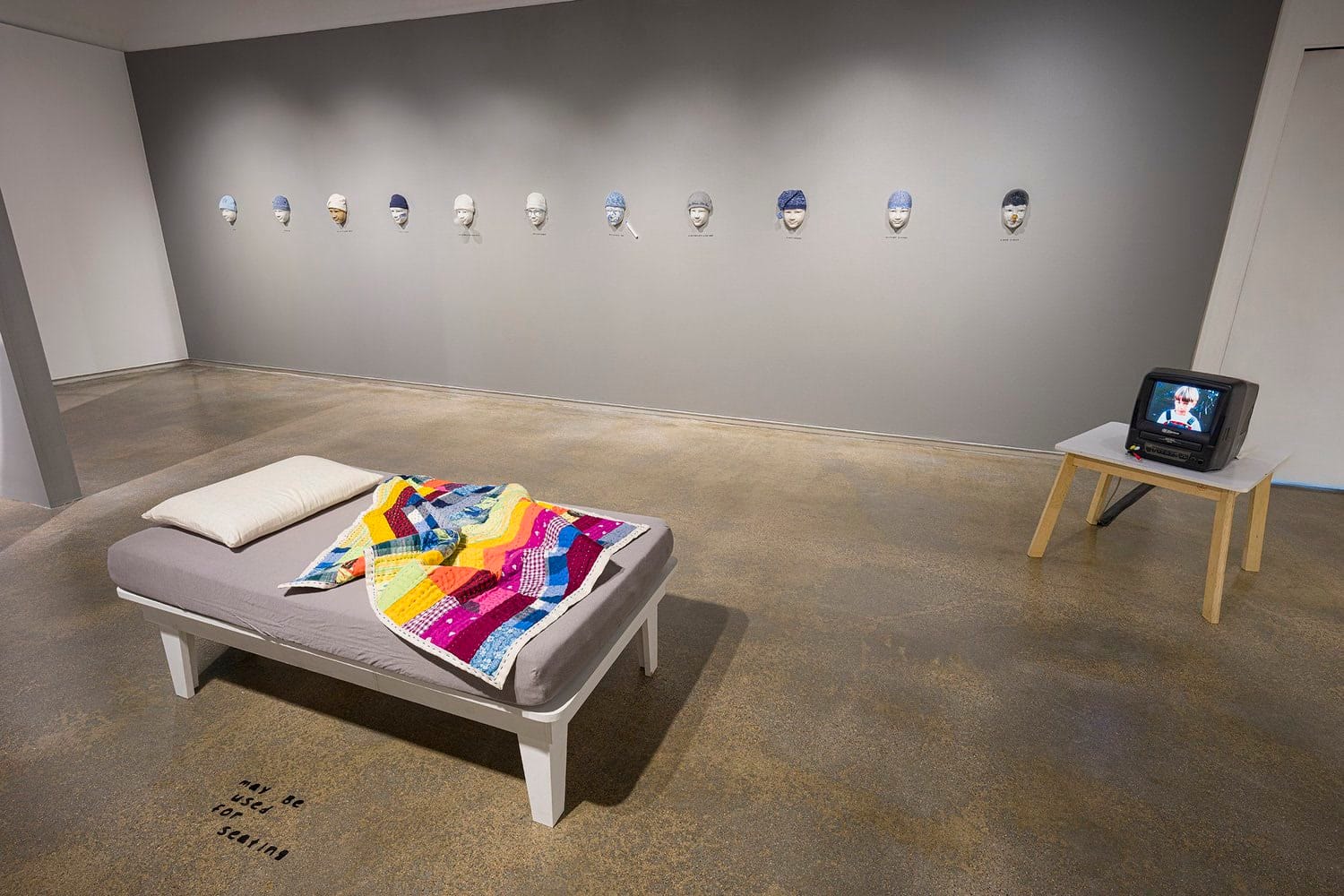
Not everything he makes uses AI. His Radical Americana plate, made for an imagined queer president and shown in the Philadelphia Museum of Art's presidential china gallery, used digital tools but no AI, CT Mirror notes. His newest plates have a speckled blue glaze made with cobalt from a smartphone battery, he says on Instagram.
He told CT Mirror he still hasn't worked out where AI is taking the art world. "I really don't know," he said. "That is the question. I haven't figured it out."

