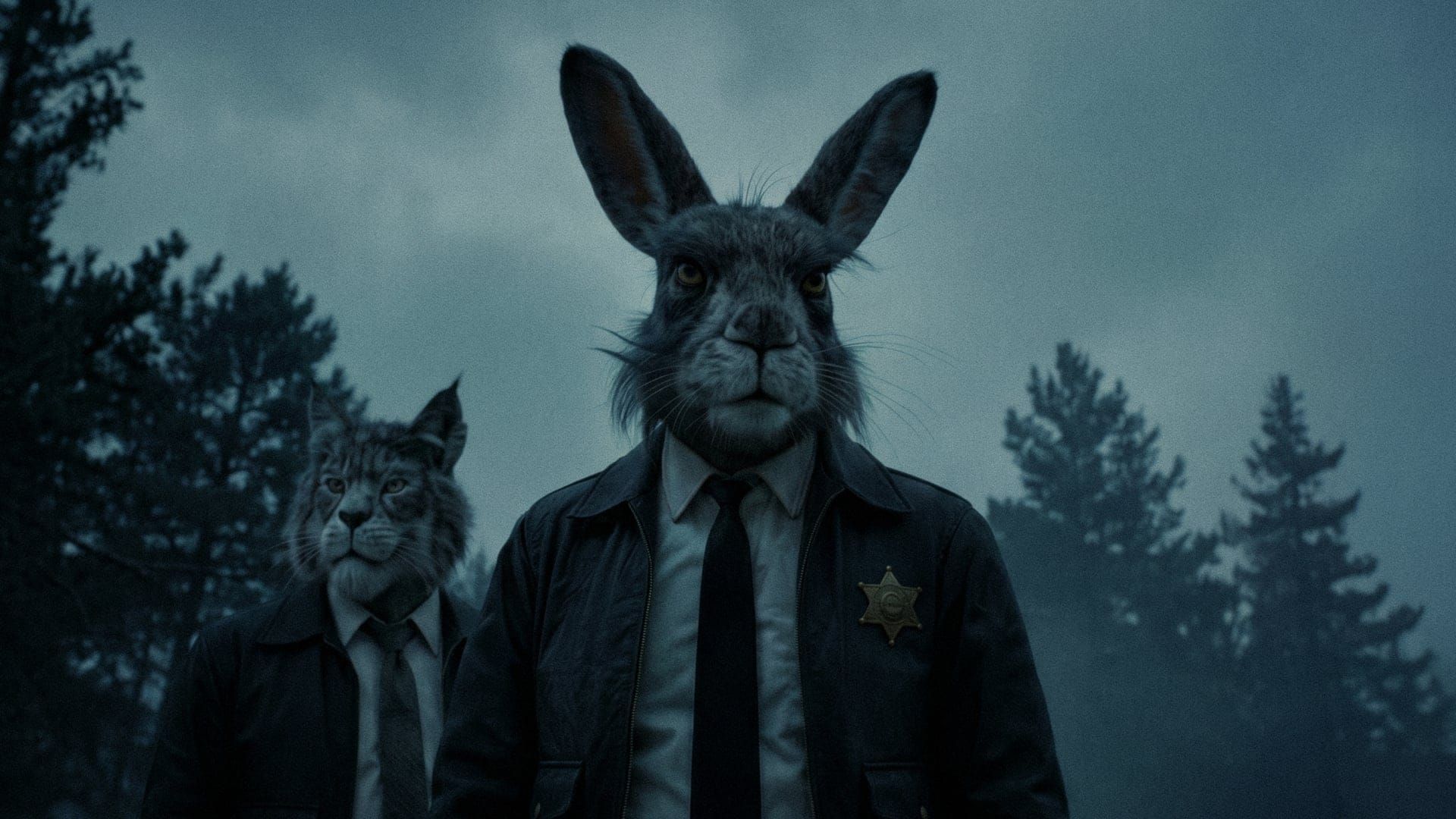

A hare in a law enforcement jacket stands in blue fog at the edge of a pine treeline, a six-point star pinned to his chest, looking straight down the lens with an expression somewhere between tired and unimpressed. A lynx in the same uniform waits a few steps behind him.
Everything about the frame is played completely straight. Nobody in the film appears to find it odd that the sheriff is a rabbit.
The Well runs five and a half minutes, went up on Vimeo in April 2026, and took the Gold award at Runway's 2026 AI Festival, behind only the Grand Prix. Curious Refuge, which put it in its AI film gallery, describes the register as sitting between a prestige crime drama and a dark fable, in a cold Pacific Northwest landscape.
The plot is a wolf's murder and a hardboiled detective hare trying to solve it.
The film outlasted three generations of tooling
The interesting number here is not the runtime. It is how long the film took.
Daniel Titz and Dorian Lebherz, the German directing pair who work as Dorian & Daniel, spent years on The Well, and the technology underneath it kept moving while they worked. Filmmaker magazine, reporting on the AI split running through independent film, describes the arc plainly: they began on early ComfyUI, and finished on Kling 3.0 and Nano Banana.
Almost nothing else in this field has that shape. The standard AI short is made inside one model generation, in a few weeks, and it looks like whatever that generation was good at. A project that starts in a node graph you have to assemble yourself and ends in a hosted model that will hand you a shot from a sentence has been through two entirely different working methods, and the finished thing has to hold together across both.
It does hold together, which is the part worth studying. The look is consistent enough that you would never guess it was assembled across that many toolchains.
They get two different reactions to the same film
Titz describes the reception as split down a hard line, and the split is about the method rather than the film.
"There are two bubbles," he says. "In the AI bubble, some people are very supportive because it's very tech- and innovation-driven, and then there's the other bubble, where once they know it's AI, they shut down. So, we're still struggling to find where we belong."
That is a working commercial director talking. The pair carry a real client reel, and they are watching one half of their own industry stop returning calls.
Their answer is to refuse the category. They do not want to be labelled AI filmmakers, and Titz says their first feature will not be fully synthetic.
"We want to embrace the magic of what happens on set, but that doesn't mean not including AI as a tool for visual effects."
The commercial work underneath it
Dorian & Daniel have been directing together for a decade. Their reel runs through Volvo, Samsung, Sony, KFC, Citroën, Lavazza, Peugeot, Jeep, Škoda, o2, Unibet and Erste Bank, and their own site lists shorts alongside the spots. Lebherz and Titz took a D&AD Pencil for direction in 2017 for a car commercial.
The piece that made their name came earlier. Dear Brother is a ninety-second Johnnie Walker spec ad from 2015 — two brothers, a Scottish landscape, one long walk — and it travelled far enough that Adweek was still identifying them by it years later.
Watching Dear Brother and then The Well back to back is the most useful hour available on what a decade of live-action direction carries into generated footage. The blocking, the patience with a held shot, the willingness to let a scene sit in weather and silence — all of that is already there in 2015, on a real hillside with a real camera.
Tools used across The Well
ComfyUI · Kling 3.0 · Nano Banana
In the order they were adopted, per Filmmaker magazine's reporting on the film. ComfyUI came first; the later two arrived while the film was still in progress.
Where to go next
The same Filmmaker piece quotes Kavan Cardoza, who posts as Kavan the Kid, taking the opposite position on the festival question — he says he could not care less about festivals or awards. Two people in one article, one chasing the legitimacy and one ignoring it. And Julien Durand's engineering day job is the nearest thing on this site to Dorian & Daniel's commercial background: an outside craft that turns out to be the reason the AI work is any good.
The Well is still up on Vimeo, and the feature they are talking about will have real actors on a real set in it somewhere.