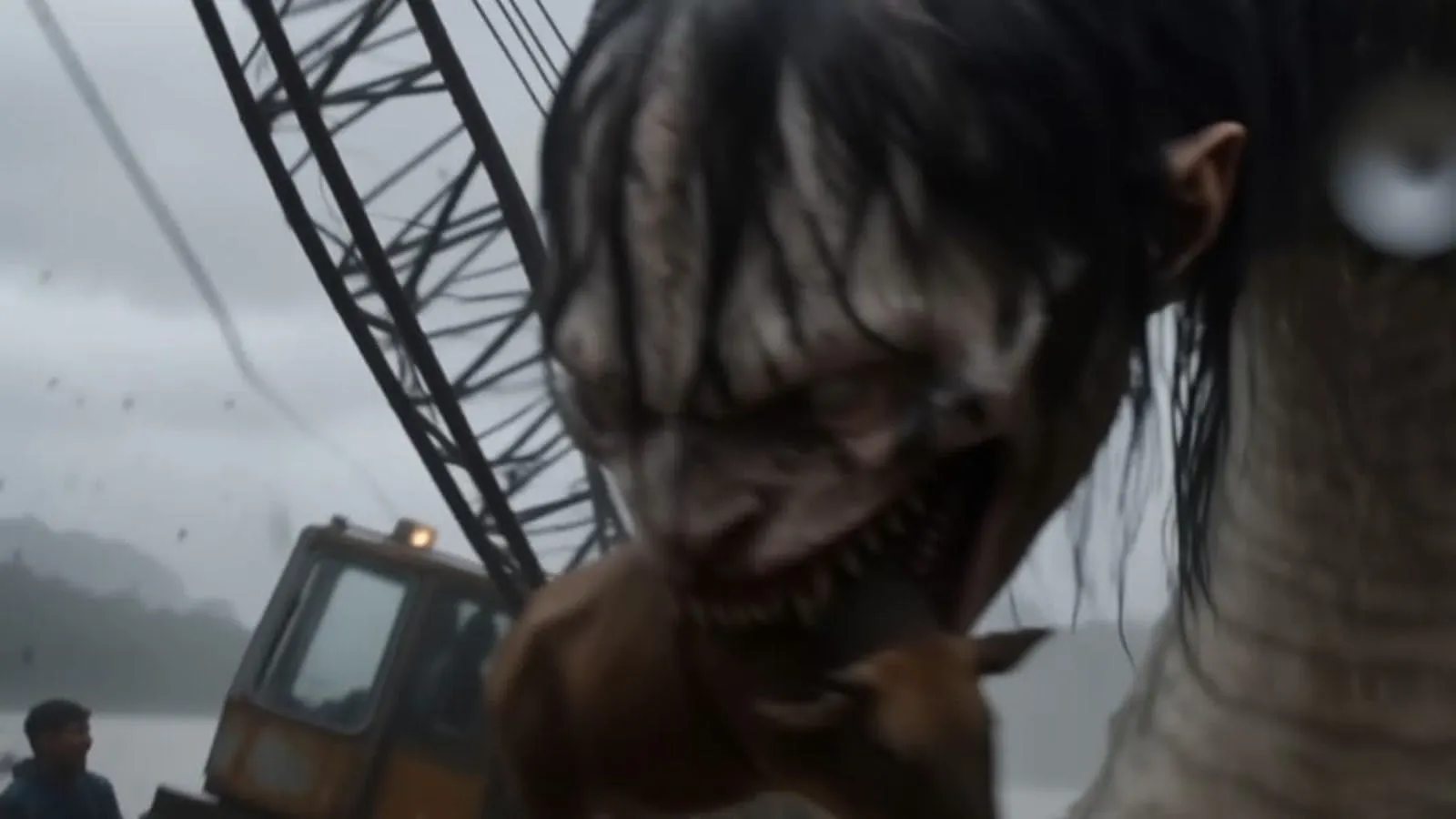

A crane swings a live bull out over a flooded brown river. Rain is beading on the lens, the sky is the colour of wet concrete, and two men in the corner of the frame are watching the water instead of the bull. Then the thing under the water takes it, and the face that comes up is not a caiman or an anaconda — it's long, pale, half-human, with black hair plastered flat over the eyes.
The camera never steadies. That's most of the trick.
That's the forbiddendimension account, 417,000 followers deep in AI video dressed up as footage somebody recovered. The Instagram display name is Jonathan Michaud. The bio says "alternate realities powered by AI," names Higgsfield as a partner, and links a playbook they sell about how the videos are made.
forbiddendimension — the bull on the crane, via Instagram (@forbiddendimension)
The Camera Is Always Somebody Else's
The reels arrive with a chain of custody. A rescue team looking for a missing helicopter finds a damaged GoPro on a riverbank in the Amazon, and the pilot is never located. A reconnaissance team goes deeper than any previous search party, loses satellite contact in six hours, and three weeks later the camera turns up tangled in tree roots. A ranger's patrol boat is recovered forty kilometres down the Javari; the ranger isn't.
Every one of those lines is a caption written to go with the video. The paperwork gets built around the footage — where it was found, who has commented, what the authorities won't disclose — and the video plays as the attachment.
The captions are careful about a second thing too. Under the recent ones they write "Created with @higgsfield.ai" and "AI-generated for entertainment purposes," and the older cryptid posts that ran without a label are still up, unedited, which leaves the shift visible in the feed itself.
forbiddendimension — "RECOVERED FOOTAGE — AMAZON EXPEDITION No.4," via Instagram (@forbiddendimension)
What the Playbook Says It Optimises For
The playbook they sell, 800 Million Views: The AI Video Playbook, is a 22-page PDF for $24, and its sales page is the closest thing to a process interview they've published. It opens with a number: one of their videos hit 805,263,958 views, and they say it brought them a million followers in a week.
The chapter list is the useful part. The book describes running every concept through four filters before anything gets generated, and it names the target directly — "Why 'Is this real?' is the engine of virality — and how to trigger that debate on purpose."
Then the prompt anatomy, broken into five pieces: "style declaration, beat-by-beat timelines, diegetic audio, deliberate imperfections, and the hard cut that doubles watch time."
Deliberate imperfections. That's the lens rain, the blown-out sky, the swing of a handheld camera that can't find the subject in time — the parts an image generator will happily leave out if you don't ask.
The Compliance Chapter
Two of the chapters have nothing to do with generating video. One covers packaging per platform — captions, hashtags, pinned comments for Instagram, TikTok, YouTube Shorts and Facebook. The other is billed as the compliance chapter: AI labels on every platform, and, in their words, "the mistake that got me a TikTok strike so you never repeat it."
Another chapter argues that "volume kills reach" — the anti-slop one, as the sales page has it. For a format that lives or dies on a viewer's first three seconds of doubt, that's a specific position to take, and the feed reflects it: each reel sets up a different incident rather than running fifty variations on the one that worked.
forbiddendimension — sea serpents, inspired by The Odyssey, via Instagram (@forbiddendimension)
Where the Format Came From
The older posts are a different animal. A helicopter surveys a sixty-foot megalodon washed up on an unnamed Australian island, written like a wire report, complete with scientists speculating about seismic activity and authorities securing the area. Another one asks whether the shape in the Amazon river is a surviving Titanoboa. Emoji headlines, all caps, "COMMENT BELOW."
The mechanism is the same — a plausible aerial vantage, a creature just far enough away, an invitation to argue in the comments — but the framing was tabloid rather than evidentiary.
The current reels dropped the exclamation marks and picked up a case file. The serpent piece is the clearest example of the shift: they say they built it after The Odyssey, and the caption is about wanting "this scene to feel like a forgotten legend suddenly becoming real." Nobody is asked to believe a sea monster is real. The framing does the work anyway.
The Stack He Credits
Tools the creator credits
- Higgsfield — named in the captions of the recent reels and in the account bio, which lists a partnership with them.
He has not published a model-by-model breakdown outside the paid playbook, so that's the whole verified list.
Anyone who has watched cursejourney build horror out of degraded footage will recognise the family. Both treat damage as information — the difference is where they put the doubt. cursejourney's clips look like something already found and archived; forbiddendimension writes the search party into the caption and lets the comments finish the argument.
The reels are still coming at a few a week, most of them from the same stretch of unmapped river, and the last few have carried the AI label in the caption before the story starts.