
In October 2024, Jacopo Reale had just finished editing a film for Warner Bros. His wife was pregnant, so he took a break, and in the downtime he started teaching himself Midjourney. That's how he tells it to Latina Oggi, his local paper (the interview is in Italian; the paraphrases here are our translation).
Two months later he posted a reel of AI shots built to look like frames from a dozen different films, with one line of text in it: "Will generative AI transform how we make movies?" It went viral on X. Within a year he'd co-founded an AI film studio, made a launch film for Kling, and won the Reply AI Film Festival in Venice.
He's worth studying because of the job he came from. Jacopo is a film editor, born in Formia in 1985, and according to his bio at Labyrinth Studio he spent more than a decade on productions for Netflix, Disney, Warner Bros and Rai Cinema. Editors spend their working lives choosing from too much footage, and that's close to what AI video asks of you every day.
He posts as @jacopo_reale on X, and his films live on Labyrinth Studio's YouTube channel.
The reel that asked the question
The reel is called This Footage Does Not Exist in the Real World. Every frame was generated in Midjourney and animated with Kling, and it jumps between genres on purpose: a girl stroking a horse, a subway car, a girl shooting an arrow at an apple.
He explained the references to the Italian trade site Youmark. The only frames he copied visually came from Giulia, a Ciro De Caro film he had edited. The rest were nods to Rohmer and the Dardenne brothers, and the arrow shot had Jojo Rabbit and Wes Anderson in mind. He wanted to show the tools could do more than one glossy digital look.
Why make it at all? He told Latina Oggi that the Italian and European film conversation about AI was all about the Hollywood writers' strike and scripts, and nobody was talking about the image. So he made something to put the image question in front of his colleagues. Youmark reported the reel passing 26 million views on X, counting only two of the accounts that posted it.
The attention changed his working life overnight. Directors in Italy and abroad got in touch, festivals invited him to speak, and he found himself treated as an expert in something he'd been using for a few months.
What an editor does with a generator
Jacopo talks about editing the way most people talk about directing. He told Latina Oggi that few people outside the industry know what editors actually do: the hours of discussion behind a film, the sheer quantity of material to sift, the work of choosing and subtracting.
Then he described his AI process in exactly those terms. If he imagines a sheep bleating, he generates ninety sheep, and that's where his job starts. He picks five, and one of those five makes the cut.
He thinks the editor is one of the roles that will have to adapt most. Talking to Youmark, he pictured an editor who knows which shots were never filmed but could strengthen a story, a documentary for instance, and can go and generate them.
He uses Avid Media Composer, which already links script lines to every take where an actor says them. He told Youmark he expects AI to build rough assemblies from that before long, with the editor still free to pick takes and set the rhythm.
His line in an interview with Openmag about the model is the one an editor would say: “Non ha un pensiero montato: glielo devi dare tu.” Roughly, it has no edited thought of its own, so you have to give it one.
Love at First Sight started with his mother crying
After the reel, Kling got in touch. The company was launching its 2.0 model, had picked three AI artists worldwide to make promo films, and Jacopo was one of them. He told Latina Oggi they gave him a free hand.
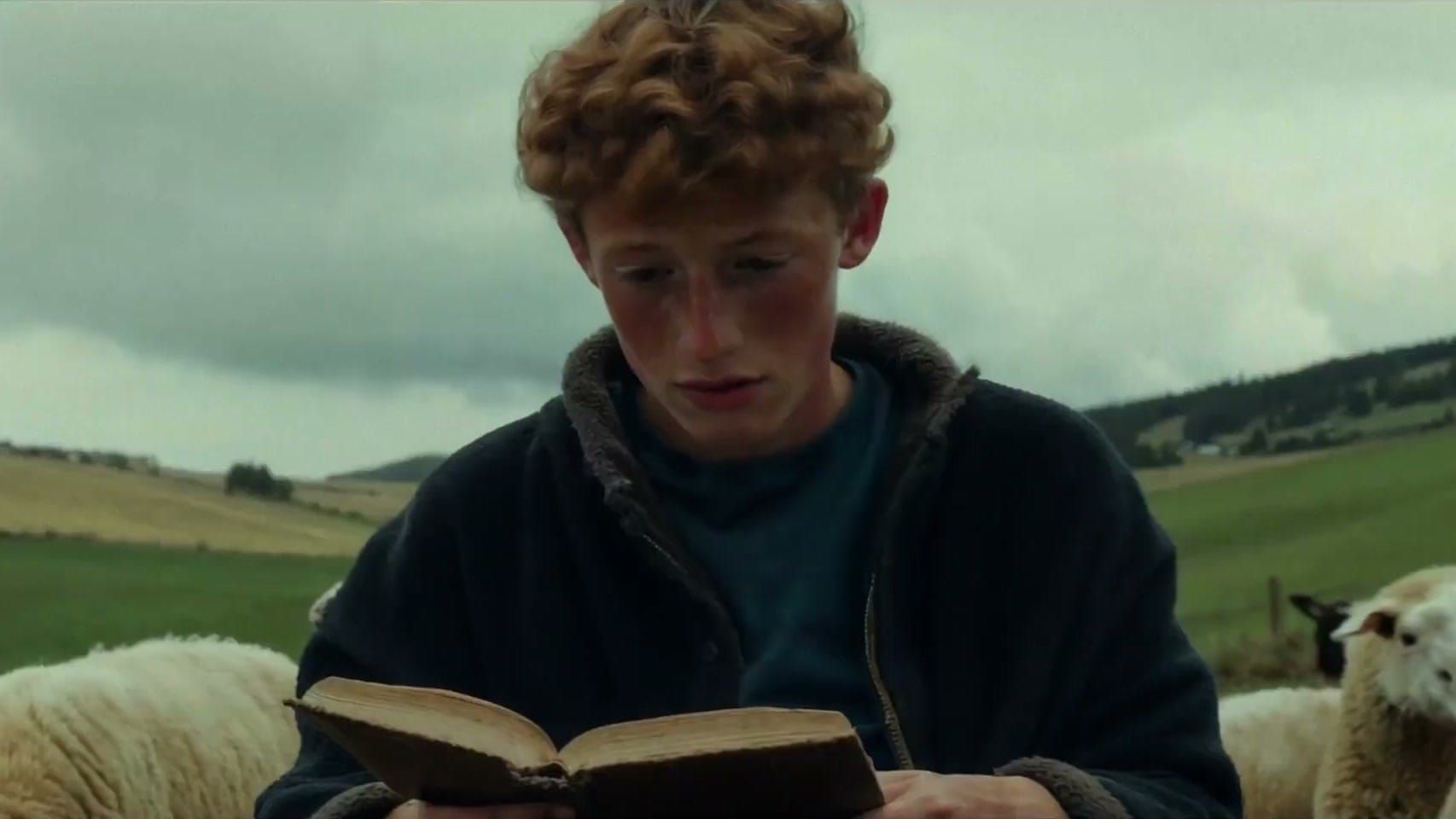
The story came from a memory. When he was a boy, his mother cried while looking at a Giorgio Morandi still life, and he didn't understand why. He'd been sketching a film about a girl who looks at a painting of a 19th-century ship breaking on the rocks and travels there in her imagination. He reshaped it into a young shepherd, reading in a field, who catches the eye of a girl on a bicycle.
In the finished film the shepherd imagines a whole life with her, and at the end we find out she's the one looking at him, in a painting on a gallery wall. In Reply's announcement of the win, he put it this way: "The film is all about the act of observation: who imagines whom, and how emotions can arise from an illusion."
There's no dialogue and no voiceover. He told Openmag he doesn't like voiceover, and at the time the models couldn't make characters speak, so he wrote a story out of lowered eyes and embarrassment. What surprised him was that the model played the shepherd's shyness better than he'd imagined it.
The workflow was stills first. He built the images, then animated the frame he cared about most, a close-up of the red-haired boy, and described the boy's character to the model in words. In Kling's release of the film he called it "a story about the purity of feelings and a tribute to shyness."
Love at First Sight won the 2025 Reply AI Film Festival at the Venice Film Festival, with Gabriele Muccino as jury president. In the same announcement Jacopo said "AI makes me distill stories to their essence, giving rhythm and meaning to images that don’t exist in a traditional sense, yet can still evoke deep emotions."
A year later he was on the other side of the table. Deadline lists him on the 2026 Reply jury.
Labyrinth Studio and the team of four
He co-founded Labyrinth Studio, based outside Rome, to make films with generative models. He told Openmag they want to prove a two-minute video can still say something with depth.
The studio's films are team work, and he credits the team every time. For Looking for Bianca, Kling's launch film for its 3.0 model, his post on X names Giacomo Cannelli, Alessandro Risuleo and Aurora Cecchini alongside himself. "It took two weeks and a team of four people to make Looking for Bianca."
It's a five-minute story set in Hong Kong about a young woman searching for her missing husky. The interesting part is how they shot it. With Kling 3's tighter spatial control, they would generate a wide shot first and build the rest of the scene from it, the way a live-action crew shoots a master and then coverage. In his words, "we often chose to start from a wide shot and generate the coverage from there, as we did in the three-character dialogue scene between Sophie and the truck drivers."
A master shot plus coverage is what an editor wants to receive. It gives you options in the cut. In the same post he wrote that "Even when a film is fully AI, the process remains surprisingly close to traditional filmmaking."
The tools, and the limits he still works around
A 2026 interview with Il Mattino lays out the studio's stack: images in Midjourney and Nano Banana Pro, then animation in Kling and Seedance. For writing prompts, he said, “Uso ChatGpt e Claude.” (I use ChatGPT and Claude.) He prefers cloud models to running anything locally, which he says costs more in graphics cards and performs worse.
He was blunt there about what's still hard. In live-action cinema every camera move is choreographed, and he said the models still struggle when you ask for too many movements and too many details at once.
He also posts tests. In May 2026 he shared one on X that started from a Midjourney 8.1 image and was animated with Seedance inside Dreamina, where he's a creative partner. What he pointed to was control: "The possibility to achieve the scene you had in mind in just a couple of iterations."
The Fracture
The Fracture is the studio's most ambitious film so far, by Jacopo's own description. It's a twelve-minute piece that he wrote and directed, produced with Animatix, with sound design by Tiziano Lamberti for Sounzone. When he posted it in March, he asked one thing of viewers: "Please watch it with sound. It is very important to us."
He thanked the executive producers for the freedom to make "what at times felt like a slightly crazy little film." In May he announced it had been selected as an official candidate at the AI Film Fest Monaco 2026.
Where it's going
The work hasn't come without a cost. Semafor reported in September that when his first AI film went viral on X, he received multiple death threats. The same piece reports that Labyrinth is working on a show for Sky Cinema; Sky didn't respond to Semafor, and we haven't been able to confirm it independently.
His next personal project, as he described it to Il Mattino, is called Non si abbracciano i conigli, set in the 18th century. He spent days just on the characters' looks.
If you're coming at AI video from a film background too, Matteo Bernardini's first AI film, Brine, is another Italian filmmaker making the same move from a different job on set.
You can watch his films on Labyrinth Studio's YouTube channel and follow his tests and releases on his X account.