
Ryan McCoy has been imagining alien civilizations for most of his professional life. More than two decades as a VFX artist and Creative Director in film and animation — the kind of career where your job is literally to describe what things look like before they exist.
AI image generation showed up, and Ryan — who posts as @brain_racked on Instagram — ran with it.
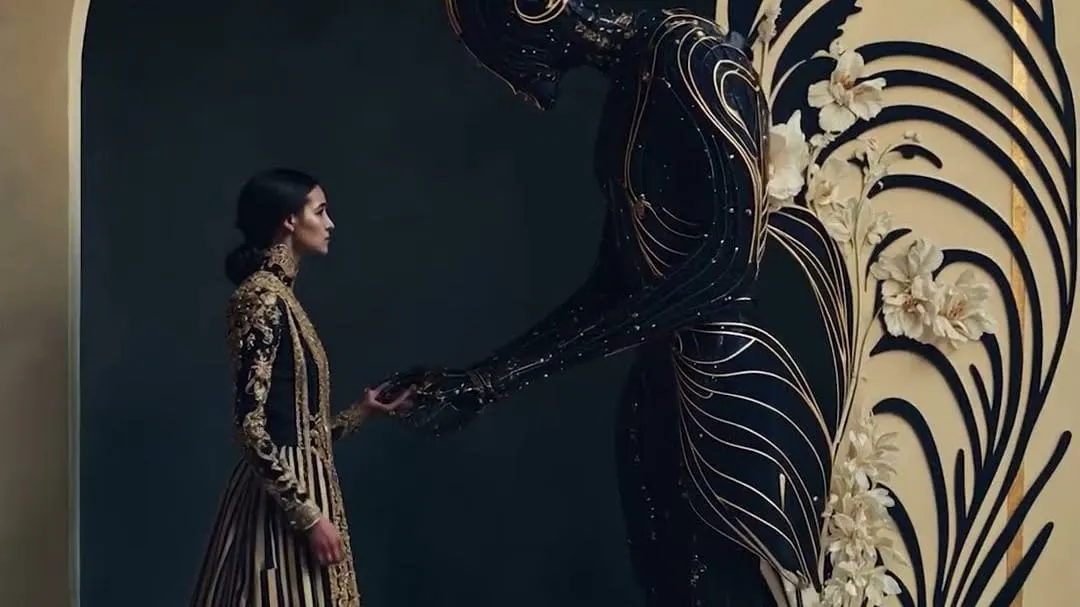
The worlds Ryan builds under the BRAINRACKED handle are not the kind you dash off in five minutes. Elaborate sci-fi civilizations, alien architectures, spaceships and characters with the kind of weight and specificity that you only get from someone who has been thinking about this stuff for a really long time.
Around 440,000 followers on Instagram have found this. The number keeps growing.
BRAINRACKED — “Unfinished business in the country of Parth”
The two-day prompt
Ryan has described spending two full workdays on a single character design. Not hours. Days.
The typical AI art workflow is not this. Generate fast, post what looks good, move on. Volume is the strategy. Ryan is doing something close to the opposite — the prompting is the work, and the AI is rendering something that has already been thought through thoroughly.
The tools Ryan uses — Kling AI for generation, Magnific AI for enhancement — are fine but not unusual. Plenty of people have access to them. What's unusual is the pace, and I think that's the whole thing.
What the years actually bought
Professional VFX work builds a specific kind of skill: a vocabulary for describing what things look like before they exist. Surface materials. Lighting conditions. Structural logic. The geometry of something that has never been photographed because it has never been real.
That is exactly the skill that makes AI generation powerful in the right hands.
The model can synthesize plausible visual outputs from language — but the language still has to describe something specific enough to actually generate. General descriptions produce general images. Ryan's sci-fi worlds look like a real universe because Ryan is being specific in ways that take years to develop. You can't prompt your way to that specificity without first having it.
The skeptic's case
You can make a fair argument that the tools are doing the heavy lifting here. The visual quality people respond to on Instagram is coming from Kling and Magnific — that with good enough models, what you bring as an artist is increasingly curation, and the craft part matters less than it used to.
I genuinely think about this. It's not an unfair read.
What I keep noticing, though: generic prompts produce generic output. The specificity that makes BRAINRACKED's work feel like a coherent universe rather than a collection of cool images — that's not coming from the model. The model does not know what "the country of Parth" means until Ryan tells it. That's the 20 years doing real work.
What I keep thinking about
There's a specific kind of person who has been quietly building a very particular imaginative world for most of their career, and never quite had the tools to get it out the way they pictured it.
I think Ryan McCoy is that person. And I suspect there are a lot more people like that — where AI didn't give them new ideas so much as it finally gave their existing ideas somewhere to land.
The BRAINRACKED Substack is worth reading if you're after this kind of process writing. The YouTube channel is early, but the work carries.