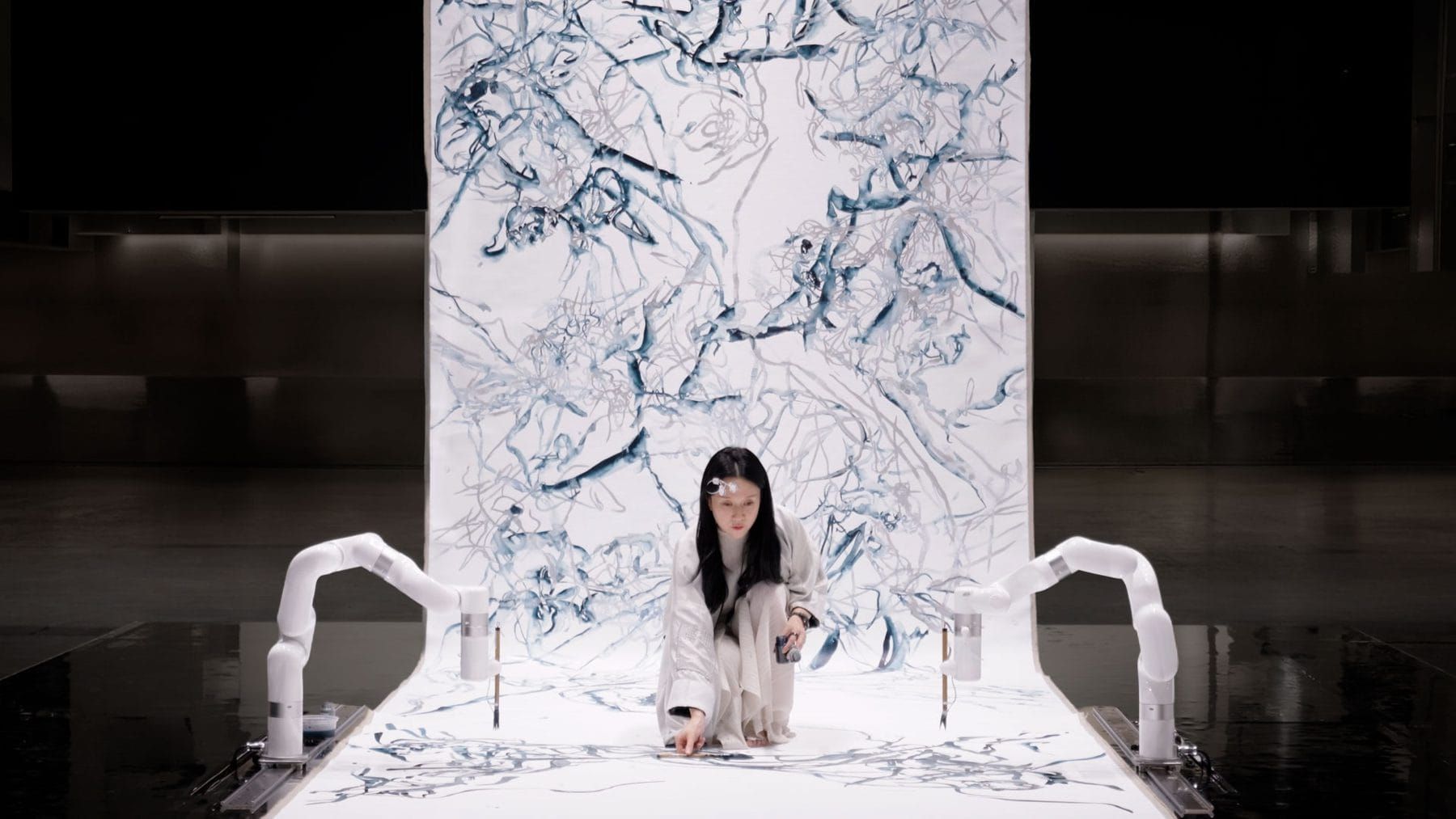

A ten-metre scroll hangs from the ceiling and continues across the floor, covered in loose blue-black strokes that tangle and open out like weather. Two white robotic arms sit on rails at either edge of the paper, each holding a brush. Kneeling in the middle, in white, brush in hand, with a small silver sensor pressed to the forehead, is the artist.
Everything on that paper was made by one of three things: a hand, a machine trained on that hand, or the electrical activity of the brain attached to the hand.
This is RECURSION 0, shown at Art Basel Hong Kong in 2026 and completed live during the fair, presented with Fellowship and ARTXCODE. Sougwen 愫君 Chung has been working this way since 2015 and calls the practice Operational Art — drawing and painting alongside robotic systems, in public, with the outcome unresolved until it happens.
Chung posts as @sougwen and is, per the studio's own listing, a Chinese-Canadian artist and researcher based in London.
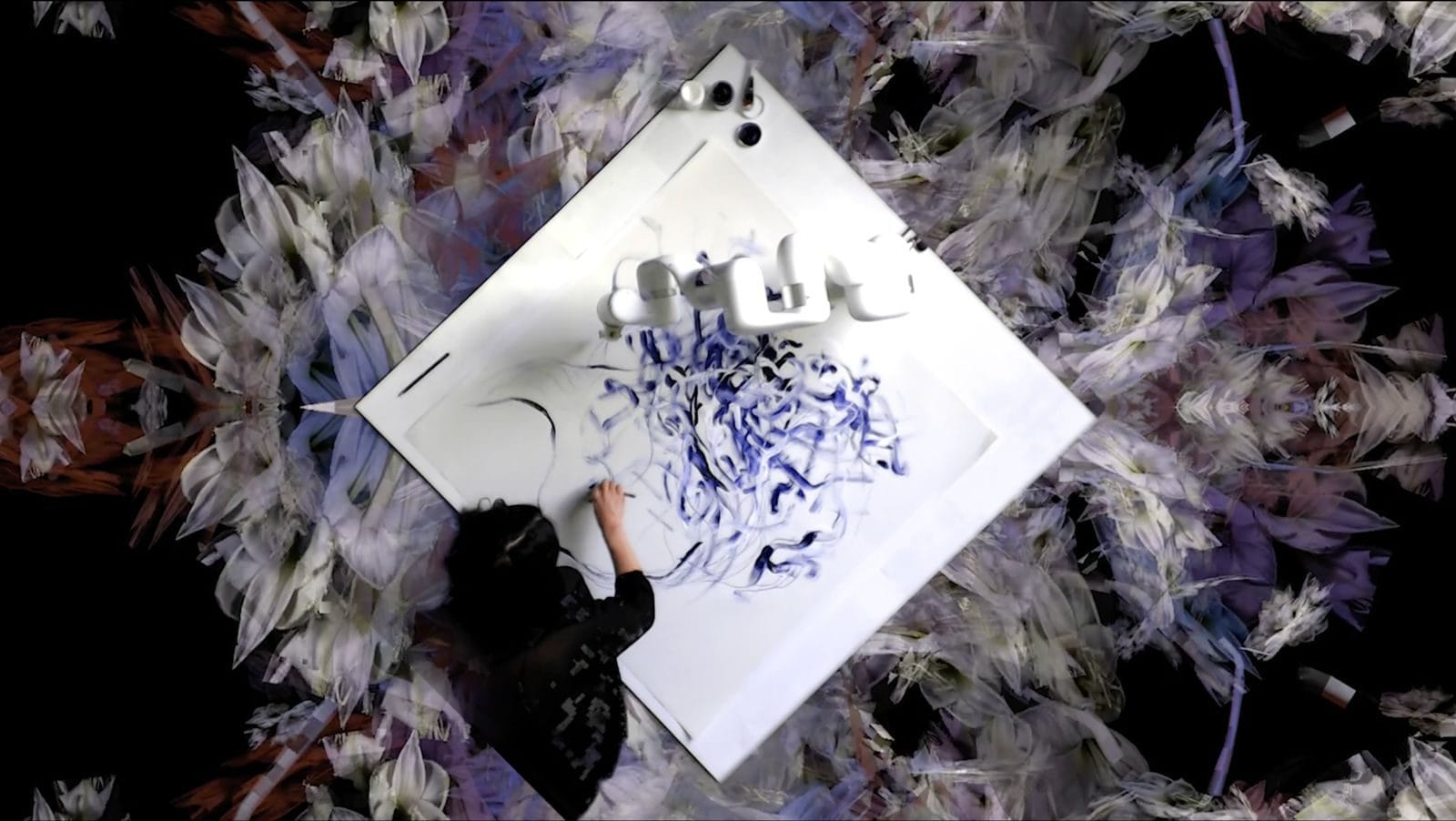
The machine learned one specific person's handwriting
The robotic collaborators are called D.O.U.G., for Drawing Operations Unit: Generation, and there have been several of them over a decade. Each generation works on a different principle.
The first ones did mimicry. A robotic arm watched a gesture and copied it, which is impressive engineering and not much of a conversation.
The later ones were trained on two decades of Chung's archived mark-making. That is the detail worth sitting with, because it is the same move a lot of people are now trying to make badly. The training set was not the internet. It was one person's own drawings, accumulated over twenty years of working, fed back to a machine that then draws alongside the person who made them.
More recent generations added EEG biofeedback, so the system responds to brain activity in real time rather than to a completed stroke.
An ancestor born in 151 CE is wired into the trigger
The current body of work is grounded in Chinese calligraphy, where the body is the instrument, the stroke cannot be undone, and the mark is a record of a decision made under time pressure.
Through 族譜 genealogical research, Chung identified Zhong Yao (鍾繇, 151–230 CE) — a canonical master of standard script, 楷書 — as a direct ancestor.
His 頓 (dùn) pause is the moment a brush holds pressure and decides whether to keep going or change direction. In the current work, that pause is what the EEG system is set to detect. The machine draws at the threshold where the ancestor's technique says a decision gets made.
It is the most literal joining of family history and signal processing anyone has built, and it is doing real work in the piece rather than sitting in the wall text.
The museum collected the model, not just the drawing
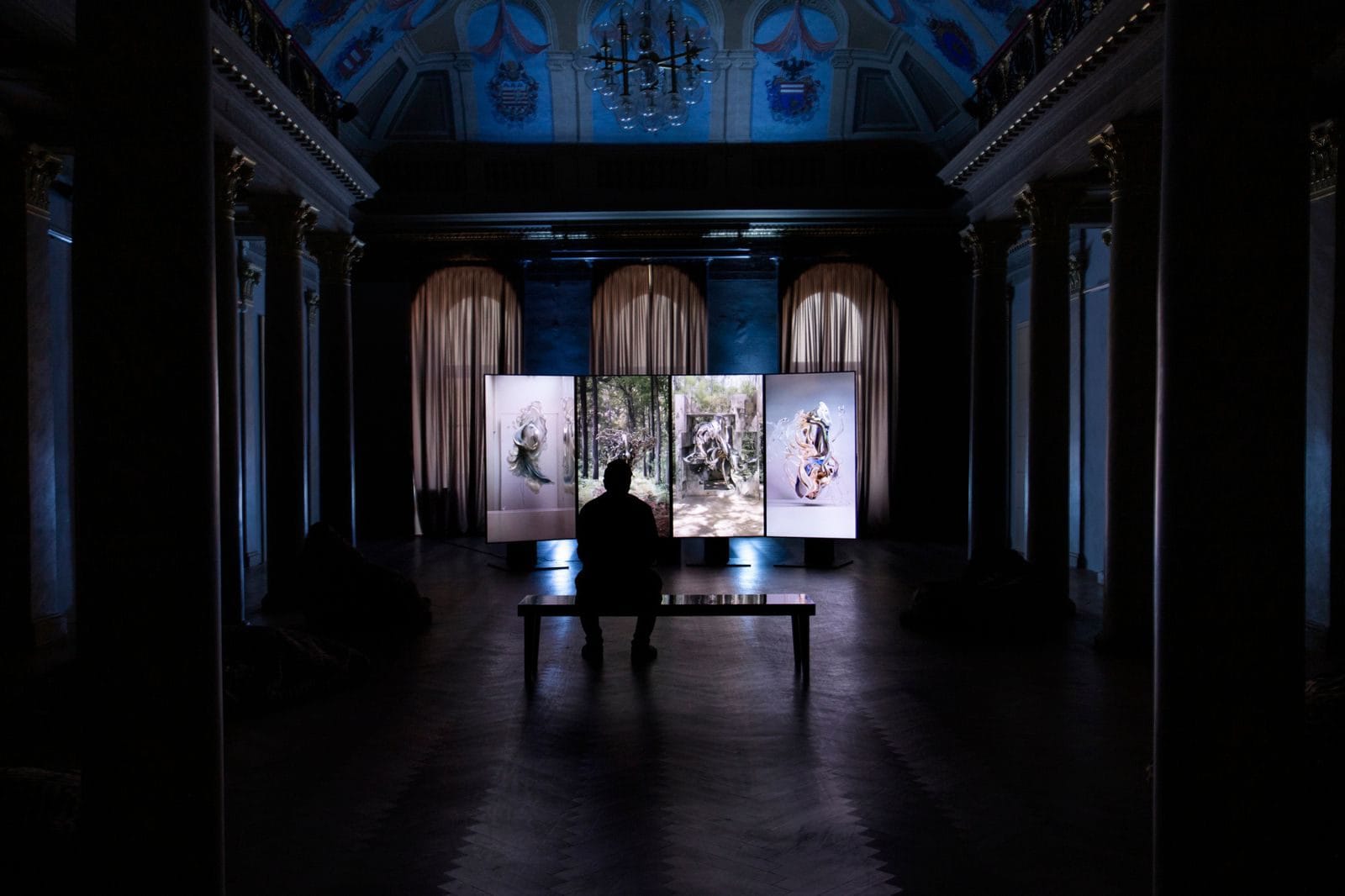
MEMORY (Drawing Operations Unit: Generation 2) is in the permanent collection of the Victoria and Albert Museum, which the studio describes as the first AI model collected by a major cultural institution. The V&A has written about the acquisition on its own blog.
A museum accessioning a trained model is a different kind of object problem from accessioning a canvas. The thing has to be kept runnable.
The rest of the exhibition record runs through institutions rather than platforms: solo shows at Palazzo Citterio in Milan and the East Slovak Gallery in Košice, a ten-year survey at Kunstverein Heilbronn, group shows at the V&A and the Shanghai Minsheng Art Museum. Chung was on TIME's inaugural Time100 AI list in 2023 and took a TIME100 Impact Award the following year, and is a doctoral candidate in computational media arts at HKUST.
What Chung says the practice is for
The 2019 TED talk is the clearest public statement of the position, and it predates the current wave of arguments by several years.
The recurring question is authorship, and Chung keeps declining to settle it in either direction. "What does our desire — or refusal — to assign authorship to a machine say about us?" runs the framing on the studio site. A 2026 interview with Le Random puts it as a rule: "Human agency is neither privileged nor collapsed."
Speaking to The Art Newspaper in March, Chung traced the start of the practice back to 2015 and to research in neuroscience, computer vision and human-computer interaction, years before generative AI became a public argument.
"In collaboration, there is always change. Mutual exchange. Promise. Peril."
Where to go next
The nearest thing to this on our site is Holly Herndon training a model on her own voice and then handing it out — the same instinct about whose data should be in the machine, arriving from music instead of drawing. And Julian van Dieken accidentally becoming the first AI artist in a museum is a useful contrast with the V&A acquisition: one route in was an accident, the other took a decade of building the system being collected.
Chung's forthcoming work extends the practice into living systems, and the studio's research page is currently full of silkworms.