
For about five years, Evgeny Stadolnik's job was making kids want toys. He directed, shot and graded commercials for toy and children's brands, supervised the animation on a kids' series created by Blippi's Stevin John, and built a video production studio from scratch along the way. He runs Stadolnik Studio now, and posts as @stadolnik.studio on Instagram.
THE THREAD is his own film. It runs a little over eleven minutes, it's about a needle-felt fox, and he made all of it himself.
Stadolnik did the writing, the generation, the edit, the color and the sound, and Higgsfield, where he made it, publishes a record of every model he ran.
I watched a lot of the Higgsfield Global Film Festival entries in September, and this was my favorite. The style took me straight back to being a kid. I wrote to him with a few questions, and he answered all of them.
What THE THREAD is
Stadolnik's own logline, on the film's Higgsfield page: "A fox brought to life by a thread of love must face losing the one who made her and find the courage to give that love a future."
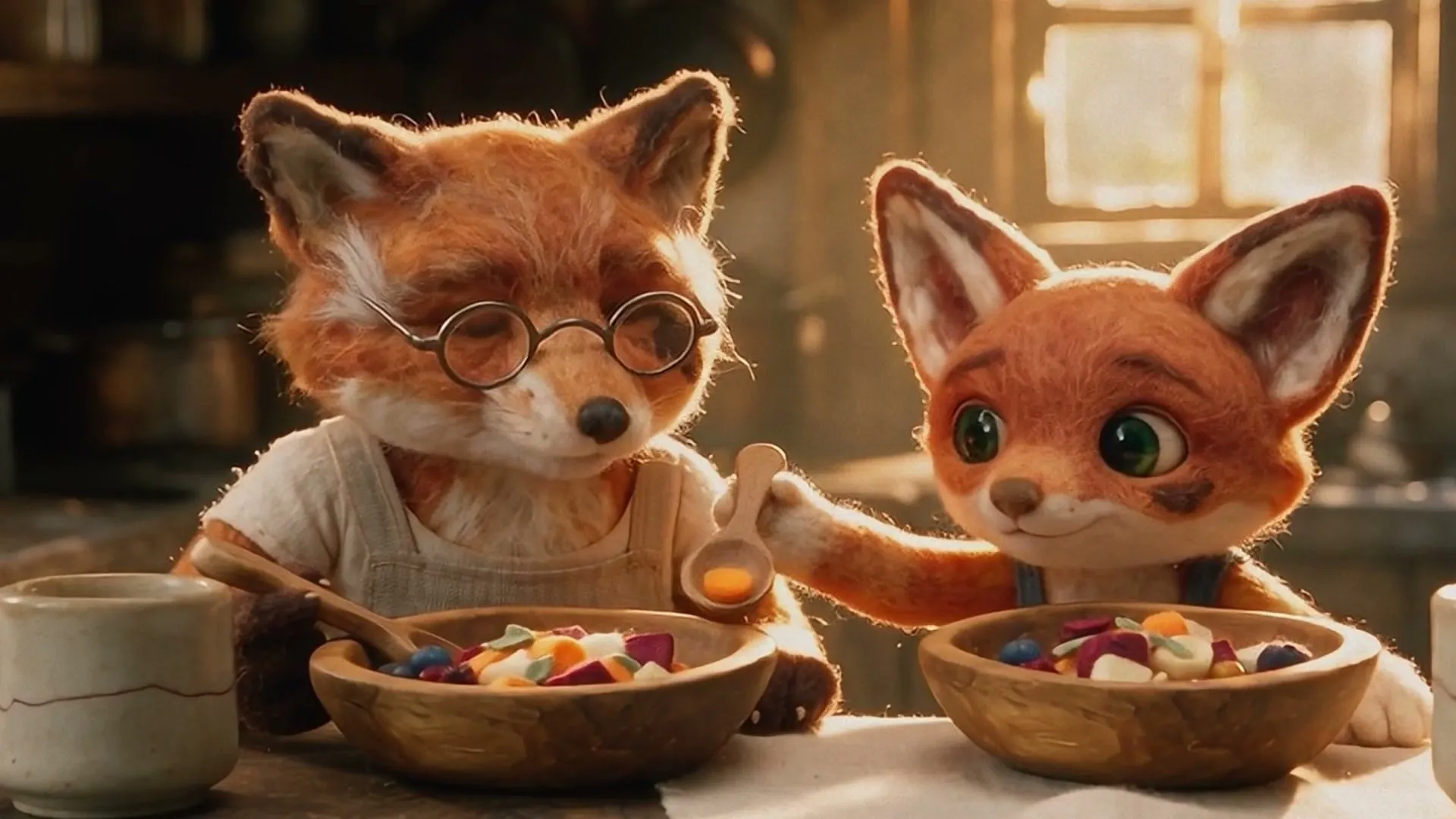
Everything in it looks handmade. The foxes are felted wool with the stray fibres catching the light, there's an older fox in round wire glasses and a knitted cardigan, and a young one in a green hooded cloak. They live in a log cottage by a lake. Breakfast is fruit in wooden bowls next to two chipped mugs. Some sequences drop to black and white, inside a rounded frame that looks like old projected film.
On October 13 he posted one scene from the film with the caption "you'll understand this scene without words."
Evgeny Stadolnik — a teaser for "THE THREAD," via Instagram (@stadolnik.studio)
He did every job on it
Stadolnik is specific about this. In the post sharing that teaser, he says he made it "on my own, from the first idea to the final edit, colour and sound design, using AI tools in production."
The same caption is where he says where the story came from: "There's so much of my own life in this film: memories of my grandmother, my family, and the things I wanted to hold on to."
When the shortlist was announced, he put the idea in one line, in his post about making the cut: "the love someone gives us can outlive them. It stays in how we care for others, and in what we pass on."
The film is for his grandmother and his son
I asked him about the grandmother in that caption. "My grandmother became a mother to me through thousands of small, everyday acts of care," he said. "Her presence, patience and attention shaped my understanding of love."
That's the relationship he gave the two foxes. "The shared meals, repaired seams and small gestures of reassurance gradually become the language of their life together." The breakfast bowls and the knitted cardigan are doing that job.
He was also preparing to become a father while he made it. He and his wife are expecting a son, and he started to see his grandmother's patience as part of "the father I hope to be." He told me making the film was "a way of facing my fear of losing the people who have always been there for me."
"The film is dedicated to both of them," he said. "The thread gives that connection a physical form: the love we receive becoming the care we give."
The generation record Higgsfield keeps
Higgsfield attaches production stats to every festival film, and THE THREAD's are public. According to the platform's record, the project ran 3,125 generations and spent 12,008.75 credits. The project file was created on August 25, and the final cut went in on September 16, the festival's submission deadline.
Most of those generations were stills. Seedream 5.0 Pro accounts for 1,694 of them, Nano Banana Pro for 983, and GPT Image 2.0 for 152, with a handful from Nano Banana 2 and GPT Image 2.5.
The video came from Seedance 2.5: 230 generations, and 8,287.5 credits, which is about 69 percent of the whole spend. Video is where the money goes on films like this; we looked at what a Seedance 2.5 shot costs when Curious Refuge published one bill.
Reading those numbers, the work looks front-loaded into the stills, roughly twelve images for every video generation. Higgsfield's stats only count what was generated inside this project, so they say nothing about anything he made elsewhere.
Stadolnik also left the project open. His prompts and his canvas are set to public on the Higgsfield page, so anyone with an account can see how individual shots were built.
Evgeny Stadolnik — a scene from "THE THREAD," via Instagram (@stadolnik.studio)
The felt fox showed up in January
In late January, Stadolnik posted a needle-felt fox to Instagram. He says Higgsfield featured it on its homepage, in the "Inspired by the Community" section.
In that January post he explains the choice: "I wanted to create a character that felt tactile" and warm in a digital world, "so I experimented with this needle-felt style." He listed the stack as Grok Imagine, Nano Banana PRO and DaVinci Resolve, and pitched the look to brands in the same caption.
I asked whether that fox is where THE THREAD started. It is. "That January fox was an experiment with a visual style I had in mind, and the first seed of THE THREAD appeared during that exploration," he told me.
The story kept growing after that, and the festival gave him a deadline. "The competition became the push to commit: I felt I had to bring this film to life." The response to the January fox helped too. People had connected with the look, and he hoped they would again "through a complete short film — this time with characters, relationships, and the ideas about care, loss and love that I wanted to explore."
Evgeny Stadolnik — the needle-felt fox featured on Higgsfield's homepage, January 2026, via Instagram (@stadolnik.studio)
Tools he credits himself
Grok Imagine · Nano Banana Pro · DaVinci Resolve
From his caption on the January needle-felt fox. His posts about THE THREAD don't name tools; the models listed earlier in this piece come from Higgsfield's production stats.
Keeping two felt foxes the right size
The visual problem he spent the most time on was scale. The older fox and the young one had to stay the same size relative to each other across every angle and every interaction. "Depending on the scene, master reference frames and character lineups helped me establish that scale," he told me.
The foxes also age, change clothes and move house over the course of the film. For that he kept "approved references for each stage of their lives" so each fox stayed recognisable from one stage to the next.
The hardest part, he said, was the acting. "Because the film has no dialogue, their acting has to speak for them." So for every scene he described to the AI what each fox was feeling, why, and how that changed during the exchange. "I tried to translate that inner experience into precise directions for micro-expressions, gaze, posture and movement."
"This often took many attempts," he said. He watched for the timing of reactions and small hesitations, and for how one fox answered the other.
No dialogue, no narration, no music
Most of the festival entries I watched fell down on voice acting. THE THREAD has no voices at all, and no score either.
"I built the soundscape around environmental ambience, material sounds, breath and silence," Stadolnik told me. "A paw touching wood or the movement of cloth helps these characters feel physically present." When that familiar soundscape changes, you feel the absence.
He shaped a lot of the feeling in the edit. "Sometimes that meant giving two characters more time to look at each other, allowing the feeling to develop before cutting away." The color follows the same moods: "Warm domestic light, cold moonlight and the changing colour of the inner thread all helped express what the characters were experiencing."
He told me he wanted to leave room for the viewer's own memories. "Deciding when to hold a moment, when to interrupt it, and when to leave silence was a large part of creating that space."
Toy commercials came first
Stadolnik's studio site describes him as a video director with "5+ years in kids & toy advertising," including work on brand campaigns for a top-three global toy manufacturer and with Stevin John, the creator of Blippi, on Born to Play. It also lists ten years of camera, light and color work outside the toy business.
His YouTube channel has the work. There's a 2021 ZZAND Kinetic Sand spot where he's credited as director, DP and colorist, all macro shots of sand being stretched and cut. And there's The Super Dough Show, a hybrid live-action, animation and 3D series for toddlers, where he was animation supervisor and post-production lead in early 2025. The credits there spell his name Eugene.
The Doughdy clips below are the early AI work from that show. The video's description says they were made "when generative AI video tools were just emerging," with new models folded into the pipeline as they appeared.
In October 2025 he posted that he was closing a five-year chapter. A few days later he wrote a longer post on what AI does in his process: "AI accelerates the process. It helps visualize what used to take months of work. But the idea, the meaning, the soul — that's always human."
His site now pitches the studio as hybrid AI films for toy and kids brands. The line he leads with there: "I don't make toy ads — I build little worlds kids want to live in."
Where the film is now
THE THREAD is on the festival shortlist. Stadolnik's own post puts it in the "Top 100" out of "67,223 entries from 176 countries"; the festival's site doesn't publish a shortlist size.
The shortlist feeds two things at once, according to the festival's rules. A jury picks the track winners and ten honorable mentions, and an Audience Choice vote, worth $100,000 and open only to paid Higgsfield subscribers, closed October 15 at 11:59 PM UTC. Winners are due in the last week of October.
If you're after more festival shorts built around one character, Robert Gaudette threw away shots where his dancer moved wrong, and he won Runway's Grand Prix doing it.
THE THREAD is streaming on Higgsfield, with Stadolnik's prompts open alongside it.