
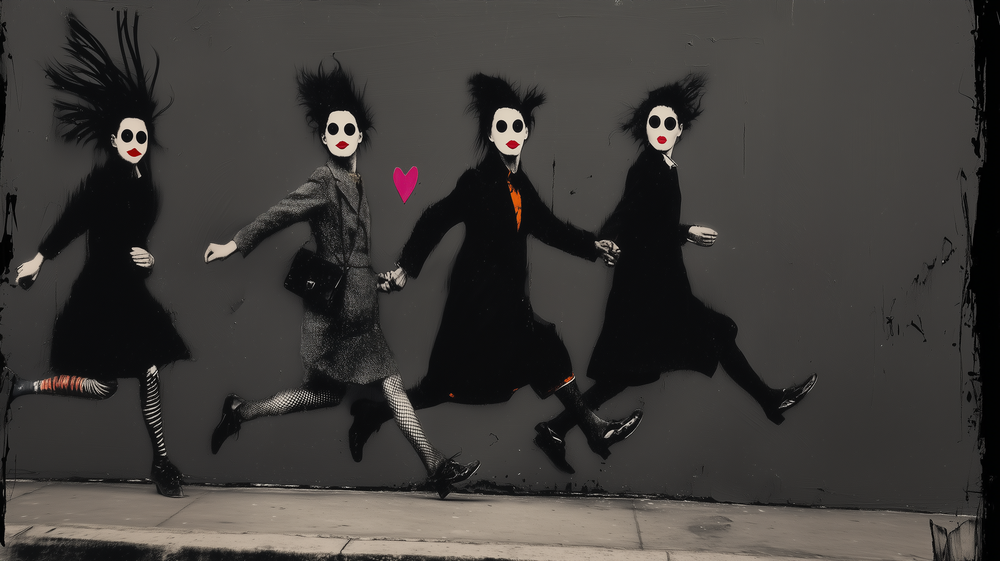
Manuela Klauser is a digital and AI artist based in Vienna who goes by sheisinblack.art on Instagram. She makes work she calls "Soft Goth Surrealism" — dark, gothic figures with an undercurrent of something almost cheerful, like Tim Burton if Tim Burton was also obsessed with contemporary fashion and wasn't precious about the medium. Her work has shown at AI Week Milano, Kunstmeile Basel, PARALLEL Vienna, and the British Art Fair at the Saatchi Gallery in London.
She has over 190,000 Instagram followers, which people will mention. It's less interesting than what she did to get there.
The tools, specifically
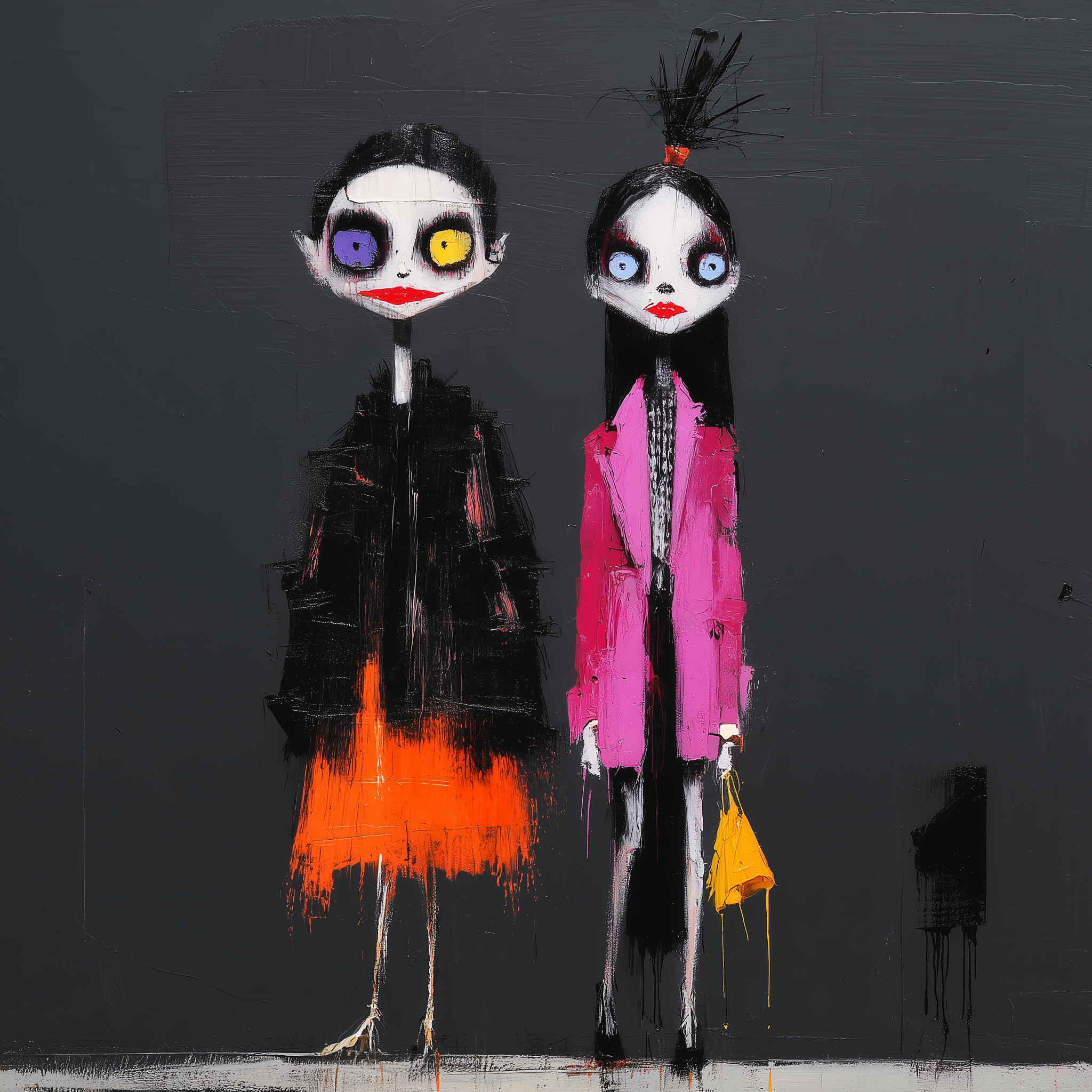
Klauser's primary tool is Midjourney. She uses Hailuo AI (MiniMax), Kling, Adobe Firefly, DALL-E 3, and Krea alongside it — for animation, video generation, and refinement — but Midjourney is where her visual language starts. Her characters have wild dark hair, white oval faces, red lips, and clothes that feel like they're from a fashion editorial that got lost in a gothic graveyard.
Every piece is recognizably hers.
That last part is the thing worth paying attention to.
How the process actually runs
The workflow is: prompting → iterative generation → curation → editing → animation when the piece calls for it. That's not unusual for AI image work. What's different is the curation step — she generates a lot and picks relentlessly, and the picking is based on a fully formed visual sensibility she had before she ever touched Midjourney.
Klauser describes AI as "creative collaboration — a system that opens new image possibilities." You'll hear variations of that from most AI artists. The interesting part, in her case, is that she already knew what "new image possibilities" meant for her before she started looking for them. The Soft Goth Surrealism aesthetic — eerie atmospheres, delicate humor, gothic figures with a pop warmth — wasn't something she discovered through generative tools. She came in with it.
I've seen a lot of AI art where you can tell someone opened Midjourney and typed "beautiful." That's how I got started too. What Klauser does is different in a way that's easy to see and harder to explain.
What the gallery wall says
The exhibitions matter because they're not Instagram metrics — they're curators deciding to put the work in a physical room alongside other things they consider art. AI Week Milano, Kunstmeile Basel, PARALLEL Vienna, and the Saatchi Gallery's British Art Fair are not doing Instagram artists a favour. They're responding to something in the work itself.
Klauser also collaborates with musicians: stage visuals, music videos, Spotify Canvas animations. The same visual language that reads well at 1080×1080 also holds up in motion and at gallery scale. That coherence doesn't happen by accident.
She runs an AI workshops and innovation consulting practice called voller ideen on the side, which makes sense. The way she talks about AI — as a creative collaborator, not a shortcut — is the kind of framing that lands in a workshop context. She's thought through what she actually believes about the medium.
The skeptic's version
The fair argument against calling this craft is that the tools are doing the heavy lifting. Midjourney generates. Klauser picks. The curation is just choosing your favourite from a grid that a model produced.
I've made that argument myself about other artists. I still half-believe it in some cases.
But it proves too much. A photographer who picks the one frame from a shoot "didn't make anything" by the same logic. The craft in both cases is in the edit — knowing what you're looking for, knowing when you've got it, and being consistent enough about it that the work is legible as yours across hundreds of pieces. Most AI-generated work is nearly anonymous. You could swap the artist and nobody would notice. That's not true of Klauser's work, and I think that gap is where the craft lives.
What I keep thinking about
Her gallery profiles at AVGD and HUG Art show pieces from the Goth Pop Rebellion series alongside older work, and you can track a visual consistency across all of it that isn't just "dark." It's a specific kind of dark — specific enough that you'd know a fake.
I don't know exactly how she built that. But I don't think the AI built it for her.