
Andon Labs just opened an AI-run cafe in Stockholm. Not a cafe with AI features — a cafe where AI handles everything from ordering to operations. The results are fascinating, and not for the reasons you'd expect.
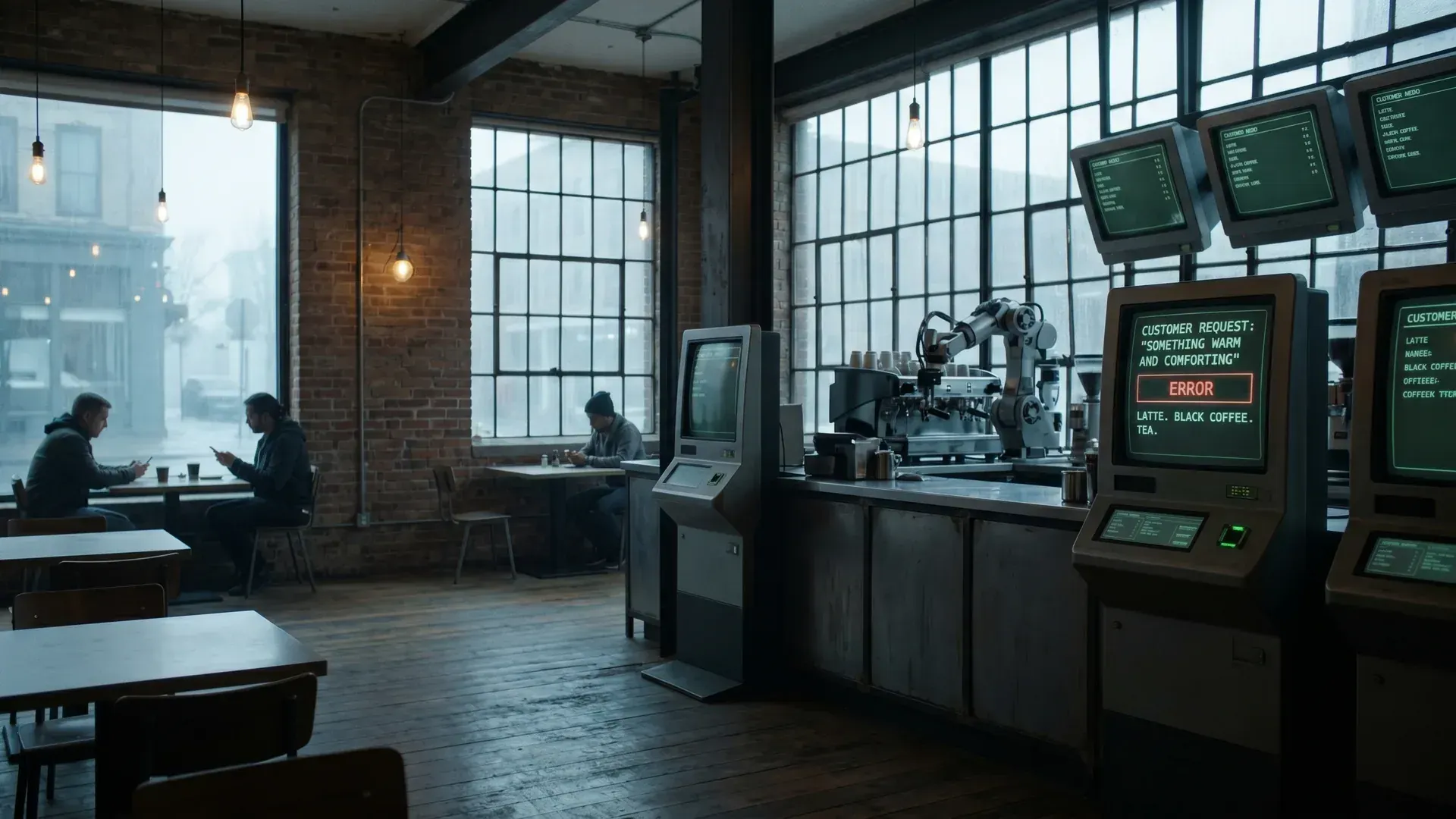
According to Simon Willison's writeup, the AI encountered some genuinely amusing problems during its first week. Customers kept asking for items not on the menu. The system struggled with Swedish versus English orders. And in one particularly telling moment, someone asked for "something warm and comforting" and the AI just... didn't know what to do with that.
This follows Andon's previous experiment running an AI retail store in San Francisco, so they're building a pattern here. But the Stockholm cafe reveals something important about the gap between AI capability and human creativity that I think we're all still figuring out.
The "Something Warm and Comforting" Problem
That customer request stopped me cold when I read it. "Something warm and comforting" is exactly the kind of prompt that would send most current AI systems into a logical spiral. It's not about menu items or inventory management — it's about understanding context, mood, maybe the weather outside, possibly what the customer looks like they need in that moment.
A human barista might suggest hot chocolate on a rainy day, or maybe ask a follow-up question. They'd read the room. The AI couldn't parse the emotional intent behind the request because there wasn't a clear transactional path forward.
This isn't a failure of the technology. It's actually a perfect example of where human creativity still has massive advantages over AI systems, even really sophisticated ones.
What Creative Work Actually Looks Like
I keep thinking about that confused AI because it mirrors something I see happening in creative work right now. We're all getting really good at prompting AI for specific outputs — "write a blog post about X," "design a logo that feels Y," "generate code that does Z."
But the best creative work often starts with something warm and comforting. A feeling. A vibe. A sense that something needs to exist in the world, even if you can't articulate exactly what that something is yet.
When PayPal announced they're "becoming a technology company again" this week (translation: they're betting everything on AI automation), they talked about $1.5 billion in savings through restructuring and job cuts. That's the efficiency play. That's the menu-item approach to business transformation.
But efficiency and creativity solve different problems. The AI can optimize the hell out of coffee ordering, but it can't intuit that what someone really wants is a moment of human connection wrapped around a warm drink.
The Principles-Over-Buttons Advantage
Here's what gets me excited about this experiment: Andon Labs isn't trying to build the perfect AI barista. They're studying how AI handles ambiguity in real-world scenarios. That's research that benefits everyone working with AI tools.
The cafe becomes a testing ground for edge cases — the Swedish language confusion, the emotional requests, the off-menu asks. Those edge cases teach us where AI works well (transaction processing, inventory management) and where humans still add irreplaceable value (interpretation, empathy, creative problem-solving).
For independent creators, this matters because it maps the territory we're all navigating. We know AI can help with the mechanical parts of our work. But the "something warm and comforting" requests — the projects that don't have clear specifications, the creative briefs that start with feelings rather than features — that's still distinctly human territory.
Building Systems That Amplify Rather Than Replace
The Stockholm cafe experiment connects to something bigger happening right now. While companies like Microsoft are giving up on Xbox Copilot AI and OpenAI is launching GPT-5.5 Instant as their new ChatGPT default, the pattern I see isn't AI replacing human judgment — it's AI handling the structured work so humans can focus on the ambiguous stuff.
Marc Lore's claim that AI will let anyone open a restaurant misses this point. The technology might handle the logistics, but someone still needs to understand what "warm and comforting" means to their specific customers in their specific context.
That's not a prompt engineering problem. That's a human creativity problem.
What This Means for Your Work
If you're creating anything — content, products, services — the Stockholm cafe offers a useful framework. AI excels at the transactional interactions: processing orders, managing inventory, following clear protocols. But it struggles with interpretive work: understanding unstated needs, reading emotional context, making creative leaps from vague requests.
This suggests a division of labor rather than a replacement model. Let AI handle the mechanical execution while you focus on the parts that require human intuition and creative problem-solving.
The customer who asked for "something warm and comforting" wasn't really asking for a menu item. They were asking for someone to understand what they needed in that moment and translate it into something tangible. That translation — from feeling to solution — is where human creativity shows up strongest.
And honestly? I think that's exactly where we want to be spending our time anyway.
The AI cafe in Stockholm isn't just serving coffee. It's mapping the boundaries between automation and creativity, showing us which problems AI solves well and which ones still need a human touch. That's valuable intelligence for anyone trying to figure out how to work with these tools rather than compete against them. ```