
Albert Barqué-Duran has spent ten years putting his own body into the loop. In 2016 he stood on the Sónar+D stage and painted, in oils, whatever a neural network handed him. In 2018 he took a band up on parabolic flights to find out what microgravity does to perception and aesthetic judgement. In 2025 he strapped sixteen electrodes to his head and let a language model finish his thoughts in front of an audience.
He performs as Albert.DATA (@albert_data on Instagram, on YouTube and on X), and keeps his own site with a page per project. By day he is a cognitive scientist, with a PhD from City St George's in London, research stints at Harvard and Oxford, and the Interactive Arts & Science Lab to run at La Salle Barcelona. That double life is what makes SYNAPTICON, the brainwave piece, worth a close look: he documented it the way a scientist documents an experiment, in a NeurIPS paper and a public GitHub repo, so the workflow can be read rather than guessed at. Almost nobody else on this site has left that kind of trail.
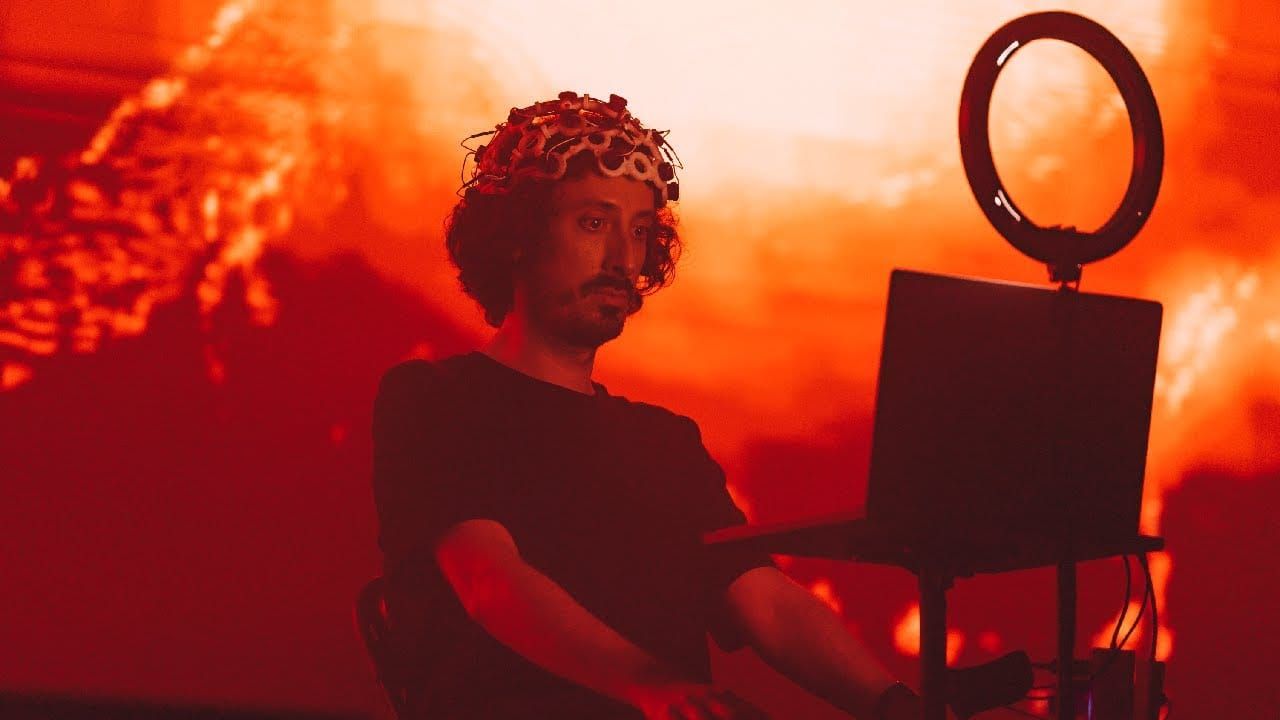
In June 2026 the piece took Best of New Media at Runway's AI Film Festival, the same edition where Robert Gaudette's A Face Only A Mother Could Love took the Grand Prix. What the jury saw was a man at a laptop in red light, a cap of white electrodes over his curls, and a wall of projection that turned over every time a new word landed on the screen.
Sixteen electrodes, a five-second window, and a BART decoder
The headset is an OpenBCI Ultracortex Mark IV with a 16-channel Cyton-Daisy board, sampling at 125 Hz. The raw signal gets band-pass filtered between 1 and 40 Hz, re-referenced and baseline corrected, and then a rolling five-second window of it goes into a bidirectional LSTM. That encoder squeezes the window down to a 768-number vector and hands it to a BART-base decoder, which finishes the vector as text the way an autocomplete finishes a sentence.
New characters or words hit the screen every few seconds. He wrote all of that up with his technical manager Ada Llauradó Crespo in a paper for the NeurIPS 2025 Creative AI track, which is where the next detail comes from.
The words never draw the pictures.
Each decoded word works as what the paper calls "a semantic index for a pre-curated library of audiovisual 'scenes'." He built those scenes in advance in TouchDesigner, and specific words are wired to specific scenes. The imagery is deliberately the geometry people report in hypnagogia and hallucination, what the neuroscience literature calls Klüver form constants: tunnels, spirals, honeycomb gratings and cobwebs, run through stroboscopic sequences.
Runway's own blurb for the win says the neural signals are "transformed into immersive audiovisual output in real time." His paper is more careful than his festival copy. Generating images live from the decoded text is listed there as "part of our crucial next steps."
"Rather than aiming for a literal reconstruction of mental imagery," he writes, "SYNAPTICON treats brain-derived text as a creative index, guiding a dynamic audiovisual environment that evolves in response to the performer's cognitive state."
Training it on his own head
The model only knows one brain. To build the training set he sat in front of a screen while sentences appeared for ten seconds each, with a two-second fixation cross between them, and the headset recorded what his cortex did while he read. Thirty sessions produced around 3,210 trials, a corpus of a few thousand EEG-and-text pairs.
The sentences are his own, and they are strange. The CSV in the repo has lines like "My bones carry hidden memories," "Yellow is the memory in my marrow," and "Audience do you feel my bones speaking?" Those are the words the decoder learns to reach for, so those are the words that end up on the screen.
The paper claims this is the first demonstration of an online imagined-speech brain-computer interface driving live artistic content. It also lays out who else was in the room: Llauradó Crespo and Ton Cortiella as technical managers, Jesús Vaquerizo on audio, Teo Rufini as an extra performer, and OpenBCI, Sónar+D and Pompeu Fabra's Center for Brain & Cognition among the partners. At MIRA Festival in Barcelona the show ran thirty minutes.
The code is on GitHub without the weights
The repo at github.com/AlbertBarqueDuran/SYNAPTICON went up in August 2025 under an MIT license. It is a lighter cousin of the stage system rather than the stage system itself, and the README says so: a four-block 1D convolutional encoder over ten-second windows, feeding a six-layer transformer decoder trained from scratch with a GPT-2 tokenizer, in place of the LSTM-plus-BART pair from the paper.
The rest of the pipeline is all there to read. BrainFlow talks to the board, PyTorch runs on Apple silicon, a Pygame script flashes the sentences word by word during data collection, and there is a synthetic-board flag so you can test the whole loop without owning a headset. Thirteen commits, all his.
Two things are deliberately missing.
The license carries a note: "This repository intentionally does not include trained model weights or EEG datasets. These artifacts involve sensitive personal data and are withheld to protect privacy and to align with the project's neuro-rights goals." The paper puts the principle in one line: "users must retain control over if and how their thoughts are decoded and used."
Ten years of putting his own head in the loop
SYNAPTICON is the sixth project on his site, and every one before it runs the same experiment on a different organ.
My Artificial Muse, from 2016, was made with Mario Klingemann and Marc Marzenit and premiered at Sónar+D that year. A neural network generated a classical-style artwork and Barqué-Duran painted it in oils, live, in front of the audience. He was an oil painter before he was any of this, and the piece went on to Google Zurich, the Daejeon Biennale and McaM Shanghai.
The Zero Gravity Band, in 2018, put him and Marzenit on a series of parabolic flights to test how perception and aesthetic judgement behave in microgravity. VESTIBULAR_1, from 2020, is a performance presented in total darkness that works on the inner ear. Slowly Fading into Data ran from 2021 to 2024 as a generative model, an 8-bit game, an album, a live A/V show and a short film, and played MUTEK Tokyo, Romaeuropa and Gray Area.
"In the last few years, I've been focused on human-machine interactions during artistic and creative processes," he told Clot Mag in 2022. "It's been very enriching to realise how malleable my self-perception as an artist can be (for the good and for the bad), depending on the context and scenario."
Years earlier he had told the SciArt Initiative that he understood the creative process "as a loop rather than a line; with no beginning and ending points." SYNAPTICON is that sentence built as hardware.
Where it has played
SYNAPTICON premiered at Sónar+D in Barcelona on 14 June 2025. Sónar's programme described it as a performance "that uses brain-computer interfaces to expose his thoughts and emotions to the audience in real-time." It went to MIRA in November, the same month RNE named him the first winner of El Ojo Crítico's new digital-innovation category, and then to NeurIPS in San Diego in December as a poster and a paper.
Then Runway in June 2026, Nu Festival in Tokyo, SPECTRA and SIGGRAPH in Los Angeles, Gray Area in San Francisco in July, and the Ars Electronica Expanded Conference in Linz on 10 September, where he presented it with Llauradó Crespo in the Embodiment track.
When La Salle announced the Runway win, his thanks went to his team and "to all those working at the intersection of art, science, and technology, who continue to defend the idea that culture is not merely an ornament of progress."
The stack, as he credits it in the paper and the repo
- OpenBCI Ultracortex Mark IV headset with the 16-channel Cyton-Daisy board
- BrainFlow to read the board
- PyTorch for the encoder, on Apple silicon
- BART-base via Hugging Face as the text decoder on stage
- TouchDesigner for the scene library the words trigger
Where to go next
If the idea of an artist training a model on their own body is the thread, Sougwen Chung's twenty years of her own drawings is the drawing version, down to the brainwave input she added at Art Basel Hong Kong. Holly Herndon's voice model is the audio version, and she made the opposite call on the weights.
The paper ends with three next steps in his words: a proper evaluation of the decoder, "practical neurorights-by-design patterns" such as on-device processing and consent switches, and generating the visuals live from the text instead of triggering scenes he built ahead of time. The last commit to the repo is from December 2025, and the weights are still with him.