
Scroll through AI art long enough and the patterns become familiar: photorealistic faces, cinematic landscapes, fever-dream composites. daejin.creates is doing something different. The Korean artist describes their practice as "Design × Psychology × AI" — and that framing, design as the method and psychology as the material, isn't how most AI artists talk about what they're doing.
They work across Instagram and Threads, and lately the work is as much AI video as it is still image — short, quiet motion pieces built with tools like Dreamina and Seedance, often starting from a frame composed in Midjourney. The output feels less like a demonstration of what a model can do and more like an ongoing inquiry into interiority — how we carry emotion, how identity shifts, what happens in the space between a feeling and a form.
Design × Psychology × AI
The framework is precise even if the images are open. Design provides the structure — intentional composition, a sense of craft in how each piece is built. Psychology provides the subject matter — the inner life, the nonlinear experience of being a person. AI gives daejin a way to picture things that resist ordinary images: a state of mind that doesn't have a visual precedent, a mood that evaporates the moment you try to describe it directly.
You can feel that intent in a single frame. One recent piece sets a figure in headphones inside a swirling tunnel of light and reflection, under a line the artist wrote: "When the world's noise fades, my own voice becomes clear." It's a picture of a feeling most people only have words for — and a lot of AI artists lead with the tool instead, what it can do, how far they pushed it. daejin.creates seems more interested in the question the tool is being used to ask.
From a Still to a Moving Image
You can usually reconstruct daejin's process from the posts themselves. The still comes first — composed in Midjourney, where the framing, palette, and mood get locked. Then the image is set in motion with an AI video tool, most often Dreamina or Seedance, turning a fixed portrait into a few seconds of drifting, breathing footage. A recent piece all but named the effect — "The Traveler of Afterimages" — a title that doubles as a description of the method: an image that keeps moving after you'd expect it to stop.
That two-step is where the design in "Design × Psychology × AI" shows up. The motion is never busy. A figure holds still while the world behind them turns; light shifts across a face; a scene settles rather than performs. In a medium that mostly rewards spectacle, the restraint is the craft.
Tradition as a Living Algorithm
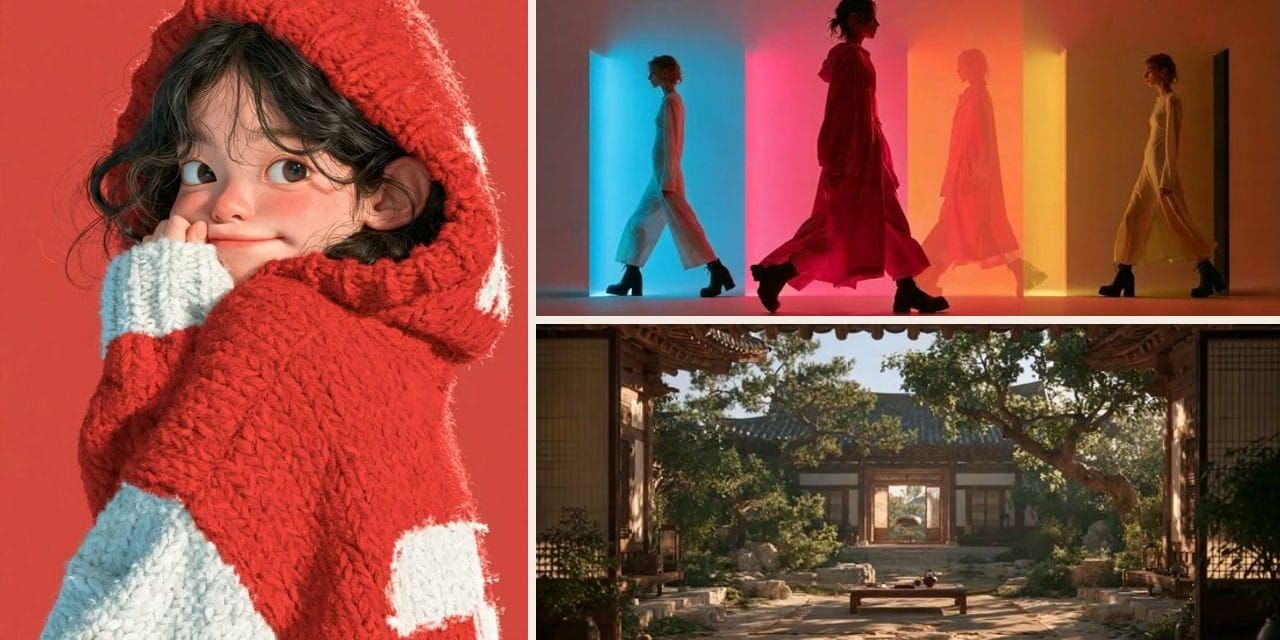
Some of the strongest recent work reaches back into Korean visual tradition and runs it forward through the tools. One piece pairs Dancheong — the intricate, saturated color-work that decorates Korean temples and palaces — with the image of a double helix, under a line the artist wrote plainly: if DNA remembers life, Dancheong remembers culture. The idea underneath it is that tradition isn't a relic to keep behind glass but, in their words, "a living algorithm that continues to evolve." The same instinct shows up quieter elsewhere — a sunlit hanok courtyard, a red-hooded figure lost in thought — heritage and interiority folded into the same frame.
Part of a Real Creative Community
daejin.creates is a member of the Korean AI Creators Association — a community organized around the serious practice of AI art. That context matters. This isn't an artist working in isolation; it's someone embedded in ongoing conversations about what AI art can actually be when the person making it has a perspective to start with. It also shows up in the sheer steadiness of the output: this is a working practice, not a one-off experiment.
Follow the work at daejin.creates on Instagram and on Threads.