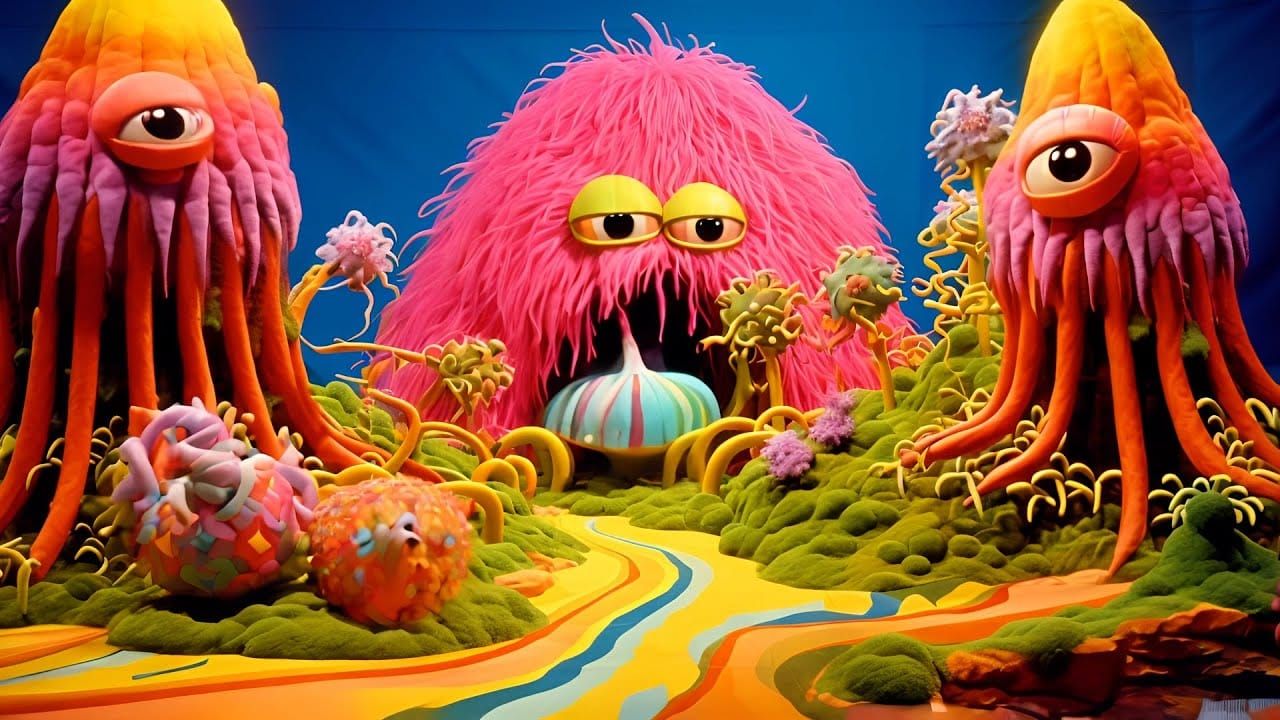

A GEDDYRUXPIN film looks like something that shouldn't have survived. Mid-century television, colors pushed a shade too far, the tape warped somewhere between then and now. Alien henchmen in business suits. A cereal commercial for a product nobody ever ate. A puppet segment that seems to have aired once, very late, and then stopped being mentioned by anyone.
Most of them run under a minute. All of them are built to feel found rather than made.
The signature series is The Glunkies — those henchmen, recurring, always in the suits, always mid-errand in somebody else's sci-fi plot. Around it sit horror trailers cut like 1966 TV promos and psychedelic puppet clips that look like they came off a water-damaged tape someone pulled out of a garage. One world, consistent rules, and every rule borrowed from a narrow corner of American television.
Nobody knows who makes it. The films go out as GEDDYRUXPIN, the project is called Stressed Quest, and no verified name is attached to either. That's worth sitting with rather than solving. The work presents itself as an artifact — something found, not authored — and artifacts don't come with a byline. The anonymity is doing the same job as the film grain.
GEDDYRUXPIN — "I dream of glunkies," via YouTube (@StressedQuest)
Why the Era Does the Work
Picking 1963 buys a lot. Film stock that already degrades, color that was never accurate to begin with, broadcast standards nobody alive remembers well enough to fact-check. It's a period the audience recognizes without being able to check the receipts — close enough to familiar that the eye relaxes, far enough back that anything strange reads as a quirk of the format.
Then the characters morph. Faces shift between cuts, proportions slide, a body reorganizes itself while the scene keeps playing like nothing happened. None of that was physically possible on a soundstage in 1963, which is exactly why it registers. The frame promises an old artifact and the motion breaks the promise.
The films look precisely as wrong as they're supposed to look. That slippage is the material.
Working With the Weirdness Instead of Around It
Most people using these tools spend their effort steering away from what the model does badly. The morphing hands, the faces that won't hold still, the physics that slides halfway through a shot — prompt it away, crop it out, regenerate until the thing behaves. The goal is to get the AI to stop looking like AI.
GEDDYRUXPIN is doing the opposite, and they're not the first to figure out it pays. Voidstomper built one of the largest audiences in AI-native art by hunting for the exact places where the model breaks down and building an entire horror aesthetic out of the breakage. Same bet, different register: Voidstomper aims the wrongness at nightmare fuel, GEDDYRUXPIN aims it at 1963 television.
There's a practical logic to it. A face that morphs mid-sentence is a failure if you're making a car commercial. It's an asset if you're making something that's supposed to feel like a degraded tape of a puppet show nobody remembers airing. The limitation stops being a limitation once the thing you're making has room for it.
What I Like About It
I found GEDDYRUXPIN doomscrolling Instagram after a few edibles. Incredible experience. I've lost plenty of evenings to that feed and gotten nothing back — this one I'd do again.
What hooks me is how the scenes are built. It opens on something completely ordinary. People in a diner, eating, talking, nothing happening. Then a robot comes through the front door and destroys everything. The surreal part doesn't get its own separate world to live in — it crashes into a normal one, and the normal one keeps behaving like it's still a normal one.
GEDDYRUXPIN — the diner, via Instagram (@geddyruxpin)
That contrast is doing the work. If the whole video were chaos, it'd be noise, and there's already plenty of that. The diner has to be believable first. It's a setup-and-payoff structure, and it's the kind of thing you can only pull off if you're actually thinking about the shot rather than just generating until something cool falls out.
The Tools They Credit
GEDDYRUXPIN tags their posts with #sora2pro — pointing to OpenAI's Sora as the primary generation tool. Kling shows up in the tags too. The Stressed Quest print shop sells the imagery as physical prints, so the stills exist as objects outside the films.
No formal process interview has surfaced publicly. What's visible is consistent: a recurring universe (The Glunkies), regular releases inside it, and a body of work where the same instability shows up on purpose every time.
GEDDYRUXPIN — "Night of the Atomic Neon Goblin," via YouTube (@StressedQuest)
A Music Video on Sub Pop Records
In 2024, GEDDYRUXPIN animated the official music video for J Mascis's "Old Friends" on Sub Pop Records. Kirby Ferguson — filmmaker behind Everything Is a Remix — publicly credited GEDDYRUXPIN for the animation.
J Mascis is a Dinosaur Jr. institution. Sub Pop is Sub Pop. Ferguson has a real following in creative-process circles and tends to be careful about who he credits. An anonymous AI video artist getting a verified attribution in that chain, within a couple years of these video tools existing — that's a concrete thing to point at.
GEDDYRUXPIN — animation for J Mascis "Old Friends" (Sub Pop Records, 2024)
The Name and the Project
The original Teddy Ruxpin was a cassette-powered animatronic bear — pre-programmed stories on a tape, a mouth and eyes moving in sync, the performance slightly mechanized. GEDDYRUXPIN is working in that territory: characters that move like they're running on something you can't see, programmed, slightly off, close enough to familiar that the wrongness registers.
Looper covered their work in a piece on "the most horrifying AI kids' puppet show" — accurate description, undersells the craft. The horror isn't accidental.
The Glunkies keep coming. The Instagram and YouTube channel are the places to watch it develop.
Tools GEDDYRUXPIN credits themselves
- Sora (OpenAI) — primary video generation tool, tagged consistently as
#sora2pro - Kling — appears in post tags alongside Sora