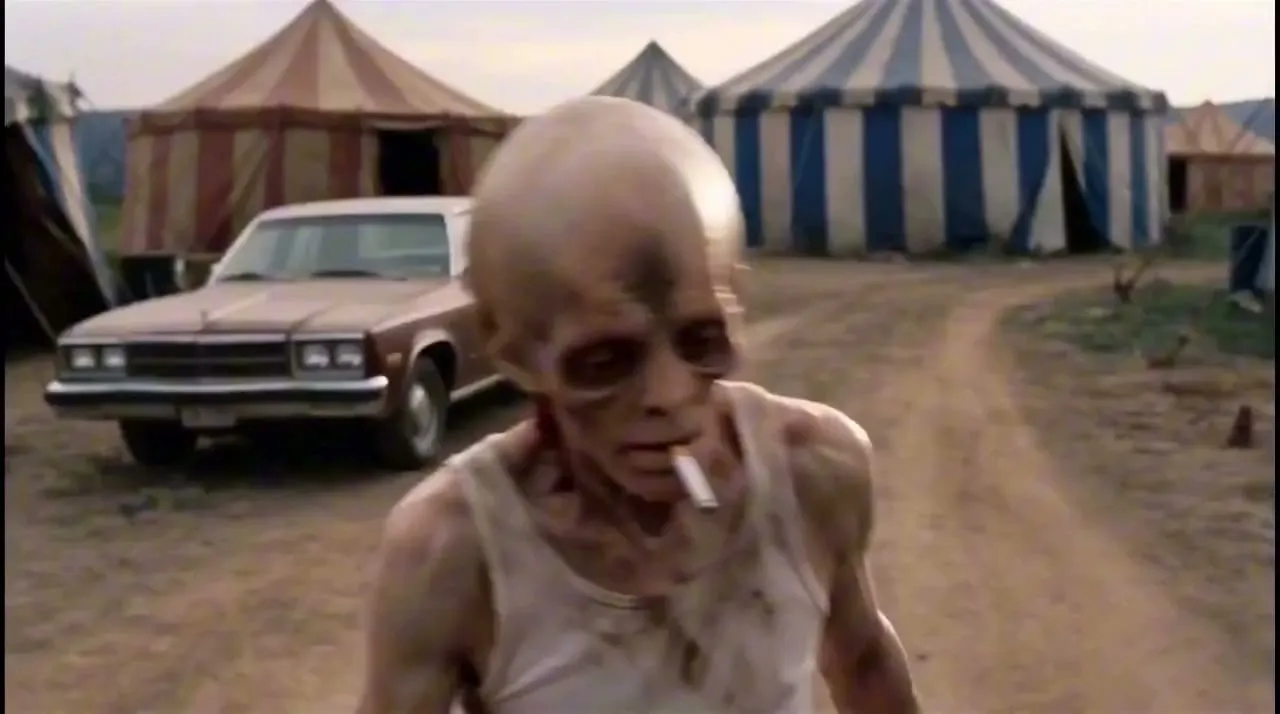

A man walks down the middle of a dirt midway with a cigarette hanging off his lip. Striped tents on both sides, a brown station wagon parked in the weeds, hard noon light on everything. His head is too large and his skin looks like it has been left outside for a season. The camera holds on him a beat longer than is comfortable, and then a clown steps into frame and sticks out his tongue.
That's about ninety seconds into a two-and-a-half-minute short that GOAT CIGS posted to Instagram, titled — their word, not ours — "DICKHEAD." It plays like a carnival sideshow shot in 1978 and left in a hot car since. The account it lives on is filed under three words: sci-fi, horror, comedy. All three are doing work in that clip.
The range is wider than the horror tag suggests
Scroll the account and the carnival grotesque is only one setting. Another post is two teenagers sitting on a suburban curb in the middle of a dead-grass summer, one of them in a "LOST BOYS" t-shirt, brick ranch house behind them, nothing happening at all. It is a completely different film — patient, sunlit, nostalgic — and it is recognisably the same hand. The light does most of the acting in both.
A third post drops the people entirely: a dead forest in fog, bare branches crossing each other, moss on the trunks, birds somewhere off frame. No character, no cut, no joke. It sits on the feed between the clowns and the kids like a held breath.
They keep the AI work in a separate room from the art
GOAT CIGS has published very little about method, but the one statement they have put out is specific and worth reading closely. On their artist page at de-generated — the site linked from their Instagram bio — they describe themselves as "a character design obsessed author/illustrator" and say they "knew immediately that I wanted to separate my physical art from anything I created with this new technology."
The account itself is the separation. They started it, in their words, "to showcase the work I've been doing with ai," and it "has really allowed me to dive deep into some of the worlds I would like to write about." So the films are not the end product. They are a way of seeing a place before writing it down — concept art that happens to move.
That reframes what you are looking at on the grid. The carnival is not a bit; it is a location scout for a book that may not exist yet. The two kids on the curb are a scene someone is planning to write. Character design obsessed is a fair self-description — the sideshow man's face gets more screen time than any event in the film.
The same statement carries an unusual line: they name the tools they do not use. "(I do not use midjourney, bing, leonardo, stable diffusion, or dalle)." That is a strange thing to volunteer, and it is the most process-revealing sentence they have published. Most creators list what they run. Listing the exclusions tells you the choice of stack was deliberate enough to be worth defending.
What they do credit
Tools goatcigs tags in their own Instagram bio
- Darkframe AI — a horror-focused generation platform
- Kinovi — co-credited on the carnival short above, which is posted as a collaboration
- Magnific
And, in their own words, the ones they don't use: Midjourney, Bing, Leonardo, Stable Diffusion, DALL·E.
Worth being straight about the limits here: the bio tags those three accounts, and one of the films is posted as a collaboration with kinovi.ai. Neither of those is a breakdown of how a shot gets made. goatcigs has not published a workflow, and we are not going to invent one for them.
The pre-AI craft is the part they keep
The detail that explains the work is the one in the first line of their statement: author and illustrator, before any of this. Someone who has drawn characters by hand for years has already solved the thing most AI film struggles with — knowing what a face needs to look like before asking for it. The sideshow man reads as designed rather than generated, and the eighties kids read as cast.
If that combination interests you, two others in the library work the same seam from different directions: Kavan the Kid builds his masks physically before an AI ever sees them, and GEDDYRUXPIN makes period shorts that pass as archive footage.
goatcigs is still posting, still mostly wordless about how, and the worlds they said they wanted to write about are accumulating on the grid one film at a time.