Hisko Hulsing is a Dutch painter who makes animated films. Throughout his career he has spent one day a week storyboarding ads to pay for the other six, which go into his own films. Those films have always started as oil paintings, done in a classical style he learned by studying 17th-century Dutch painters.
His new short, Danse Macabre, took 11 years and about 75 of those paintings. It's also one of the most openly documented hybrid productions around. Hulsing posted the whole pipeline on his YouTube channel, step by step, including the narrow part where AI comes in: tools trained on his own paintings gave the 3D animation his brushwork, and then he fixed the results by hand, frame by frame.
A painter who animates
Hulsing was born in Amsterdam, and his films live on his own site next to his paintings, comics and music. The best-known one from before the AI era is Junkyard, an 18-minute short about a man who, while dying after a robbery on a metro train, remembers a friendship from his youth. According to the film's Vimeo credits, he wrote and directed it, did the oil paintings, shared the 2D animation, and composed the music. It won the Grand Prize at the Ottawa International Animation Festival, and it's free to watch online.
After that came bigger studio work. As Cartoon Brew reported in June, he directed both seasons of Amazon's Undone, which won Annecy's Jury Award in 2020, directed "A Dream of a Thousand Cats" for Netflix's The Sandman, and made the animated sequences for the Kurt Cobain documentary Montage of Heck. He told Cartoon Brew he got close to the look of his paintings on Undone and The Sandman, but the tools to fully match them weren't there yet.
It started with a piece of music
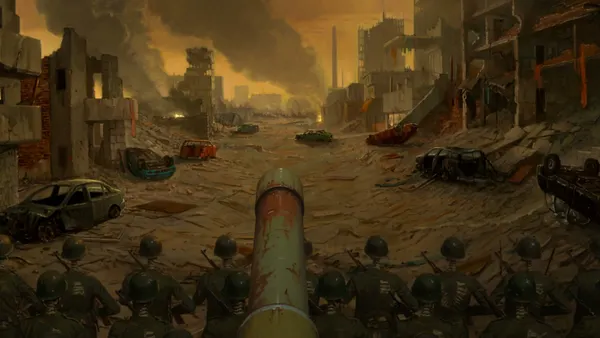
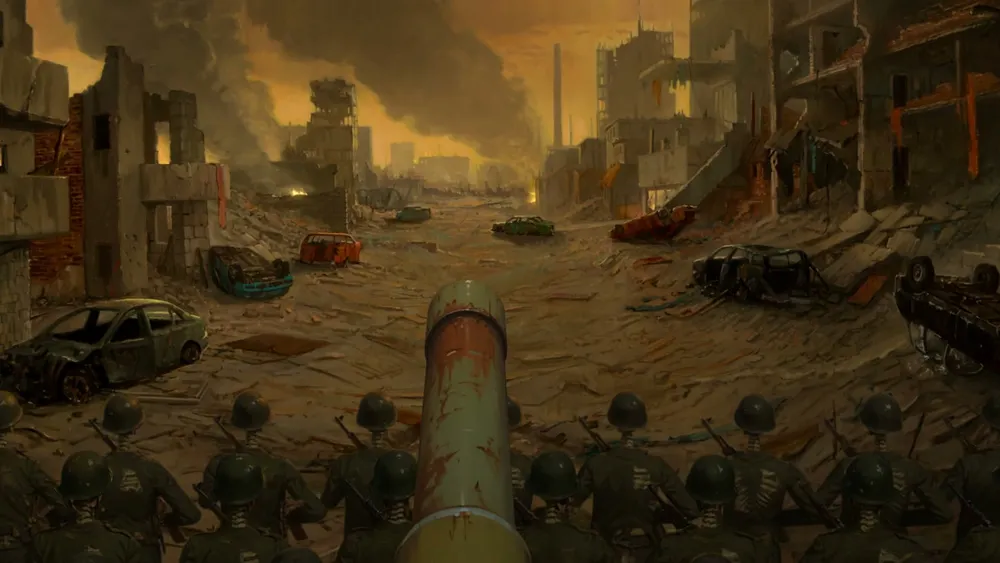
Danse Macabre is about five minutes long and set to the second movement of Shostakovich's Tenth Symphony. An army of skeleton soldiers starts in an orderly march and ends in total destruction. Hulsing began it after Russia invaded Crimea, when Putin's expansion and the rehabilitation of figures like Stalin looked to him like "a resurrection of fascism," as he put it in a Q&A with Cartoon Brew this month.
There was never a script. "I didn't have a script," he told Cartoon Brew in June. "The storyboard was the script."
He built that storyboard by listening to the piece over and over. "Every day I was listening to the music, coming up with images that were inspired by the music, and then developing my ideas for the film," he said. The drawings were so detailed that, in his long making-of video, he says he could only finish two a day.
One oil painting for every shot
Once the moving storyboard worked, he started painting. "I made one oil painting per shot," he says in the long making-of. He painted the characters into each painting too, which he calls unusual, then photographed the canvas and took the characters out in Photoshop so it could serve as a clean background.
He sticks with real paint because "it feels more organic," he says in the same video. "It's less synthetic, less sterile." The paintings are also meant to stand on their own: Danse Macabre will tour as an exhibition and play with live orchestras.
One painting from the film took about 50 hours. He filmed it as a timelapse while he was artist in residence at the Museums Quartier in Vienna in 2025, and scored the clip with music he wrote for Junkyard.
Actors on a green screen, skeletons in Blender
Before any animation, the team filmed every shot with actors and musicians as reference. "We shot the whole film on a green-screen stage with actors and musicians," he told Cartoon Brew. None of that footage is in the film, and there's no rotoscoping (tracing over live footage). It was there so the animators could see real movement. He wanted the skeletons to move "like real soldiers and not like cartoony soldiers," he says in the making-of, and he cast players who could really play their instruments, including his son on violin.
The animation was split across four countries. Studios in France and on La Réunion animated the skeletons, tanks and horses in Blender, a free 3D program. A Hungarian studio animated the angel-like muses and the cloth, and an artist in the Netherlands made the fire, smoke and collapsing buildings in Houdini, a 3D effects program. In the Q&A, Hulsing says eighty people from six studios worked on it.
Where the AI comes in
The 3D animation looked good, but it didn't match the paintings. In the making-of, Hulsing calls it "too realistic and too synthetic and sterile to fit with my paintings."
So about two and a half years ago the team tried building their own shaders, the part of the software that decides what a surface looks like, with machine learning. They trained a model on "hundreds of my paintings," he says. Then they fed maps from the 3D renders (depth, surface direction and outlines) into ControlNet, which steers an image model to keep the shape of what it's given. The texture itself came from Stable Diffusion and AnimateDiff, run in ComfyUI, an open-source tool where you wire those models together.
It didn't work right away. Compositing supervisor Stijn Calis told Digital Production that Stable Diffusion could paint the texture quickly but had a poor memory from one frame to the next, so the brushwork boiled as a character moved. Working in short chunks helped. The team kept adjusting the setup for two years. "We kept programming and programming throughout two years until we had something that looked like my paintings," Hulsing told Cartoon Brew.
Then came the hand work. The results "were beautiful and painterly, but full of errors," he says in the making-of, so he went through them frame by frame in TVPaint, a 2D animation program, "being my own intern, so to speak." Calis then put the shots together in Fusion. On one, he graded the skeleton against the original painting until he could no longer tell which version was rendered.
Tools he credits himself
From the tool list in his own making-of video descriptions.
- Oil paint on panel and canvas, pencil on paper
- Blender, Houdini and ZBrush for 3D
- TVPaint for 2D animation and retouching
- ComfyUI with Stable Diffusion, AnimateDiff and ControlNet for the painted texture
- DaVinci Fusion and DaVinci Resolve for compositing and finishing
- Photoshop, After Effects, Premiere and Pro Tools
The premiere at Annecy
Danse Macabre premiered in competition at Annecy in June. Hulsing told Cartoon Brew that about 100 people walked out before it started, many wearing matching anti-generative-AI stickers, and a group that stayed began booing. Annecy's artistic director, Marcel Jean, put out a statement saying he could not condone "a witch hunt targeting the work of artists who explore the possibilities of these new tools with transparency."
Hulsing told Cartoon Brew he gets where the protest comes from. "I understand what they're scared of. I lost my storyboard job," he said. That was the one-day-a-week job that paid for his films.
What bothered him was that the argument swallowed the film. "The sad thing about this whole thing is that nobody talks about the content of the film," he said.
The debate kept going after the festival. In a Cartoon Brew piece on Nov 20, Manchester Animation Festival announced it will refuse films made with generative AI starting in 2027, and the article walks through Danse Macabre as one of the films at the center of that debate.
What's next for Danse Macabre
The film has since qualified for the 2027 Oscars through a theatrical run, Cartoon Brew reports. The finished film isn't on his channel yet. What he's posted there are the trailers and the making-of videos.
The paintings have their own plans. Hulsing says Danse Macabre will also be a traveling exhibition of the oil paintings and a series of screenings with live orchestral performances of the Shostakovich.