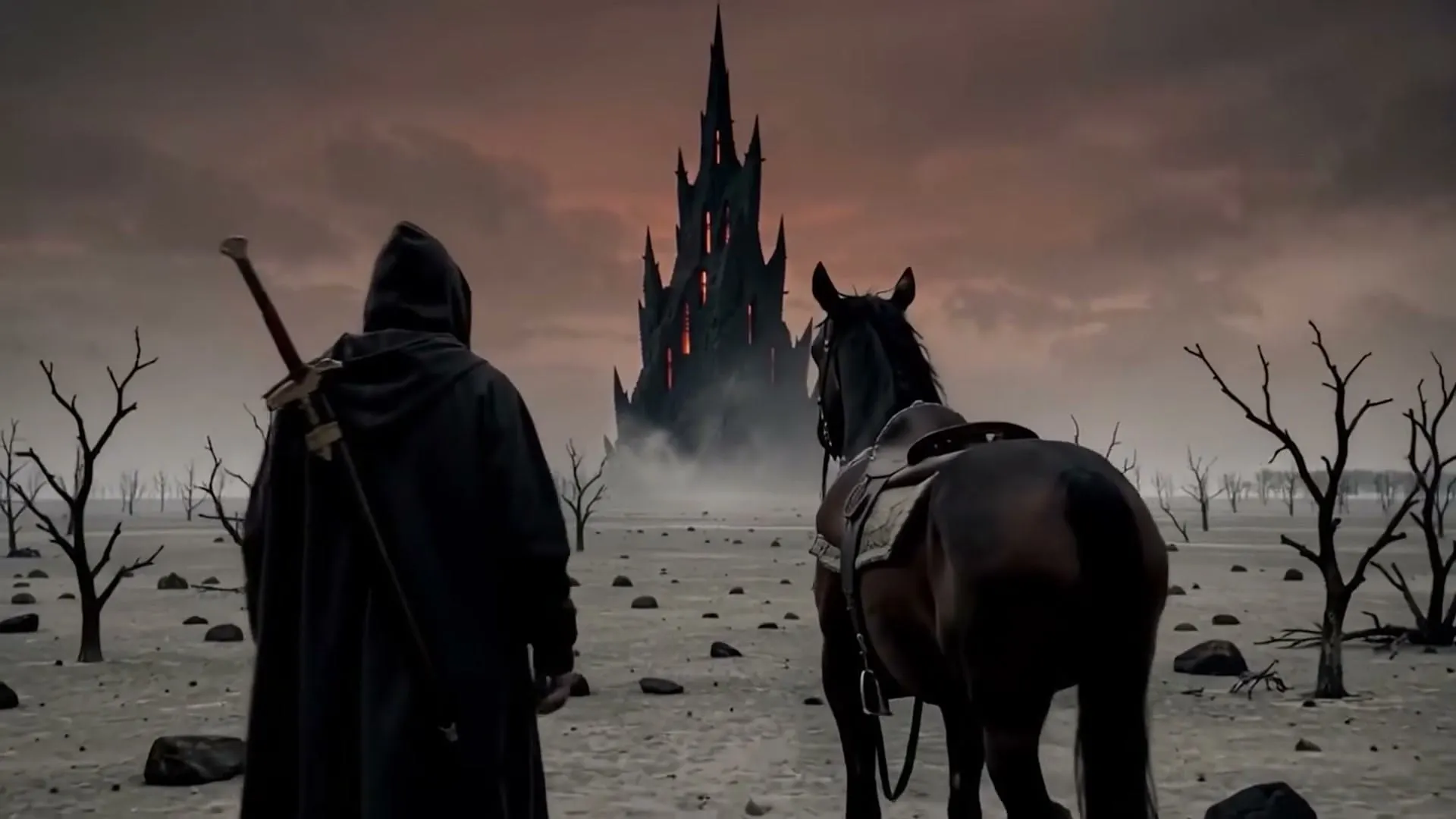

A hooded figure stands on a plain of grey ash, a sword slung across their back, facing a black spired castle with fire glowing in the windows. Dead trees, an orange sky, a horse waiting at their shoulder. The shot holds for a few seconds and cuts — a woman in a wide-brimmed hat outside a stone cottage, a man at a lectern with an enormous insect chalked across the blackboard behind him, a rider crossing a treeline at dusk.
It looks like the trailer for a fantasy film. It is the demo reel for a ComfyUI workflow, and it comes with a download link.
That is the shape of nearly everything on the Mickmumpitz channel: make a real piece of film, then hand over the machine that made it. The channel describes itself as being "all about understanding new technologies from the worlds of digital art, film, and games in a playful and project-oriented way," which undersells the engineering a little. Most videos ship with a free ComfyUI workflow, an installation guide, and a set of example files.
Modular filmmaking
The fantasy trailer comes from a May 2026 video built around LTX 2.3 and Flux 2 Klein. You give the workflow character references, set references, a voice sample and a prompt; it generates a start frame, turns that into a video with lip-synced dialogue, and moves to the next shot.
The design goal is stated plainly in the video description. "Nothing is baked in. Every shot is built from swappable references, which means you can rewrite a character, relocate a scene, or recast the lead at any point — for the cost of regenerating one shot."
Mickmumpitz named the approach: "I call this approach modular filmmaking, and this is the first workflow that actually makes it possible on a single consumer GPU."
The demo ends by swapping the protagonist's reference images and letting the whole trailer rebuild around a new lead. Custom nodes handle the plumbing — a shot duplicator, a shot-order node, a final assembler — and those are published too, in a public repository of custom nodes.
Rebuilding somebody else's research as nodes
The August 2026 video turns one 360-degree panorama into an explorable 3D scene, and the work behind it was mostly evaluation. Apple's SHARP, Insta360's UniSHARP, Tencent's HY-World 2.0 and NVIDIA's Lyra all got tested and set aside. Matrix-3D won, and then got rebuilt from scratch as custom ComfyUI nodes.
The resulting pack, ComfyUI-SplatKit on GitHub, explains the core problem in two sentences. "One panorama is a single viewpoint, and one viewpoint cannot constrain a 3D scene. So the pack invents the missing viewpoints, then reconstructs a real camera solution from them."
In practice you pilot a virtual 360-degree drone through the scene to draw the exact path the model should invent along, and Wan fills in everything the original photo never saw — including rooms on the other side of a wall. The output is a standard COLMAP dataset, so it trains in whatever Gaussian Splatting trainer you already use. That detail is the tell: the pack deliberately stops short of doing the last step for you.
A motel run by bears
The June 2026 render-engine video needed something to render, so the pipeline got pointed at a fake commercial for a budget motel staffed by a family of bears. It is called Bear Minimum, and the finished shots are warm interiors — a lamplit tavern with a hand-painted sign, a four-poster bed, an adventurer in a knit cap.
The method is the part being demonstrated. You rough a scene out in Blender, guide the look with a few reference images, and the AI renders the final shot with lighting and effects; lip sync and facial animation come from an audio file. The video walks through generating the environments and characters from prompts, rigging them, exporting depth and outline passes, building a reference frame in FLUX, running the LTX-2.3 render, and upscaling to 4K.
All of it runs locally on open-weight models. That video was a paid partnership with NVIDIA and was tested on an RTX 5090, which is disclosed at the top of the description.
The cast problem, solved with training data
The other long-running thread on the channel is character consistency, and it has been iterated on for two years. An October 2025 masterclass takes a single input image, generates a training dataset from it with captions, trains a custom LoRA, and then uses a "Consistent Character Creator" workflow to transfer poses, swap outfits and drop the character into any scene.
By July 2026 the same problem had a different answer: build a whole cast into one LoRA without the characters bleeding into each other, then place them in a shared frame with bounding boxes. The dataset gets auto-captioned by a local vision model, and there is a reviewer step where you fix the captions and boxes by hand before training.
That manual review step keeps showing up. The workflows automate the grinding parts and then stop and ask.
It started with a short film that went sideways
The channel opened in February 2021, and the earliest uploads are not tutorials at all. "I asked an AI to animate a short film and it got weird." Then "How I generated a full CG Short Film with AI." Then, a while later, "I re-rendered my AI-generated CG short film in Stable Diffusion."
Read down the list in order and you can watch a filmmaker turn into a pipeline engineer. The 2023 and 2024 videos are Blender plus Stable Diffusion experiments — 3D sets, set extensions, turning storyboard sketches into moving shots, an AI-generated Planet Earth that came out cursed. From 2025 onward the titles change register, toward render engines, masterclasses and node packs, and the word FREE starts appearing in most of them.
The GitHub account only dates to July 2025, which lines up with when the tooling got serious enough to need version control.
Tools Mickmumpitz credits directly
ComfyUI · Blender · LTX-2.3 · Flux 2 Klein · Wan 2.1 / 2.2 · Ideogram 4 · Krea 2 · RunPod
Named in the tool lists and descriptions on the videos cited here.
Where to go next
If character consistency is the thread you want to pull, how Delphi Motion Pictures keeps the same face across a film is the narrative version of the same problem — a filmmaker solving it for one story rather than packaging it for everyone. And the way Minuit assembles a single fantasy reel out of five AI tools is a useful contrast: a stack chosen per shot, against Mickmumpitz's habit of pulling everything into one local graph.
The most recent workflow renders a 3D scene straight from a Blender viewport playblast, with sound generated for the shot at the same time — dialogue included. It arrived with a free version, an advanced version, and an installation guide, same as the rest.