I watched the entries to Higgsfield's Global Film Festival in September, and a lot of the scenes that fell apart fell apart the same way: a generated person delivering a generated voice, and the voice giving it away. Adrian Brück, who posts as odngr on Higgsfield, made one of the few films I watched that mostly avoids the problem.
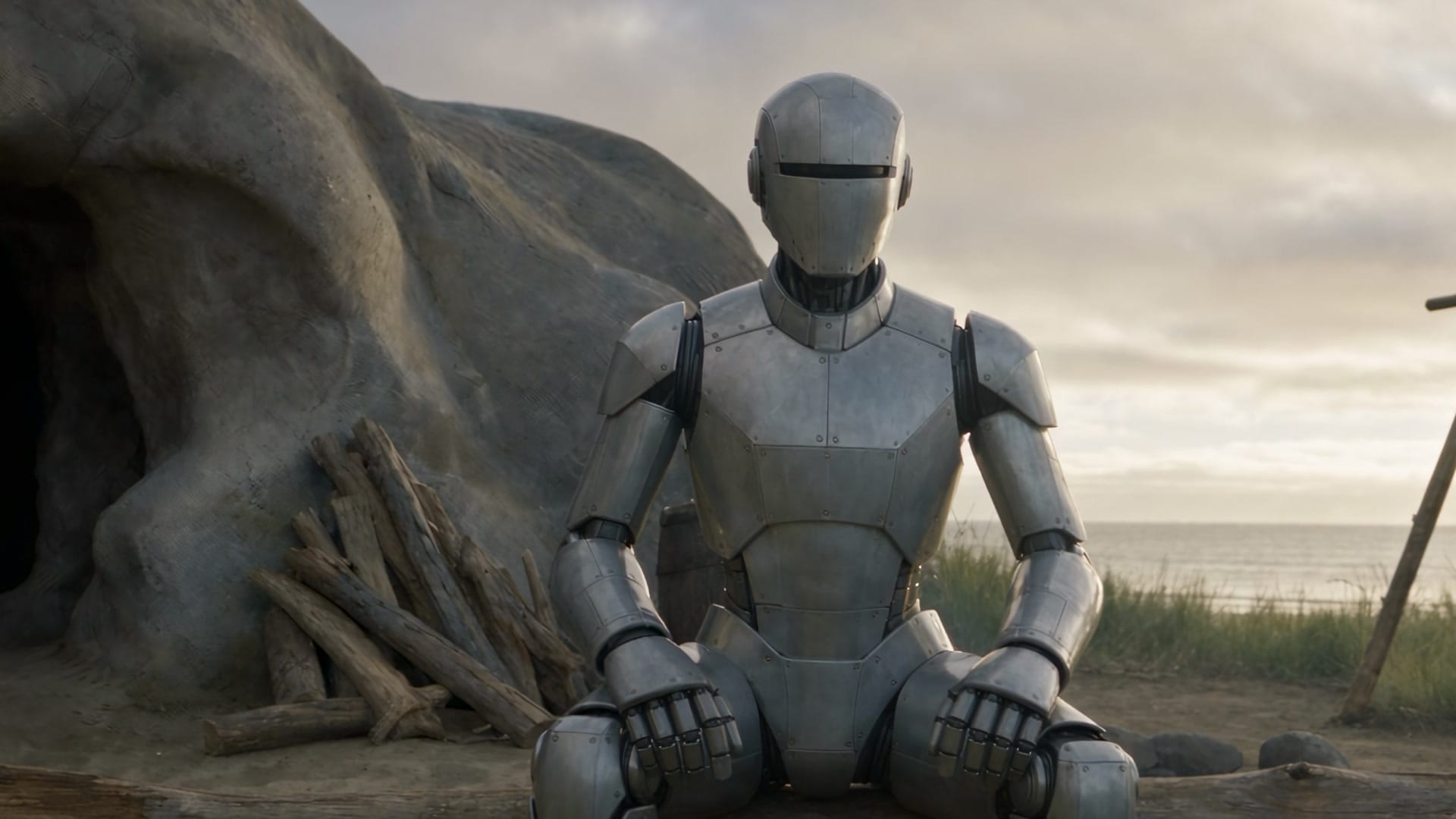
Nearly every spoken line in And Where Are We Going? belongs to a robot. A robot is allowed to sound like a robot.
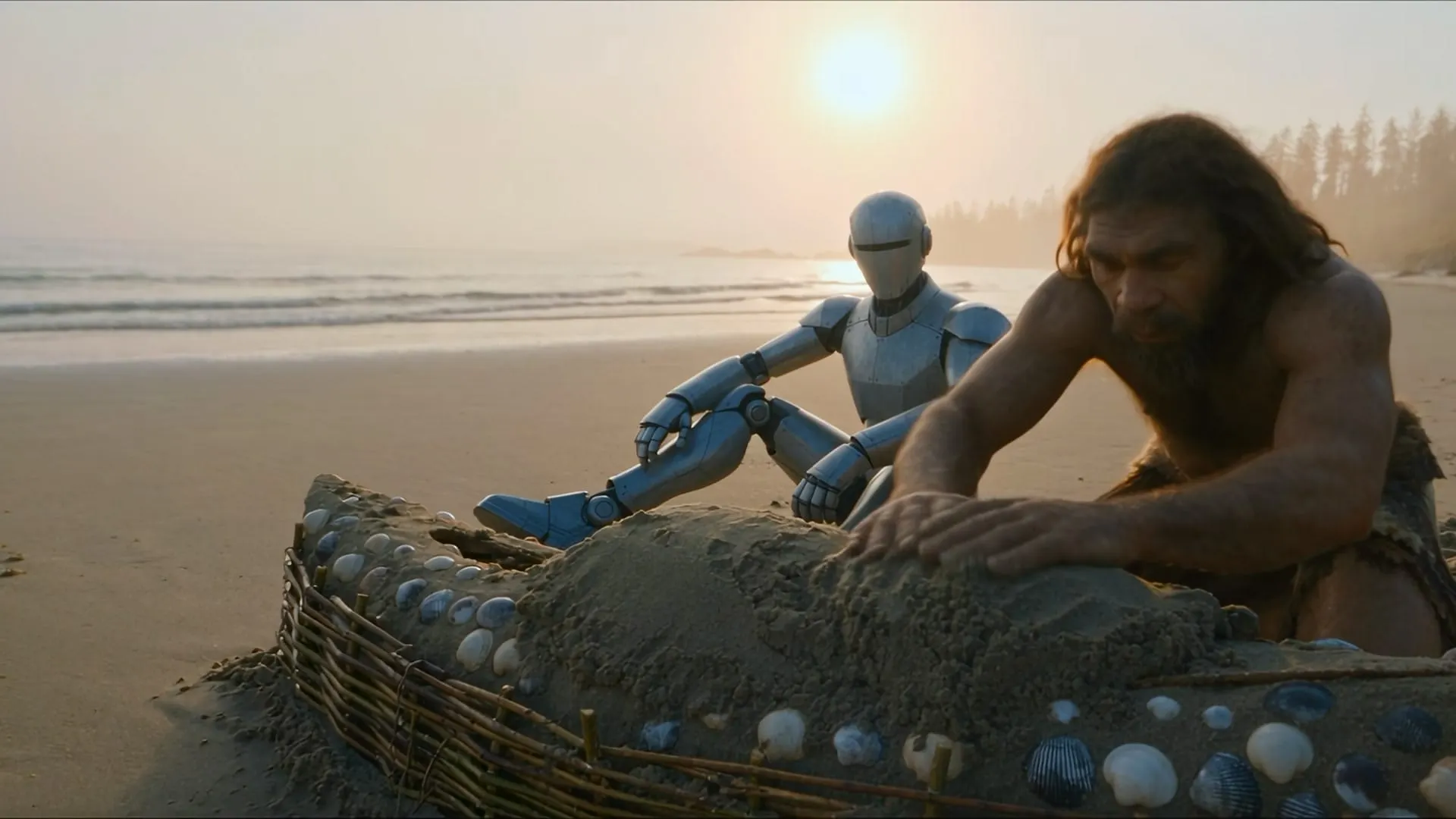
The film runs just under six minutes. A silver humanoid robot and a Neanderthal share a cave on a beach at the edge of a pine forest, and the Neanderthal decides, for no reason anyone can name, that he wants to build a boat. Brück's own logline on the film's Higgsfield page: "A mockumentary about a seemingly superior robot who can't understand why his Neanderthal companion wants to build a boat."
It's on the festival's shortlist. The festival rules put the winners announcement in the last week of October.
What we know about odngr
Not much yet, and I'd rather say that than fill the gap. The name comes from the film's end credits, which open on a title card crediting it as a film by Adrian Brück. His Higgsfield profile lists Berlin, says he joined in May 2026, and holds exactly one project.
The film also went up on the ODNGR channel on YouTube on September 11. It's the only video there.
I've asked him the questions his notes don't answer: what made the Neanderthal's interview so hard, whether the robot narrator was a deliberate way around the voice problem, why a mockumentary, and what he did before this. Until he answers, everything below is the film, his notes on the Higgsfield page, a few of his replies to commenters, and the credits.
Why a Neanderthal and a robot
Brück did explain the casting, in a short note under the project brief on Higgsfield. "I wanted to make a parable about humans and AI – one that asks the oldest questions: where do we come from, and where are we going?"
Then the casting itself: "That's why it had to be a Neanderthal: someone we drove to extinction. And a robot: something that might one day do the same to us."
The note also explains the one prop that matters most. Late in the film the Neanderthal makes the robot a hat, a stitched cap of hide that sits on its steel head like a helmet. "The hat was my way of showing how we humanize technology to make it graspable."
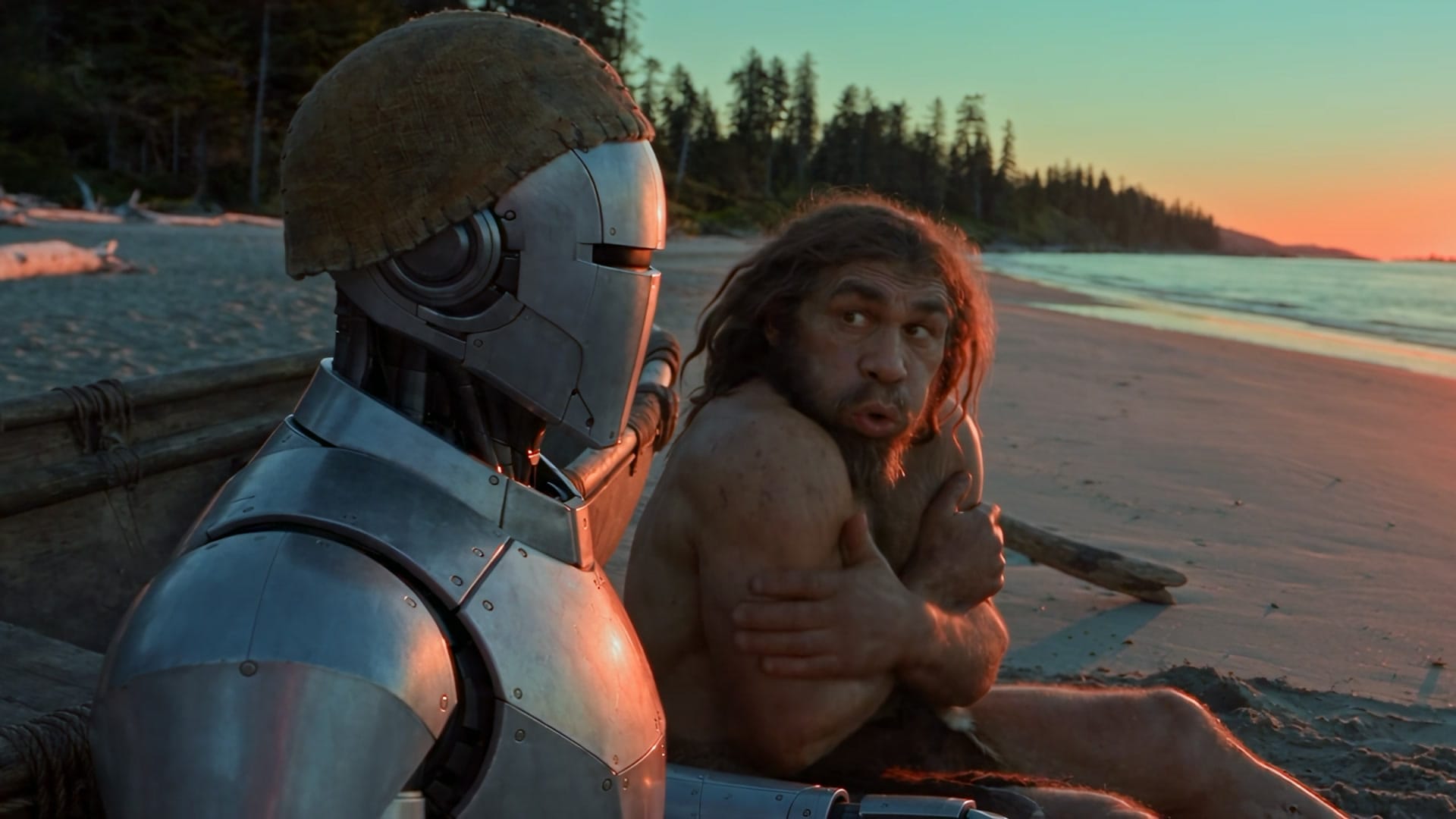
He closes the note on the line the title comes from: "In the end, we're both sitting in the same boat – not knowing where we're going."
The robot does all the talking
The narration is credited to ElevenLabs, and it's written in the robot's first person, flat and polite. Over the Neanderthal's first tries, a hull of wet sand studded with shells and then a raft of sticks, the robot says: "His first attempts were pretty unpromising to say the least."
The Neanderthal gets one word in the whole film. He says "Boat." Everything else from him is grunting and screaming.
Here I'm guessing at intent, and it's one of the questions I've sent him. An AI voice that's slightly too even is the thing an audience catches first in most generated drama. Put that voice in a robot and the evenness becomes the character: a machine reporting on something it can't make sense of.
The jokes run on the same flatness. The robot explains that the Neanderthal likes to compete and loses badly, so "I let him win every now and then." On screen, that line plays over an arm-wrestling match that ends with the Neanderthal screaming, face-down on the log.
Shot like a crew is standing just off frame
Brück describes the film as a mockumentary, and he commits to the grammar. Both characters get a seated interview in front of the cave, with the hides drying on a rack behind them, and the film keeps cutting back to the robot in that same chair. A lot of the observational footage is shot on a long lens from behind tree trunks, the way a nature crew films an animal it doesn't want to disturb.
The best gag depends on that crew. The robot says, "I am sure he can tell you more about it." Cut to the Neanderthal in the interview chair. He stares into the lens, reaches up, grabs the boom microphone hanging into frame and beats it down out of shot.
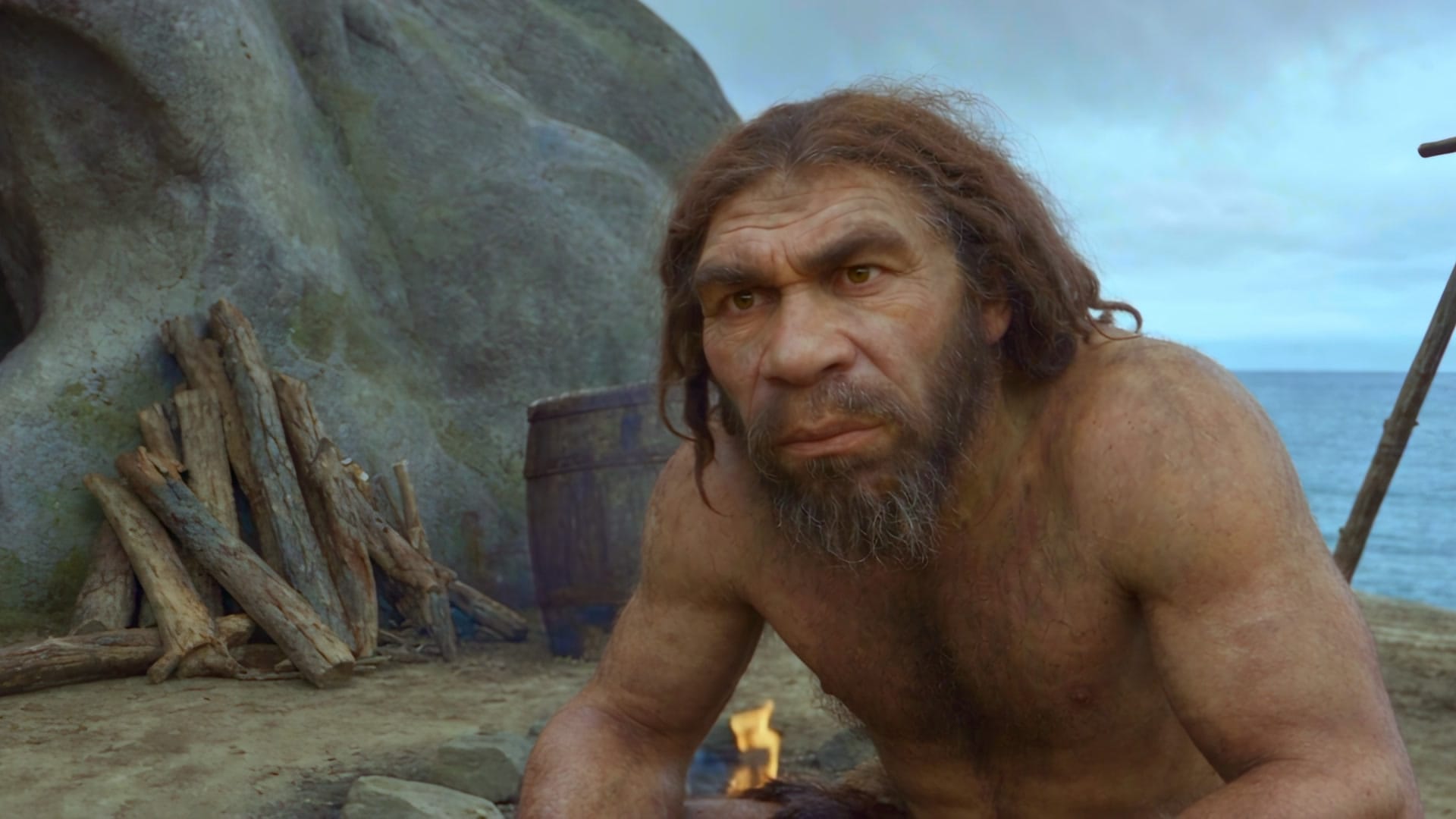
That was also the hardest shot to get. When a commenter guessed the scene where the Neanderthal walks his leaking boat into the sea must have taken many tries, Brück answered: "That surprisingly worked out pretty well! The most challenging part was definitely the interview scene with the Neanderthal."
The robot's stillness is directed too. Asked about its relaxed pose behind the boat-builder in an early shot, he wrote: "Yeah, if he's not actively doing something, I wanted him to sit and observe or just chill."
The boat comes first
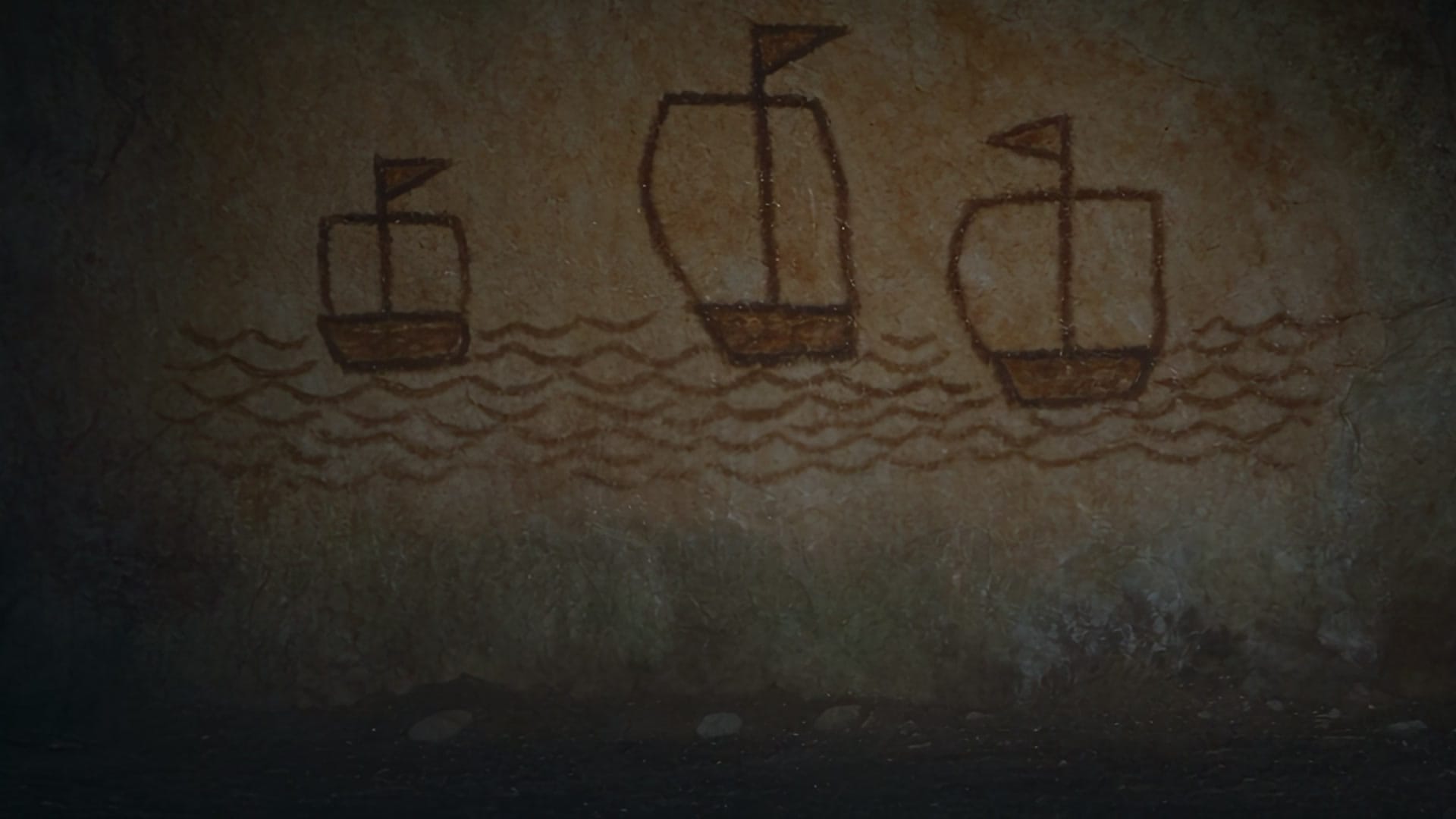
The film shows you the obsession before it shows you either character. One of the opening shots is a cave wall painted with three sailing boats over rows of wavy lines.
Then come the attempts: the sand hull, a raft of sticks, a hide stretched between his arms like a pair of wings, and a round hide boat he climbs into and wades out in until it sinks. The robot runs into the water and carries him out.
After that, the robot projects a wireframe plan of a boat from its visor and builds a planked wooden one itself. Its explanation: "So there was no other way than to build the boat for him."
The last shots are the two of them carrying the boat into the water in low sun and rowing out, and the title lands over them as an orange card. Brück's YouTube description ends the same way: "In the end, only one question remains."
How it was made
The credits list four tools: Seedance 2.5 for video, GPT Image 2 for images, ElevenLabs for the voice-over and Suno for the music. The YouTube description opens with "This short film was created entirely using artificial intelligence."
The Higgsfield page counts 522 generations and 5,285 credits for the project. Higgsfield's festival data splits that into 295 Seedance 2.5 generations and 218 GPT Image 2 generations, plus a few edit jobs and three voice-change jobs. Close to one still for every clip suggests he built shots image-first, a GPT Image frame animated in Seedance, though that's my inference and one of the things I've asked him.
He also built it in public. The project went up on Higgsfield on August 19, nine days after the festival opened, and through August he answered commenters with updates like "Thanks again for all the feedback! New trailer is coming in 2-3 days!" Higgsfield's data has the final cut submitted on September 15, the day before the deadline.
And he left the whole workbench open. The project's asset folders are named after scenes (_Boat, _Fire, _Hat, _Hunt, _Laser, _Plan, _Strength, +Interview), and the +Interview folder alone holds fifteen generations, including a version of the Neanderthal's interview set in a fern forest. The finished film puts him in front of the cave. His note on the page: "All AI-generated creations, including all unused prompts, have been left as is and unsorted for display purposes, because this is how the film was created and it was not divided into specific scenes beforehand."
Tools Adrian Brück credits on And Where Are We Going?
Seedance 2.5 · GPT Image 2 · ElevenLabs · Suno
From the film's end credits. Made on Higgsfield, which he tags in the YouTube description.
Where to go next
The closest thing on this site to Brück's documentary framing is Mike Bennion's Kev, a documentary-style portrait of an invented young blind man, made by a director who spent years on TV commercials. For the other side of a 522-generation project, The Dor Brothers' fifty-clips-to-keep-two habit is the most detailed account we have of what gets thrown away.
Audience Choice voting on the festival shortlist closes October 15. The full project, unused takes and all, is still open on Higgsfield.