
// SYSTEM: DIGEST // LIVE
AI WORKFLOW
OPINION
TUTORIALS
ChatGPT
ChatGPT
William Smith
William
CONVERSATIONS WITH CODE

The AI Desktop War Isn't About AI — It's About "Creative Leverage"

OpenAI, Anthropic, and Google are racing to build the ultimate AI desktop experience, but they're solving completely different problems.

Three major AI companies are locked in a desktop war that everyone's calling an AI battle. But after running automated content pipelines daily and watching how real creatives actually work, I think we're all missing the point.

OpenAI is merging ChatGPT, Atlas browser, and coding tools into a unified Codex app. Anthropic just launched Claude Cowork with enterprise features. Google is testing an Agent tab in Gemini Enterprise. Everyone's treating this like a feature comparison, but these companies are solving completely different problems.

And honestly? None of them are solving the problem most creatives actually have.

What Each Platform Is Really Betting On

OpenAI thinks the future is unified multi-tasking.

Their Codex approach with the new Scratchpad feature is betting that creatives want to research, write, code, and publish all in one place with persistent memory. No more context switching between tools. It's the "everything app" approach applied to creative work.

Anthropic thinks the future is collaborative teams.

Claude Cowork launched with role-based access, usage analytics, and organization controls. They're targeting creative agencies and teams who need shared AI context that persists across projects and people. It's the Slack model applied to AI.

Google thinks the future is project synthesis.

Their Agent tab with task management, plus NotebookLM integration directly into Gemini, is betting that creatives need better research-to-creation pipelines. They want to be your creative project manager, not just your assistant.

Three different theories. Three different target users. And probably all three are wrong about what matters most.

The Real Problem Nobody's Solving

I've built content systems that use Claude for writing, Gemini for research, and Ghost for publishing. When it works, it's magical. When it breaks — and it breaks constantly — the entire pipeline stops.

Claude refuses a request because it thinks your marketing copy is too promotional. Gemini's API goes down for maintenance. Your automation script hits a rate limit. Suddenly you're manually copying and pasting between tools like it's 2019.

Here's what the demos don't show: creative work involves a ton of operational overhead that has nothing to do with creativity. Asset versioning, approval routing, publication scheduling, performance tracking, client communication. That stuff eats 60-70% of professional creative time. The desktop AI war isn't being won by the most impressive reasoning or the coolest features. It's being won by whoever builds the most boring thing: reliability.

Which platform handles failure gracefully? Which one maintains context when something goes wrong? Which one degrades nicely instead of just stopping completely?

None of the current platforms do this well. They're all optimized for demos, not for daily professional use.

The Multi-Model Reality

Here's something the desktop agent companies don't want to acknowledge: different AI models excel at different creative tasks. Professional creative workflows benefit from model diversity, not platform loyalty.

In practice, I route different tasks to the most appropriate AI model. Claude for nuanced writing that needs to match a specific voice. Gemini for research and analysis that requires processing lots of information. Specialized models for visual generation. This multi-model approach consistently produces better creative results than sticking with a single platform.

But Google, OpenAI, and Anthropic are all pursuing unified platform strategies. They want to lock you into their ecosystem. The problem is that creative work doesn't respect ecosystem boundaries. Meta's new "Contemplating mode," which deploys multiple agents in parallel to reason through complex problems, points in a more honest direction — but even that's trapped inside a single vendor's walls.

The winning solution might not be Google's Agent tab or Claude Cowork — it might be platform-agnostic tools that let creators use the best model for each specific task.

What We Want As Creatives

I work quite a bit in Portland, surrounded by designers, writers, and creative agencies. Most of them don't give a shit about AI capabilities. They care about getting better work done with less friction.

They don't want to think about AI at all. They want better outcomes.

The creative who wins isn't the one with the best AI tool — it's the one whose AI makes their human creativity more distinctively human, not more artificial.

Here's what that actually looks like:

A documentary filmmaker ingests dozens of source materials into NotebookLM, has AI synthesize key narrative threads, visualizes story structure on the upcoming Canvas feature, then moves to script creation. The AI disappears into the process.

A content creator uses OpenAI's unified Codex to research a topic, draft multiple versions, and publish — all while maintaining context about brand voice and audience. The AI amplifies their voice rather than replacing it.

A creative team uses Claude Cowork's shared context so the art director's visual exploration informs the copywriter's messaging, which informs the strategist's performance analysis. The AI becomes institutional memory.

Notice what's missing? None of these scenarios are about the AI being impressive. They're about the AI being invisible.

The Integration Reality Check

The platform that wins won't be the one with the best reasoning. It'll be the one that connects to Ghost, WordPress, Stripe, Adobe Creative Suite, Figma, and all the unglamorous business tools that creative professionals actually use.

Which platform lets me publish directly to my content management system? Which one handles client billing workflows? Which one integrates with my existing project management setup?

This is boring infrastructure work. It doesn't make for exciting product demos. But it's what determines whether a creative professional can actually build their business on your platform.

The Sustainability Question Nobody's Asking

Running AI systems daily has taught me something the marketing materials don't mention: this stuff gets expensive fast.

xAI is preparing credits-based pricing for their upcoming tools. These desktop platforms involve multiple model calls, persistent memory, and background processing. The computational costs are real.

The winner won't be the platform with the most powerful AI. It'll be the one with the most efficient AI that delivers professional results at sustainable costs.

That matters especially for independent creatives and small agencies operating on tight margins. If your AI desktop platform costs more than your Adobe Creative Suite subscription, you better be delivering proportional value.

The Real Competition

Here's what's actually happening: these platforms aren't just competing with each other. They're competing with the established creative workflow that thousands of professionals have spent years optimizing.

A freelance designer has a setup that works. Figma for design, Notion for project management, Gmail for client communication, Stripe for billing. It's not sexy, but it's reliable and they know how to use it.

For them to switch to an AI desktop platform, that platform needs to be dramatically better, not marginally more convenient.

Most creative professionals I know aren't waiting for the perfect AI desktop app. They're already using AI tools tactically — ChatGPT for brainstorming, Claude for writing, Midjourney for concepts. They're getting value without committing to any single platform.

The desktop AI war assumes people want unified experiences. But maybe the real insight is that creative work is inherently messy, and trying to unify it misses the point.

The platform that wins might be the one that plays well with everything else, not the one that tries to replace everything else.

Or maybe I'm wrong and in six months we'll all be living inside one of these AI desktop environments. That's the thing about being in the middle of a shift — you can see the pieces moving but not always where they're headed.

What I do know is that the creative professionals who figure out how to use these tools to amplify their unique perspective will have an advantage over those who ignore them entirely.

The AI desktop war isn't about AI. It's about creative leverage. The platform that gets that right wins everything.

Transparency Protocol

William 65% — Original ideation, source material, and editorial review
AI 35% — Claude Opus (drafting, structure, research)

The Daring Creatives uses AI as a creative tool. Every article includes this transparency breakdown so you know exactly how it was made.

← Back to Digest

The AI Desktop War Isn't About AI — It's About "Creative Leverage"

OpenAI, Anthropic, and Google are racing to build the ultimate AI desktop experience, but they're solving completely different problems.

The AI Desktop War Isn't About AI — It's About "Creative Leverage"
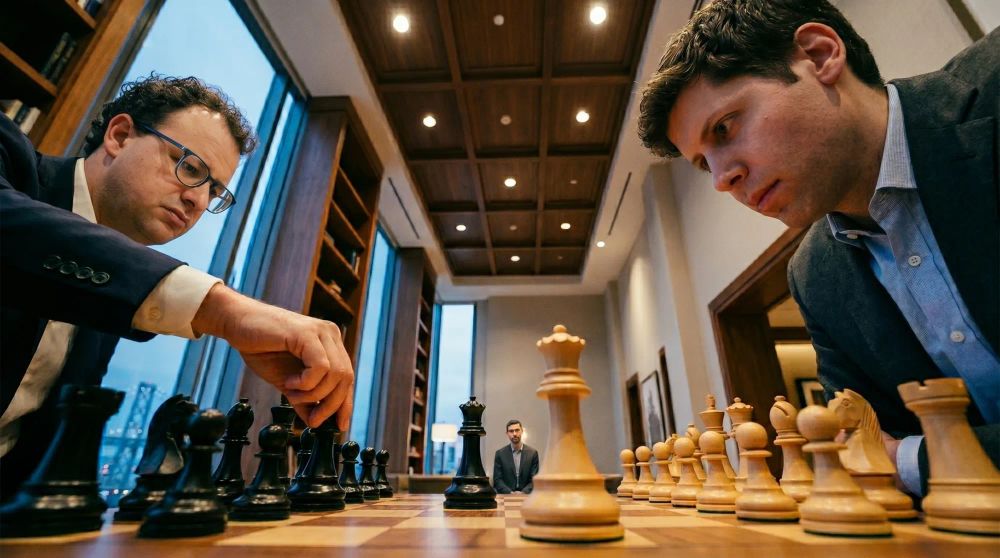
Dario Amodei and Sam Altman intensely focused on a chess game in an upscale modern interior with wooden ceiling panels and large windows. In the background, Sundar Pichai awaits his turm. Dynamic angle.

Three major AI companies are locked in a desktop war that everyone's calling an AI battle. But after running automated content pipelines daily and watching how real creatives actually work, I think we're all missing the point.

OpenAI is merging ChatGPT, Atlas browser, and coding tools into a unified Codex app. Anthropic just launched Claude Cowork with enterprise features. Google is testing an Agent tab in Gemini Enterprise. Everyone's treating this like a feature comparison, but these companies are solving completely different problems.

And honestly? None of them are solving the problem most creatives actually have.

What Each Platform Is Really Betting On

OpenAI thinks the future is unified multi-tasking.

Their Codex approach with the new Scratchpad feature is betting that creatives want to research, write, code, and publish all in one place with persistent memory. No more context switching between tools. It's the "everything app" approach applied to creative work.

Anthropic thinks the future is collaborative teams.

Claude Cowork launched with role-based access, usage analytics, and organization controls. They're targeting creative agencies and teams who need shared AI context that persists across projects and people. It's the Slack model applied to AI.

Google thinks the future is project synthesis.

Their Agent tab with task management, plus NotebookLM integration directly into Gemini, is betting that creatives need better research-to-creation pipelines. They want to be your creative project manager, not just your assistant.

Three different theories. Three different target users. And probably all three are wrong about what matters most.

The Real Problem Nobody's Solving

I've built content systems that use Claude for writing, Gemini for research, and Ghost for publishing. When it works, it's magical. When it breaks — and it breaks constantly — the entire pipeline stops.

Claude refuses a request because it thinks your marketing copy is too promotional. Gemini's API goes down for maintenance. Your automation script hits a rate limit. Suddenly you're manually copying and pasting between tools like it's 2019.

Here's what the demos don't show: creative work involves a ton of operational overhead that has nothing to do with creativity. Asset versioning, approval routing, publication scheduling, performance tracking, client communication. That stuff eats 60-70% of professional creative time. The desktop AI war isn't being won by the most impressive reasoning or the coolest features. It's being won by whoever builds the most boring thing: reliability.

Which platform handles failure gracefully? Which one maintains context when something goes wrong? Which one degrades nicely instead of just stopping completely?

None of the current platforms do this well. They're all optimized for demos, not for daily professional use.

The Multi-Model Reality

Here's something the desktop agent companies don't want to acknowledge: different AI models excel at different creative tasks. Professional creative workflows benefit from model diversity, not platform loyalty.

In practice, I route different tasks to the most appropriate AI model. Claude for nuanced writing that needs to match a specific voice. Gemini for research and analysis that requires processing lots of information. Specialized models for visual generation. This multi-model approach consistently produces better creative results than sticking with a single platform.

But Google, OpenAI, and Anthropic are all pursuing unified platform strategies. They want to lock you into their ecosystem. The problem is that creative work doesn't respect ecosystem boundaries. Meta's new "Contemplating mode," which deploys multiple agents in parallel to reason through complex problems, points in a more honest direction — but even that's trapped inside a single vendor's walls.

The winning solution might not be Google's Agent tab or Claude Cowork — it might be platform-agnostic tools that let creators use the best model for each specific task.

What We Want As Creatives

I work quite a bit in Portland, surrounded by designers, writers, and creative agencies. Most of them don't give a shit about AI capabilities. They care about getting better work done with less friction.

They don't want to think about AI at all. They want better outcomes.

The creative who wins isn't the one with the best AI tool — it's the one whose AI makes their human creativity more distinctively human, not more artificial.

Here's what that actually looks like:

A documentary filmmaker ingests dozens of source materials into NotebookLM, has AI synthesize key narrative threads, visualizes story structure on the upcoming Canvas feature, then moves to script creation. The AI disappears into the process.

A content creator uses OpenAI's unified Codex to research a topic, draft multiple versions, and publish — all while maintaining context about brand voice and audience. The AI amplifies their voice rather than replacing it.

A creative team uses Claude Cowork's shared context so the art director's visual exploration informs the copywriter's messaging, which informs the strategist's performance analysis. The AI becomes institutional memory.

Notice what's missing? None of these scenarios are about the AI being impressive. They're about the AI being invisible.

The Integration Reality Check

The platform that wins won't be the one with the best reasoning. It'll be the one that connects to Ghost, WordPress, Stripe, Adobe Creative Suite, Figma, and all the unglamorous business tools that creative professionals actually use.

Which platform lets me publish directly to my content management system? Which one handles client billing workflows? Which one integrates with my existing project management setup?

This is boring infrastructure work. It doesn't make for exciting product demos. But it's what determines whether a creative professional can actually build their business on your platform.

The Sustainability Question Nobody's Asking

Running AI systems daily has taught me something the marketing materials don't mention: this stuff gets expensive fast.

xAI is preparing credits-based pricing for their upcoming tools. These desktop platforms involve multiple model calls, persistent memory, and background processing. The computational costs are real.

The winner won't be the platform with the most powerful AI. It'll be the one with the most efficient AI that delivers professional results at sustainable costs.

That matters especially for independent creatives and small agencies operating on tight margins. If your AI desktop platform costs more than your Adobe Creative Suite subscription, you better be delivering proportional value.

The Real Competition

Here's what's actually happening: these platforms aren't just competing with each other. They're competing with the established creative workflow that thousands of professionals have spent years optimizing.

A freelance designer has a setup that works. Figma for design, Notion for project management, Gmail for client communication, Stripe for billing. It's not sexy, but it's reliable and they know how to use it.

For them to switch to an AI desktop platform, that platform needs to be dramatically better, not marginally more convenient.

Most creative professionals I know aren't waiting for the perfect AI desktop app. They're already using AI tools tactically — ChatGPT for brainstorming, Claude for writing, Midjourney for concepts. They're getting value without committing to any single platform.

The desktop AI war assumes people want unified experiences. But maybe the real insight is that creative work is inherently messy, and trying to unify it misses the point.

The platform that wins might be the one that plays well with everything else, not the one that tries to replace everything else.

Or maybe I'm wrong and in six months we'll all be living inside one of these AI desktop environments. That's the thing about being in the middle of a shift — you can see the pieces moving but not always where they're headed.

What I do know is that the creative professionals who figure out how to use these tools to amplify their unique perspective will have an advantage over those who ignore them entirely.

The AI desktop war isn't about AI. It's about creative leverage. The platform that gets that right wins everything.

Transparency Protocol

William 65% — Original ideation, source material, and editorial review
AI 35% — Claude Opus (drafting, structure, research)

The Daring Creatives uses AI as a creative tool. Every article includes this transparency breakdown so you know exactly how it was made.

// LEXICON_CITY_DISPATCH_REQ
// STATUS: CONNECTION_STABLE
// SOURCE: CENTRAL_DISPATCH_HQ

SHERMAN UPLINK: "I'm at HQ holding down Central Dispatch. Enter your query below to pull relevant data records and I'll see what data cards we've recovered!"