I've been watching this in awe.
AI tools have gone from "pretty interesting, mildly useful" to "holy shit, this saves me huge chunks of time."
It's happening across every model and every tool, general or specific. I follow the creative side most closely — generative AI in particular — and what's possible right now is wild.
What does being a creative in 2028 actually look like?
We're in 2026. I'm giving a two-year runway because we could be in the middle of something that looks a lot like superintelligence by then. Literally anything a person can do, a computer might do faster and better. So if you're a creative, what's left? Do you have a job? Do you have a role?
I think you'll have a role. But the job is going to be different.
The roles that are quietly disappearing
I was musing the other day about how the marketing manager — as a role — probably goes away in the next five years. Maybe sooner. Not "gets transformed." Just doesn't get hired anymore. And not only at the senior level. All the way down.
If you're a graphic designer, a videographer, a web builder, someone who makes physical things — the way you do that work is about to be replicated by anyone with a laptop. Any style. Any concept. High quality, on demand.
What an hour looks like now
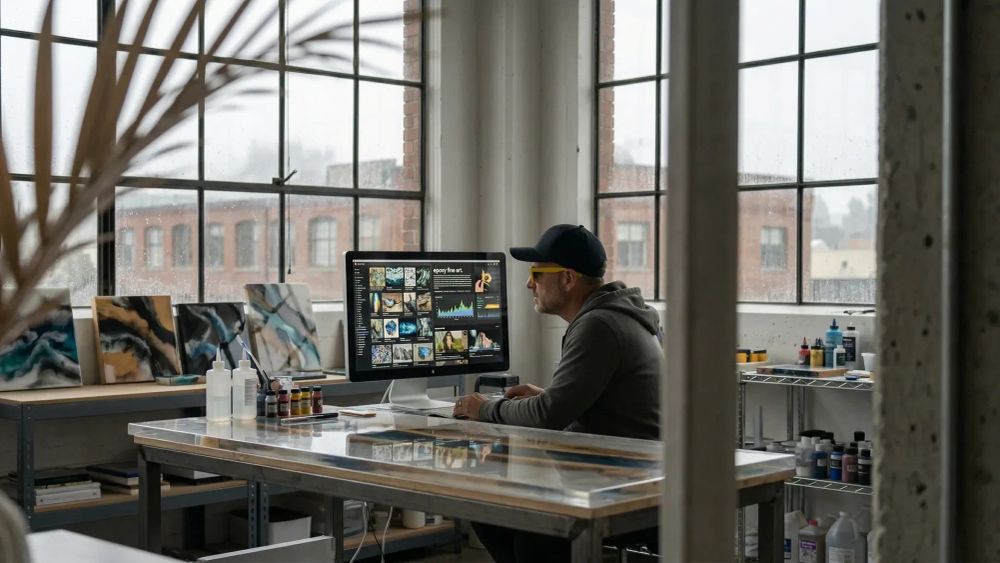
Earlier this week I had about an hour before a meeting. My client was riffing out loud about other lower-price-point things we could make in the studio. In that hour I ran a market research analysis on epoxy fine art pricing, separated it from hobbyist work, broke down what the top artists in that space offer at each price point, then used that research to generate images and a video at something close to commercial quality.
That's fucking crazy. I asked myself if I'd ever been in a meeting where someone produced something like that in the flow of the conversation. I haven't. Not once.
I was so proud. And then immediately I thought — okay, what does it look like when everybody can do this?
Why I think this is exciting, not terrifying
For me it raises the bar on how productive and how creative a person can be.
But it's a black box.
You don't really know what's on the other side.
The tools are improving exponentially, week over week.
Will commercials and videos matter as much when everybody can make them? You don't need to hire a videographer to edit anymore.
You don't need to go on location to be in a location. I travel all around a fictional city solving creative problems with a crew of dogs without ever leaving my desk. Sometimes I'm building those worlds on a walk.
Websites are going to get more immersive and more branded.
Experiences that used to take a team will get built by one person on a Tuesday. There's so much I can dream of now that I never thought I'd be able to make.
The real question isn't "what gets replaced." It's "what will people still not be able to do yet?" That's where the next wave of creatives lives.
The hard part
It's hard to imagine something that doesn't exist.
It's hard to plan for a thing you can almost see but can't quite name.
That's the scary part — not the AI itself, but the fog around what comes next.
I want more creatives thinking past where they are right now. Thinking bigger than the tool they used yesterday. It's an enormous opportunity, and the people who lean into it instead of bracing against it are the ones who'll define what this role even means in 2028.