
Everyone using AI tools has felt it at some point: that creeping sense that you're getting dumber. That the skills you spent years building are slowly dissolving. That you're becoming dependent on something that's making you less capable, not more.
I get it. I've felt it too. But here's the thing — this isn't actually what's happening.
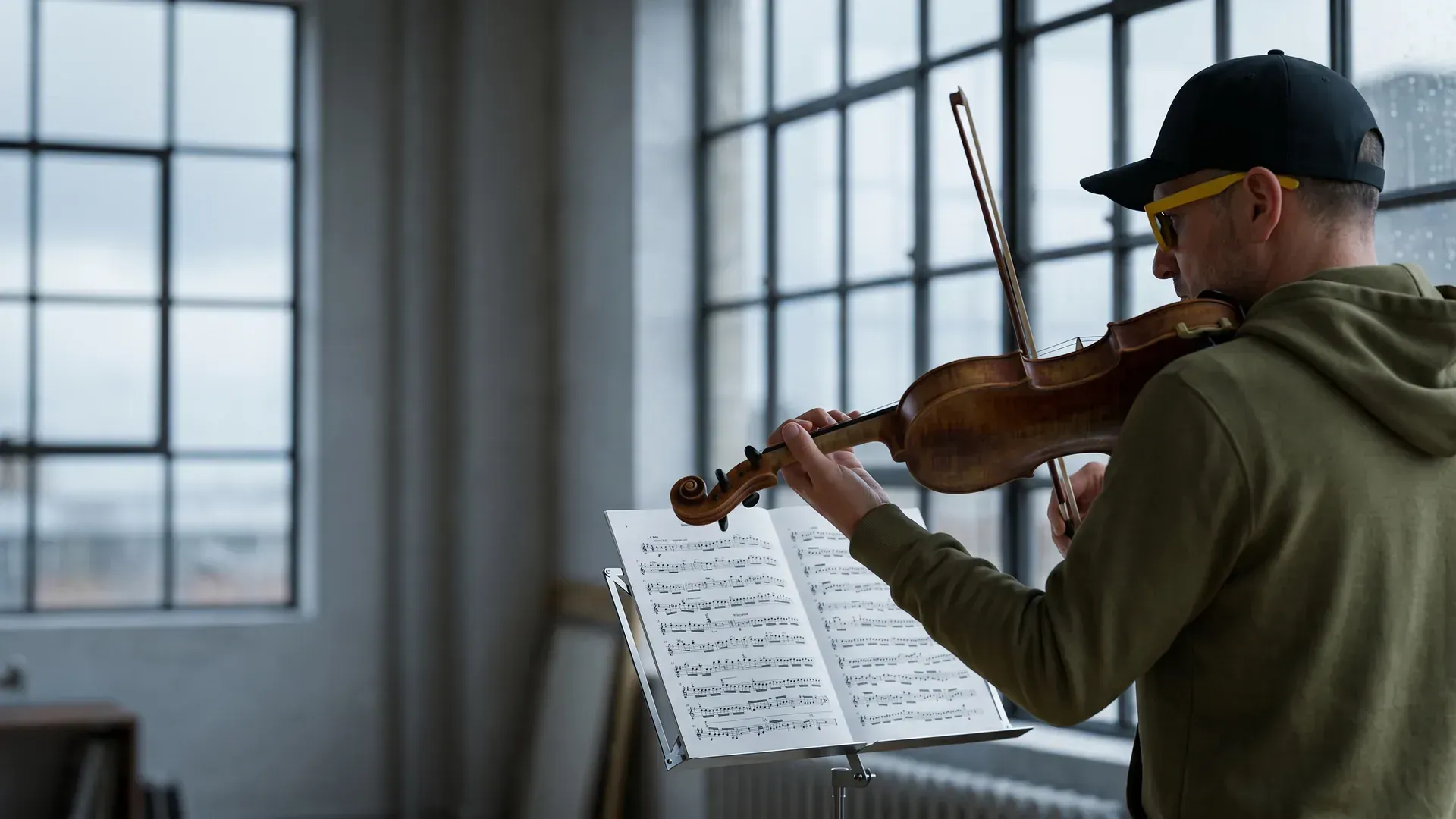
The Violin I Can't Play Anymore
I was a classical violinist for 20 years. Started as a kid, played through college, then I got burned out and moved on to something else. Then life happened, and I haven't touched a violin in over 20 years.
If you handed me one right now, I'd sound like garbage.
My fingers wouldn't find the right positions.
My bow technique would be sloppy as hell.
All that muscle memory, all that dexterity — completely gone.
I can still read music. I still know music theory. I can hear when something's out of tune or when a melody needs work. I understand harmony and composition in ways I never did when I was focused on just playing the notes correctly.
My manual skills faded, but the knowledge deepened. And honestly? Now I can focus on the parts of music that actually interest me — the orchestration, the arrangement, the big picture stuff — instead of just trying to nail my part.
The Designer's Evolution
Think about graphic designers who came up in the 90s and early 2000s.
They spent years mastering the pen tool in Photoshop, painstakingly cutting out objects pixel by pixel. That was a real skill that took time to develop.
Most of those designers aren't doing that anymore.
They've moved into creative direction, art direction, strategy.
Their job now is to critique and guide the creation of art, not necessarily execute every detail themselves. They learned new skills to replace the old ones.
Nobody calls this "getting dumber." We call it career progression.
What AI Atrophy Actually Is
When you start using AI tools heavily, some of your manual skills will fade.
The copywriter who spent years perfecting their ability to write snappy headlines might find that skill getting rusty if they're using AI to generate options.
But they're developing new skills: prompt engineering, editing AI output, strategic thinking about messaging.
The developer who could write complex algorithms from scratch might get slower at that.
But they're getting faster at architecting systems, reviewing code, and solving higher-level problems.
This is normal. This is how skills have always worked. Use it or lose it isn't just true for AI — it's true for everything.
The Real Question
The question isn't whether your skills are changing. They are. The question is whether the new skills you're gaining are more valuable than the old ones you're losing.
If you're using AI to handle the repetitive, mechanical parts of your work so you can focus on strategy, creativity, and high-level problem solving? That's probably a good trade.
If you're using AI as a crutch to avoid thinking altogether? That's a different story.
But most people I know aren't doing the second thing. They're doing the first thing and feeling guilty about it because they think skill change equals skill loss.
The Part That Stays
Foundational knowledge usually sticks around.
My music theory didn't disappear when I stopped playing violin.
The manual execution fades. The deep understanding often grows.
And honestly? Wouldn't it be more fun to just focus on the part that you enjoy and are driven to do? I think so.
Your skills aren't atrophying. They're evolving. And that's exactly what they should be doing.
## Generated Images
> Seven variants below — three standard compositions, one documentary (foreground bokeh), and three dynamic-angle "spatial" compositions for parallax video.
> To request a fix on any one, add a checkbox under `## Image Touch-ups` like:
> `- [ ] spatial-square: remove the random hand on the right`
**landscape** — 1920×1080
