
I'm not going to pretend I wasn't curious.
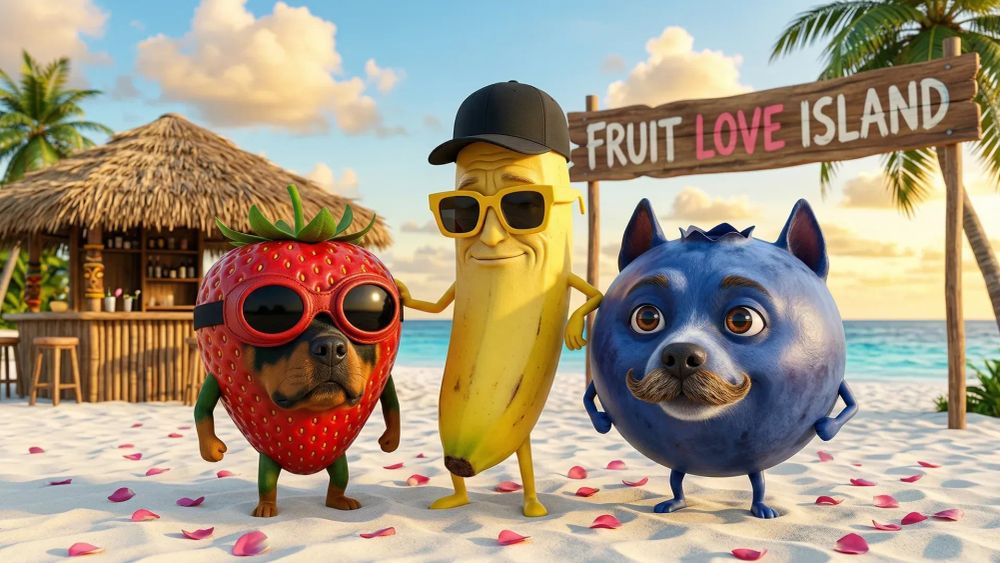
When Fruit Love Island started popping up everywhere — Strawberina dumping Bananito, Orangelo's chaos energy, the kind of unhinged re-coupling drama that somehow tracked with real reality TV — my first instinct was dismissal.
I thought, "Well, people are going to call this AI slop."
Anthropomorphic fruit people, generated for engagement, serving nothing. Move on.
Then I noticed that by the time I was hearing about it, the account had already amassed over three million followers in eleven days. I noticed that there were nineteen episodes. I noticed that each one dropped every single day. I noticed that Strawberina is still Strawberina across all of them — same face, same voice, same personality — and that's not trivial.
So I looked closer. And the thing I found isn't what I expected.
The Fastest-Growing TikTok Account You Don't Know Anything About
The account is AI Cinema. They started posting on March 14th, 2026. By the time most people had heard of Fruit Love Island, they had crossed three million followers — a pace that reportedly broke records for the platform.
The creator is anonymous. No name attached to the account. No interviews where they reveal themselves.
That's not unusual for someone doing AI creative work — a lot of people stay behind the curtain. But it does mean that what we know about the process comes entirely from the work itself, plus one statement the creator made: each two-minute episode takes around three hours to make.
Three hours. Daily. For nineteen consecutive days at launch.
That's not nothing. That's 57+ hours of focused production in less than three weeks, on top of managing an audience that grew from zero to three million while you were doing it.
Of Course it Has Critics
The criticism of Fruit Love Island has been predictable. "It's slop." "There's no real creativity." "Anyone could make this." The usual framing where AI work gets evaluated purely on whether it looks impressive and not on what it actually requires to pull off.
What I see?
Someone built a serialized narrative franchise, from scratch, in under a month, that millions of people returned to daily.
Think about what that requires even before you touch the AI tools.
You need a format that works — Love Island's structure (challenges, recouplings, bombshells, hideaway drama) turns out to be almost perfectly modular for AI video production. The scenes are short, the drama is contained, and the episode template repeats. Whoever runs AI Cinema understood this. They didn't pick an arbitrary format. They picked one that their tools could serve reliably at volume.
You need consistent characters. Strawberina has to look like Strawberina in episode 19 the same way she did in episode 1. In AI video generation, character consistency is a real problem — tools are probabilistic, not deterministic, and keeping a character stable across dozens of outputs requires either a very tight reference workflow or a lot of culling. Probably both.
You need a voice for each character. Coconick isn't just a coconut. He has a personality that viewers recognize across episodes. That's a writing decision, not a generation decision. Someone thought it through.
You need to release every day. Not when you feel like it, not when a good episode comes together, but every day. The audience expected it. The algorithm rewarded it. That cadence discipline is something a lot of creators with way more resources can't maintain.
The Audience Participation Angle
AI Cinema invited viewers to submit storyline suggestions through a Google form. They explicitly asked for content that was "dramatic," "messy," and involved "backstabbing."
That move is smart in multiple ways.
It generates narrative material.
It creates investment in the audience — people feel ownership of a storyline they suggested.
It also solves one of the harder creative problems in a daily format: running out of ideas.
But it also reveals something about how the creator thinks. They understood that the show wasn't just content — it was participation. They built a feedback loop between audience and output, which is something professional shows with full writing rooms try to do and rarely pull off.
AI Cinema did it with a Google form.
What This Is Actually About
The conversation about AI and craft always gets derailed by the quality-of-output debate. Does this look good enough? Is it real art? But Fruit Love Island reframes the question in an interesting way: does it need to look good? Or does it need to work?
The fruit characters look like what they look like. Nobody's watching for the rendering. They're watching for Orangelo's drama. They care about whether Strawberina gets a fair chance. The emotional hook is real even if the imagery is rough.
That's a meaningful distinction. AI didn't break what makes storytelling work. It just changed what the barrier to entry for storytelling looks like. A single person, anonymous, with access to AI video tools and a clear format understanding, built a serialized show with a bigger opening week than most network TV launches.
I'm not going to tell you the episodes are beautifully crafted. They're not. The visuals are choppy. Some plots go nowhere. The pacing is inconsistent.
But nineteen episodes in nineteen days, three million subscribers, tens of millions of views per episode, and an audience that comes back? That's not slop. That's a functional media operation run by one person with a laptop and a clear head about what the format required.
The anti-AI crowd keeps imagining the wrong player. They picture someone with no creative thought pressing a button. What @ai.cinema021 actually looks like is a person who understood the assignment — the format, the audience, the cadence, the consistency requirements — and then used the tools to execute it at a pace no traditional production could match.
The work isn't impressive because the AI made beautiful things. The work is impressive because one person figured out how to be a showrunner.
AI Cinema's Toolkit
AI Cinema hasn't disclosed their specific tools publicly. But based on the output and what's known about how similar content gets made, here's a reasonable map of what's likely in play:
Text-to-Video Generation (likely Veo 3 or Kling)
The character animation — lip movement, facial expressions, environmental movement — is consistent with current generation-era video models. The outputs run 10–30 seconds per scene, strung together into 2-minute episodes.
Character Reference Workflow
To keep Strawberina looking like Strawberina across 19 episodes, the creator almost certainly maintains reference images for each character that get fed into each generation. This could involve image-to-video or image reference features in their generation tool, or a separate image consistency workflow upstream.
Script / Story Outlining
Given the audience participation form, the creator is likely running some form of LLM-assisted story outlining — feeding viewer suggestions into a writing pipeline that structures the episode's dramatic beats before generation begins.
Audio (ElevenLabs or similar)
Character voices are consistent across episodes. That consistency requires either a voice cloning tool or careful management of generated voice profiles. ElevenLabs or a similar TTS platform is the most likely candidate.
Editing
CapCut is the most common editing tool for this kind of mobile-first AI video content — fast, accessible, and capable of stringing multiple short AI clips into a coherent episode.