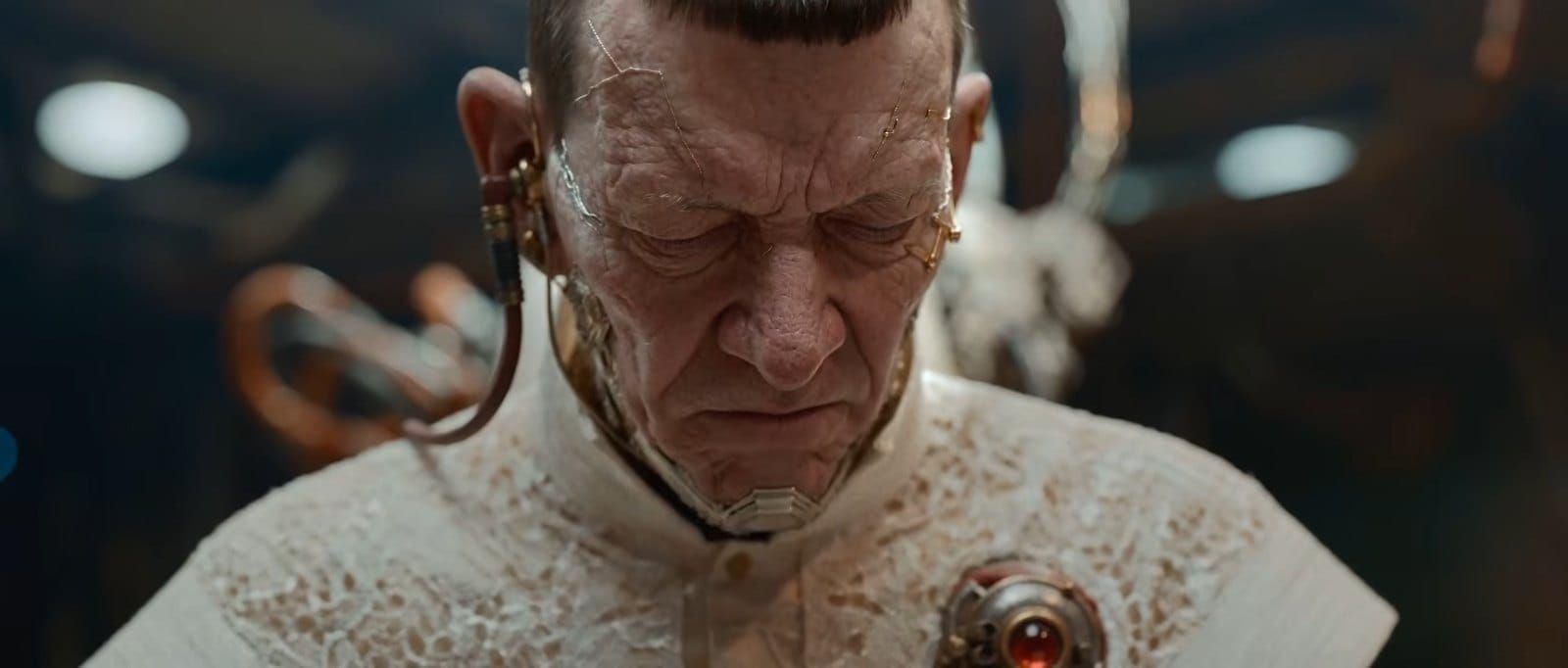

An old man sits in a workshop with gold filament stitched through his face. There's a port in the side of his neck with a cable running out of it, and he's wearing something cream-colored and embroidered that looks expensive in a way that stopped meaning anything a long time ago. He's bored. He has been bored for centuries.
That's the setup for "Pomegranate," which Gossip Goblin put on YouTube on July 22. His own description of it: "After centuries of simulated wars, wives, and wonders, a jaded aristocrat visits his neighborhood dreamspool dealer in search of something, anything, that still feels real."
It runs 27 minutes and 56 seconds. It's free. And, it's glorious.
Before the animation, look at the credit roll he put at the end of the description. It names fifteen people.
Sam Dale, Ben Kersley, Oscar Merry and Ayça Özkan on voices. Alexandru Mihai as animation lead, with Benjamín Muñoz Alonso, Alberto Alepuz Fernandez and Nowell Englund animating. Răzvan Ilinca edited it and supervised post. Anne-Sophie Versnaeyen and Juan Torán wrote the score. Ștefania Grigorescu graded it. Marian Bălan did sound design and the re-recording mix. Zack London wrote, directed, and produced, alongside Edward Saatchi and Fable Studio.
Most coverage of AI film doesn't print the crew, which is a shame, because the crew is the argument. His studio says it plainly on its own site: "Every story is imagined, written, and directed by humans. AI is just our force multiplier."
Nineteen days of rollout for a free short
Here's the part I hadn't seen anyone lay out. Pomegranate didn't just appear — it was released like something with a marketing budget, and the schedule is sitting right there in the channel's upload history.
- July 3 — "Pomegranate - Official Trailer (2026)"
- July 14 — "Pomegranate: Make Me Feel"
- July 15 — "Pomegranate: Trailer 3"
- July 17 — "Pomegranate - Trailer 4"
- July 18 — "Pomegranate - Sneak Peek"
- July 21 — "Pomegranate - Trailer 5"
- July 22 — the film, as a scheduled live premiere, plus a livestream
- July 23 — "A True Swordsman (Pomegranate)"
- July 24 — "Pomegranate - Out Now!"
Six drops before release. A premiere with a live chat, not a quiet upload. Then two more cutdowns after, on the days when a new release is actually getting shared.
And then there's the date. July 22 is also the day Variety, Forbes and IndieWire all reported that his feature, "Gods Don't Give Gifts," is getting a limited U.S. theatrical release on October 30.
So the trade press ran a story about a movie nobody can see yet, and on the same morning, 28 minutes of finished work from the same world went up for free where anyone reading that story could watch it immediately. By July 26 it had passed 1.1 million views.
That's a distribution decision, and it's a good one. If you're asking people to buy a ticket for an AI feature in October — and plenty of them have already decided how they feel about that phrase — the strongest thing you can hand them is a long, finished, unpaywalled piece of the same thing.
What he actually does to make one of these
Pomegranate lives in the same world as "The Patchwright," his 21-minute cyberpunk short from earlier this year. Both are set in what he calls the Second Cycle of Humanity, and the Pomegranate title card even stamps the same location on it — Niiro Cradle, the city from Patchwright.
He walked through the Patchwright method in detail in an interview with PJ Ace in May, and the specifics are more stubborn than you'd guess.
Every shot starts as a still in Midjourney — and he was working in v7, not the newer version, because he thinks v7 sits closer to the ceiling of what the tool can actually do. He builds custom profile codes rather than leaning on prompt syntax. Nano Banana comes after, never first: "no image starts in nano banana. Nano banana is just our photoshop."
His reason for avoiding the defaults is the most useful sentence in the whole interview.
"Whatever the default agent gives you is going to look like what it gave the next thousand people who asked."
So the interrogation room in Patchwright is a circular panopticon instead of the gray table you'd get for free. He explores each location separately — penthouse, ship interior, mid-air city, street level, wet market — locks a few hero shots per environment to set the light, then fills the connecting frames from those anchors. Roughly 90% of the final color grade is baked into the stills before anything moves.
Animation is Kling, all of it, with Sync Labs patching some lip-sync. He deliberately skipped the omni-reference and multi-shot features that would have sped this up, because he wanted to control every frame — a choice he reckons cost him a couple of months. Before Nano Banana Pro existed, he hand-painted directly on images for a nine-minute scene, drawing arrows and marking cables to feed the notes back in, hundreds of angles one at a time.
No upscalers, because of the artifacts and oversharpening. Grain added on purpose, to fight the waxy too-clean surface the models default to. Real voice actors on every discernible line. Paid composers.
"AI is not going to behave the way you want," he told PJ Ace. "It's like wet clay. You understand the medium, you know how to manipulate it, but it has a mind of its own."
None of that is a shortcut. Patchwright took four months by his own count in the PJ Ace interview, and five by the figure Forbes and The Hollywood Reporter both used — either way, months, for twenty-one minutes of film. That tracks with what turned up the first time we went through the work hidden inside Gossip Goblin's worlds, where he'd run 400 prompts and 1,600 images just to lock one set of faces.
Tools he credits himself (Patchwright era, May 2026)
- Midjourney (v7) — every shot starts here as a still; custom profile codes over prompt syntax
- Nano Banana — the editing step, never the generation step
- Kling — all animation
- Sync Labs — supplemental lip-sync
- DaVinci Resolve — edit and finish
His stack has shifted between films — an earlier breakdown had Seedream, Veo 3, Runway Act Two and HeyGen in it. This is what he described for Patchwright.
The theatrical one
"Gods Don't Give Gifts" opens in limited U.S. theaters on October 30. It's an anthology — four stories — co-produced with Edward Saatchi's Fable, and it sits in the same transhumanist future, where bodies are upgradeable and memory is something you can buy.
London's framing of it: the film is about "what happens to ordinary human hungers" once the physical limits come off. Forbes reported it came together in about two months with roughly ten artists, and that he employed voice actors, musicians and a Foley artist — performance and sound being the parts he doesn't want to hand off.
There's also a $15,000 contest for the best fan-made short set inside the same universe, with the winner announced on release day. Which is a fairly clever way to turn the people who liked Pomegranate into the people making more of it.
About that George Lucas line
If you read around on him you'll hit the George Lucas comparison a lot, usually presented as something he says about himself. It isn't.
It came from Seth Abramovitch in The Hollywood Reporter, who put it to him as a question — that someone is going to be the George Lucas of this, and wouldn't it be interesting if it were him. London's answer was to duck it: that's what they're telling investors, but he doesn't want to jinx it.
Worth getting right, because the version where he's crowning himself makes him sound like a completely different person than the one who spent nine minutes of screen time hand-painting arrows onto stills.
The rest of the background is less quoted and more interesting. He's 35, from Los Angeles, studied sculpture and anthropology at Pitzer, and worked as a product designer before doing VR at Facebook and Oculus. He moved to Sweden about four years ago. He started on AI tools around three and a half years ago, beginning with a fictional travel series in Midjourney before video generation existed, and he now moves between somewhere in the range of fifteen to twenty-five tools. It's also worth remembering he's the one who said there's zero skill involved in generating AI images — a line that reads very differently once you've seen the workflow it came from.
His studio describes itself as "a storytelling studio creating original universes and mythologies for the modern age," with more than 600 episodes released in two years.
The pinned comment under Pomegranate, from him: "Pomegranate is just the beginning. Bigger, more delightfully provocative announcements coming soon!"