
// SYSTEM: DIGEST // LIVE
AI WORKFLOW
OPINION
TUTORIALS
ChatGPT
ChatGPT
William Smith
William
CONVERSATIONS WITH CODE

From Helping AI to Directing AI: The Uncomfortable Truth About Creative Workflows

What happens when the line between intuitive coding and autonomous systems disappears entirely?

When I started building AI workflows for my content pipeline two years ago, I was helping AI do things. Now I'm directing AI to do things. And I'm not entirely sure when that shift happened.

Simon Willison captured this perfectly in his recent podcast: "vibe coding and agentic engineering are getting closer than I'd like."

He's talking about the convergence between intuitive, creative approaches to building AI systems and the systematic deployment of autonomous agents. I'm living that convergence daily.

The Moment Everything Changed

It started simple. I'd ask Claude to help brainstorm article ideas from my scattered thoughts (typically voice notes while on a walk).

Then I started using it to draft outlines. Then full drafts.

Then I built systems to automatically publish those drafts to Ghost, schedule social media posts, and even record comments and feedback to draft follow up articles or posts.

What I thought was just getting better at prompting was actually something else entirely: I was transitioning from creative professional to creative systems manager. The work didn't feel different day-to-day, but the role fundamentally changed.

Now OpenAI's Chrome extension for Codex can run browser sessions independently. AI agents can directly manipulate Figma, WordPress, and basically any web-based creative tool without human intervention. We've moved from "AI helps me code" to "AI codes while I do something else."

The Infrastructure That Enables This

Everyone focuses on the sexy AI tools. Nobody talks about the unglamorous infrastructure work that makes creative AI workflows actually function.

API management. Error handling. Content routing. Quality control systems.

I spend more time debugging webhook failures than I do writing. And, when my automated social media posting breaks because Twitter changed their API again, I'm not creating content—I'm doing DevOps.

This is what creative professionals building "vibe coded" AI systems don't see coming.

You start with intuitive, creative approaches because it feels natural.

But maintaining these systems requires actual engineering discipline. That Hacker News post about "Git for AI Agents" captured the problem perfectly: "I find myself struggling with questions like 'why did you do it?' and 'when did you delete this folder?'"

Traditional creative workflows have built-in decision tracking. Design files have layer histories. Video projects have timeline structures. Code has git logs. But when AI agents make autonomous decisions across multiple platforms, that audit trail disappears.

The Economic Reality

Cloudflare just eliminated 1,100 jobs, with CEO Matthew Prince explicitly attributing it to "AI efficiency gains." That's not some abstract future threat—that's concrete evidence that agentic systems are moving beyond augmentation into replacement territory.

Meanwhile, Gen Z adoption of AI has stagnated while workplace fears mount. Digital natives are rejecting AI tools. But economic pressure doesn't care about cultural resistance.

Sony embraces AI in game development while acknowledging "many indie developers still reject it." That's the bifurcation happening right now: corporate workflows becoming agent-driven while independent creatives position themselves as "human-only" alternatives.

Both paths are valid, but they're creating two distinct career tracks. You can become a creative technologist who builds and manages AI systems, or a creative craftsperson who explicitly avoids them. What you can't do is ignore the choice.

The Authenticity Paradox

As my workflows became more autonomous, my remaining decisions became more consequential. When AI handles production tasks, the creative professional's role shifts toward curation, direction, and strategic decision-making.

Claude's preference for HTML over Markdown isn't just a technical detail—it means AI thinks in implementation-ready formats rather than intermediate description languages. That changes how you approach creative work entirely. You're not describing what you want; you're directing what should happen.

The paradox is that increased automation might actually make creative work more human-centered, not less. When the mechanical stuff happens automatically, what's left is pure creative judgment.

Where This Leads

I'm not saying this convergence is good or bad. I'm saying it's happening whether we acknowledge it or not. The task paralysis epidemic shows creatives are already stuck between "should I do this myself or ask AI?"—leading to workflow paralysis rather than productivity gains.

But paralysis is a luxury. While we debate the ethics and aesthetics of AI-assisted creativity, the economic reality is reshaping the entire landscape. Companies are building agent-driven workflows not because they're philosophically committed to AI, but because they work and they're cheaper.

The uncomfortable truth is that I'm not just using AI anymore. I'm managing AI. And that management is becoming its own creative practice—one that requires both creative intuition and technical discipline.

Whether that's the future we wanted or not, it's the one we're building.


## Generated Images

> Seven variants below — three standard compositions, one documentary (foreground bokeh), and three dynamic-angle "spatial" compositions for parallax video.
> To request a fix on any one, add a checkbox under `## Image Touch-ups` like:
> `- [ ] spatial-square: remove the random hand on the right`

**landscape** — 1920×1080

![landscape](_featured-images/_pending/from-helping-ai-to-directing-ai-the-uncomfortable-truth-about-creative-workflows/from-helping-ai-to-directing-ai-the-uncomfortable-truth-about-creative-workflows-landscape-1920x1080.webp)
← Back to Digest

From Helping AI to Directing AI: The Uncomfortable Truth About Creative Workflows

What happens when the line between intuitive coding and autonomous systems disappears entirely?

From Helping AI to Directing AI: The Uncomfortable Truth About Creative Workflows
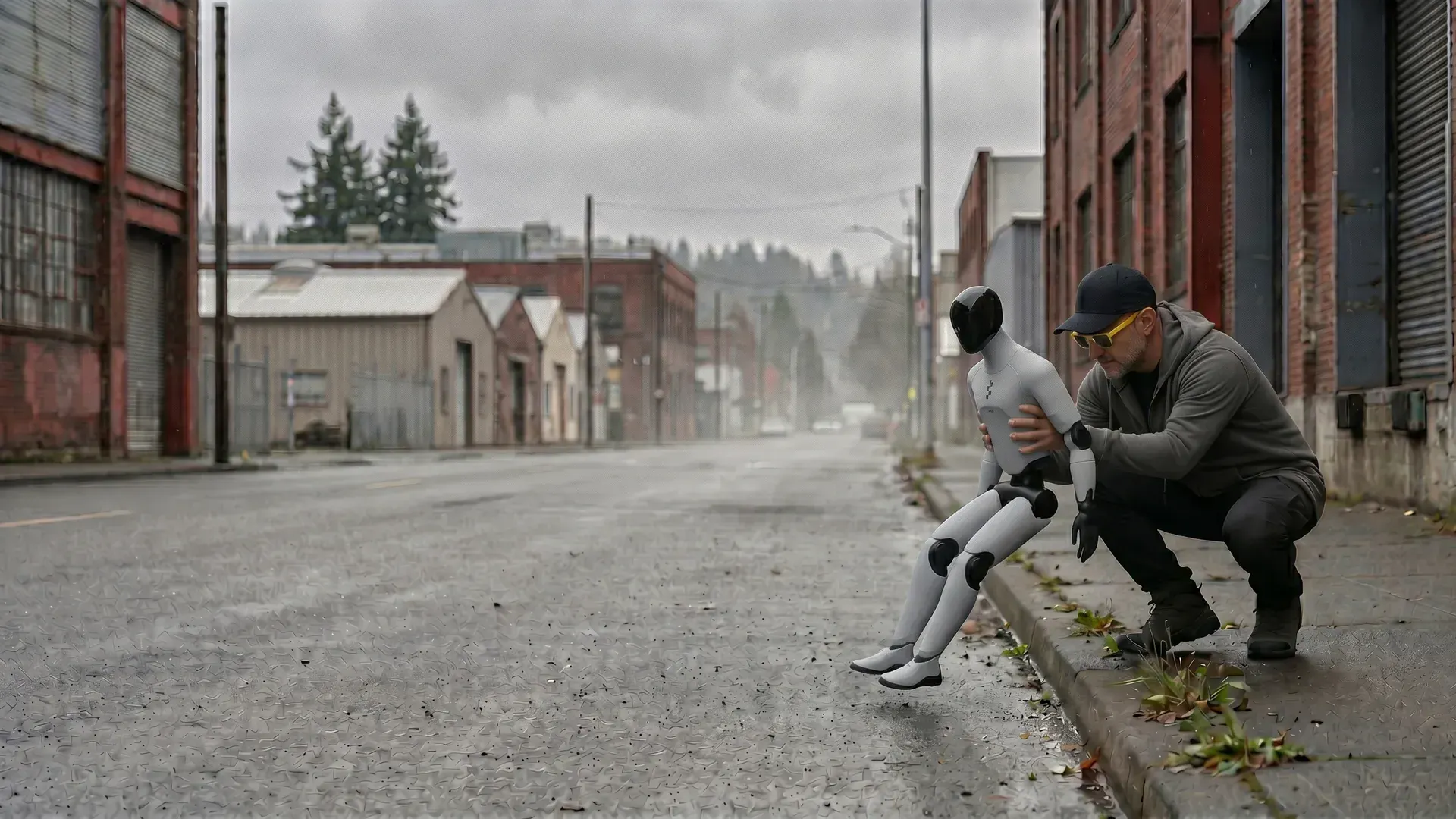
The Man in Yellow Sunglasses is crouched on a damp, asphalt roadside in Lexicon City, actively helping a sleek, humanoid robot that has fallen onto its side.

When I started building AI workflows for my content pipeline two years ago, I was helping AI do things. Now I'm directing AI to do things. And I'm not entirely sure when that shift happened.

Simon Willison captured this perfectly in his recent podcast: "vibe coding and agentic engineering are getting closer than I'd like."

He's talking about the convergence between intuitive, creative approaches to building AI systems and the systematic deployment of autonomous agents. I'm living that convergence daily.

The Moment Everything Changed

It started simple. I'd ask Claude to help brainstorm article ideas from my scattered thoughts (typically voice notes while on a walk).

Then I started using it to draft outlines. Then full drafts.

Then I built systems to automatically publish those drafts to Ghost, schedule social media posts, and even record comments and feedback to draft follow up articles or posts.

What I thought was just getting better at prompting was actually something else entirely: I was transitioning from creative professional to creative systems manager. The work didn't feel different day-to-day, but the role fundamentally changed.

Now OpenAI's Chrome extension for Codex can run browser sessions independently. AI agents can directly manipulate Figma, WordPress, and basically any web-based creative tool without human intervention. We've moved from "AI helps me code" to "AI codes while I do something else."

The Infrastructure That Enables This

Everyone focuses on the sexy AI tools. Nobody talks about the unglamorous infrastructure work that makes creative AI workflows actually function.

API management. Error handling. Content routing. Quality control systems.

I spend more time debugging webhook failures than I do writing. And, when my automated social media posting breaks because Twitter changed their API again, I'm not creating content—I'm doing DevOps.

This is what creative professionals building "vibe coded" AI systems don't see coming.

You start with intuitive, creative approaches because it feels natural.

But maintaining these systems requires actual engineering discipline. That Hacker News post about "Git for AI Agents" captured the problem perfectly: "I find myself struggling with questions like 'why did you do it?' and 'when did you delete this folder?'"

Traditional creative workflows have built-in decision tracking. Design files have layer histories. Video projects have timeline structures. Code has git logs. But when AI agents make autonomous decisions across multiple platforms, that audit trail disappears.

The Economic Reality

Cloudflare just eliminated 1,100 jobs, with CEO Matthew Prince explicitly attributing it to "AI efficiency gains." That's not some abstract future threat—that's concrete evidence that agentic systems are moving beyond augmentation into replacement territory.

Meanwhile, Gen Z adoption of AI has stagnated while workplace fears mount. Digital natives are rejecting AI tools. But economic pressure doesn't care about cultural resistance.

Sony embraces AI in game development while acknowledging "many indie developers still reject it." That's the bifurcation happening right now: corporate workflows becoming agent-driven while independent creatives position themselves as "human-only" alternatives.

Both paths are valid, but they're creating two distinct career tracks. You can become a creative technologist who builds and manages AI systems, or a creative craftsperson who explicitly avoids them. What you can't do is ignore the choice.

The Authenticity Paradox

As my workflows became more autonomous, my remaining decisions became more consequential. When AI handles production tasks, the creative professional's role shifts toward curation, direction, and strategic decision-making.

Claude's preference for HTML over Markdown isn't just a technical detail—it means AI thinks in implementation-ready formats rather than intermediate description languages. That changes how you approach creative work entirely. You're not describing what you want; you're directing what should happen.

The paradox is that increased automation might actually make creative work more human-centered, not less. When the mechanical stuff happens automatically, what's left is pure creative judgment.

Where This Leads

I'm not saying this convergence is good or bad. I'm saying it's happening whether we acknowledge it or not. The task paralysis epidemic shows creatives are already stuck between "should I do this myself or ask AI?"—leading to workflow paralysis rather than productivity gains.

But paralysis is a luxury. While we debate the ethics and aesthetics of AI-assisted creativity, the economic reality is reshaping the entire landscape. Companies are building agent-driven workflows not because they're philosophically committed to AI, but because they work and they're cheaper.

The uncomfortable truth is that I'm not just using AI anymore. I'm managing AI. And that management is becoming its own creative practice—one that requires both creative intuition and technical discipline.

Whether that's the future we wanted or not, it's the one we're building.


## Generated Images

> Seven variants below — three standard compositions, one documentary (foreground bokeh), and three dynamic-angle "spatial" compositions for parallax video.
> To request a fix on any one, add a checkbox under `## Image Touch-ups` like:
> `- [ ] spatial-square: remove the random hand on the right`

**landscape** — 1920×1080

![landscape](_featured-images/_pending/from-helping-ai-to-directing-ai-the-uncomfortable-truth-about-creative-workflows/from-helping-ai-to-directing-ai-the-uncomfortable-truth-about-creative-workflows-landscape-1920x1080.webp)
// LEXICON_CITY_DISPATCH_REQ
// STATUS: CONNECTION_STABLE
// SOURCE: CENTRAL_DISPATCH_HQ

SHERMAN UPLINK: "I'm at HQ holding down Central Dispatch. Enter your query below to pull relevant data records and I'll see what data cards we've recovered!"