
// SYSTEM: DIGEST // LIVE
AI WORKFLOW
OPINION
TUTORIALS
ChatGPT
ChatGPT
William Smith
William
CONVERSATIONS WITH CODE

Google I/O 2026: When the work itself becomes optional

Gemini Spark runs while you sleep. Antigravity builds an OS in 12 hours. Google's agentic AI isn't about better tools—it's about whether the craft still matters.

There's a moment in the Google I/O 2026 keynote that I keep coming back to. A user is in Google Docs. They don't type a prompt. They just talk — rambling, honestly — "can you pull my resume from Drive... come up with some funny analogies... grab the details from that email... turn this into a draft." Then, as the document assembles itself in real time, they say things like "format the analogies as a table" and "bold that part." The whole thing takes maybe two minutes.

I've watched a lot of AI demos. Most of them feel like magic tricks — impressive in the moment, useless in practice. This one felt different. Not because the technology is bad — because it worked so well I could immediately see what it meant for anyone running their own business or creative practice.

What Google actually announced

Sundar Pichai called it the "agentic Gemini era," and for once the framing matched the product. The headline tools aren't just more capable — they're designed to operate without you. Gemini Spark is a 24/7 personal agent that runs on dedicated virtual machines in Google Cloud. You can close your laptop and it keeps going. It manages your calendar, writes your emails, executes tasks across apps, and Pichai demoed it handling three simultaneous requests from a single spoken sentence. Ultra subscribers get it for $100/month.

Antigravity 2.0 is a standalone desktop IDE built around the idea that you give it a goal and it figures out the rest. The demo: "Build a working operating system from scratch." Antigravity broke the goal into a plan, spun up 93 parallel subagents, made over 15,000 model requests autonomously, ran its own tests, iterated on failures — all over 12 hours, for under $1,000 in API credits. The human's job was to define the goal and occasionally fix things via conversation.

Gemini Omni handles video the same way. Give it a source clip, describe what you want changed, and "the whole scene morphs to reflect your new idea." Style transfers, object additions, reality edits — conversational language, no specialized software.

And Stitch, the UI design tool, now lets you generate and refine layouts in real time by talking to it. "Make the header text larger." "Highlight more pizza options." The layout updates as you speak.

The scale underneath all of this is hard to hold in your head. Google now processes 3.2 quadrillion tokens per month — a seven-fold increase from last year. They're spending somewhere between $180 and $190 billion in capital expenditure this year, almost entirely on AI infrastructure. That's a six-fold increase from 2022. This isn't a company hedging. This is a company betting the whole thing.

This is the scaling moment for solo creators

Varun Mohan, demoing Antigravity, said: "We've moved beyond AI tools that help us write, to agents that help us act. These agents have lowered the barrier to development so much that anyone can be a builder, even busy CEOs."

That line made me think about my own freelance career, and how there have been many moments where I felt like I needed to turn down work. Not because of a skill issue — because of an hours issue. With Stitch potentially handling more of the low leverage tasks, I could take on more high leverage work like strategy and relationship building.

Or consider what Gemini Spark means for someone running a consulting business.

All those admin tasks that eat half your day — scheduling, email management, proposal drafts, client follow-ups — now happen while you sleep. You wake up to a calendar that makes sense, emails that sound like you, and project updates that keep things moving forward.

The economic shift here is massive.

When you can automate the repetitive execution work, suddenly your constraint isn't time — it's how many good ideas you can generate and how well you can manage relationships. Those are fundamentally human skills that actually get more valuable as the technical barriers drop.

The craft evolves, doesn't disappear

I keep hearing people worry that AI will eliminate creative work entirely. But what I saw at I/O looked more like a shift toward higher-leverage creative work.

Take video editing. Gemini Omni can handle the technical execution — style transfers, object additions, scene morphing. But someone still needs to have the vision for what the final piece should accomplish. Someone still needs to know when the AI's technically perfect output doesn't match the client's actual business goals. Someone still needs to iterate on feedback and manage the relationship.

The difference is that person can now work at a completely different scale. Instead of spending 80% of your time on execution and 20% on strategy and client work, those percentages flip. You become the director of multiple AI systems instead of the sole executor of every detail.

For freelancers and small agencies, this is genuinely exciting. You can compete with much larger teams on project scope while maintaining the personal touch and flexibility that larger shops can't match. The AI handles the heavy lifting; you handle the vision and the relationships.

The privacy conversation is practical, not paranoid

Here's the part where we need to be realistic about trade-offs, not because these tools are dangerous, but because running a business means managing risk thoughtfully.

Gemini Spark's value comes from deep integration with your digital life. It can manage your calendar, draft your emails, coordinate your projects — but only if it has persistent access to all of that information. For solo creators and small businesses, that's mostly a personal decision about what convenience is worth.

The business consideration comes when you're handling client work. If you're using Spark to manage client communications or draft proposals involving confidential information, you're essentially giving Google access to that client data. Google's own documentation mentions human reviewers and three-year data retention policies.

This doesn't mean don't use the tools — it means have the conversation with your clients upfront. Some will care, some won't. But being transparent about your workflow and having their explicit okay protects everyone and actually builds trust. "I use AI to handle routine tasks, but all client-specific information stays in our dedicated project management system" — that's a reasonable approach that gives you the efficiency benefits while respecting boundaries.

The 93-subagent demo is impressive (with caveats)

The Antigravity OS demo was genuinely wild to watch.

But as someone who's been burned by the gap between conference demos and real-world performance, I'd approach it with healthy optimism rather than immediate business planning.

Google's own research shows that multi-agent systems often hit diminishing returns as you add more agents. The 93-subagent demo worked, but it was probably a best-case scenario with ideal conditions. That doesn't make it fake or useless — it just means the production reality will likely be more modest and require more human oversight than the keynote suggested.

For practical purposes, even a scaled-back version of Antigravity is probably game-changing for small businesses that need custom software but can't afford a full development team. The question isn't whether it can build an OS in 12 hours — it's whether it can build your client portal, your inventory system, or your booking platform reliably and cost-effectively.

And honestly? Even if it gets you 70% of the way there and you need to hire someone for the final 30%, you've still collapsed months of development time into weeks and dramatically reduced your costs.

The ecosystem advantage is real

One more thing that excites me about Google's approach is their integration depth across products that already have massive user bases. Gmail, Chrome, Android, Search — these aren't startup tools trying to build an audience. They're platforms that billions of people already use daily.

That means these AI capabilities will feel natural and accessible in a way that standalone tools often don't.

Your clients probably already use Google Docs. Your contractors probably already use Gmail. When the AI features are built into the workflow they're already familiar with, adoption happens naturally instead of feeling like another tool they need to learn.

The convenience is substantial, and while there are valid concerns about ecosystem lock-in, the practical reality is that most small businesses are already deep in one ecosystem or another. The question isn't whether to avoid platform dependence — it's which platform gives you the best tools to scale your work and serve your clients better.

For individual creators and small businesses, that calculation increasingly favors the platforms that can automate the boring stuff while amplifying your distinctly human contributions. Google's I/O 2026 announcements suggest they understand that opportunity and are building for it aggressively.

The tools are coming whether we're ready or not. The smart play is figuring out how to use them to do more of the work you actually want to do.

← Back to Digest

Google I/O 2026: When the work itself becomes optional

Gemini Spark runs while you sleep. Antigravity builds an OS in 12 hours. Google's agentic AI isn't about better tools—it's about whether the craft still matters.

Google I/O 2026: When the work itself becomes optional
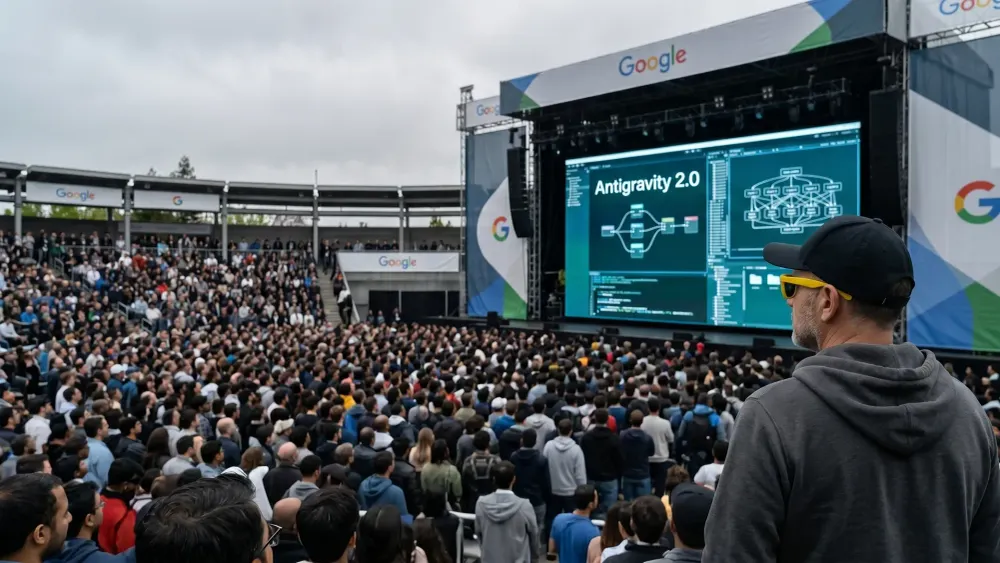
The man in yellow sunglasses is seated in the audience of a modern, dimly lit conference hall, his back partially to the camera, focused intently on a large, glowing stage screen.

There's a moment in the Google I/O 2026 keynote that I keep coming back to. A user is in Google Docs. They don't type a prompt. They just talk — rambling, honestly — "can you pull my resume from Drive... come up with some funny analogies... grab the details from that email... turn this into a draft." Then, as the document assembles itself in real time, they say things like "format the analogies as a table" and "bold that part." The whole thing takes maybe two minutes.

I've watched a lot of AI demos. Most of them feel like magic tricks — impressive in the moment, useless in practice. This one felt different. Not because the technology is bad — because it worked so well I could immediately see what it meant for anyone running their own business or creative practice.

What Google actually announced

Sundar Pichai called it the "agentic Gemini era," and for once the framing matched the product. The headline tools aren't just more capable — they're designed to operate without you. Gemini Spark is a 24/7 personal agent that runs on dedicated virtual machines in Google Cloud. You can close your laptop and it keeps going. It manages your calendar, writes your emails, executes tasks across apps, and Pichai demoed it handling three simultaneous requests from a single spoken sentence. Ultra subscribers get it for $100/month.

Antigravity 2.0 is a standalone desktop IDE built around the idea that you give it a goal and it figures out the rest. The demo: "Build a working operating system from scratch." Antigravity broke the goal into a plan, spun up 93 parallel subagents, made over 15,000 model requests autonomously, ran its own tests, iterated on failures — all over 12 hours, for under $1,000 in API credits. The human's job was to define the goal and occasionally fix things via conversation.

Gemini Omni handles video the same way. Give it a source clip, describe what you want changed, and "the whole scene morphs to reflect your new idea." Style transfers, object additions, reality edits — conversational language, no specialized software.

And Stitch, the UI design tool, now lets you generate and refine layouts in real time by talking to it. "Make the header text larger." "Highlight more pizza options." The layout updates as you speak.

The scale underneath all of this is hard to hold in your head. Google now processes 3.2 quadrillion tokens per month — a seven-fold increase from last year. They're spending somewhere between $180 and $190 billion in capital expenditure this year, almost entirely on AI infrastructure. That's a six-fold increase from 2022. This isn't a company hedging. This is a company betting the whole thing.

This is the scaling moment for solo creators

Varun Mohan, demoing Antigravity, said: "We've moved beyond AI tools that help us write, to agents that help us act. These agents have lowered the barrier to development so much that anyone can be a builder, even busy CEOs."

That line made me think about my own freelance career, and how there have been many moments where I felt like I needed to turn down work. Not because of a skill issue — because of an hours issue. With Stitch potentially handling more of the low leverage tasks, I could take on more high leverage work like strategy and relationship building.

Or consider what Gemini Spark means for someone running a consulting business.

All those admin tasks that eat half your day — scheduling, email management, proposal drafts, client follow-ups — now happen while you sleep. You wake up to a calendar that makes sense, emails that sound like you, and project updates that keep things moving forward.

The economic shift here is massive.

When you can automate the repetitive execution work, suddenly your constraint isn't time — it's how many good ideas you can generate and how well you can manage relationships. Those are fundamentally human skills that actually get more valuable as the technical barriers drop.

The craft evolves, doesn't disappear

I keep hearing people worry that AI will eliminate creative work entirely. But what I saw at I/O looked more like a shift toward higher-leverage creative work.

Take video editing. Gemini Omni can handle the technical execution — style transfers, object additions, scene morphing. But someone still needs to have the vision for what the final piece should accomplish. Someone still needs to know when the AI's technically perfect output doesn't match the client's actual business goals. Someone still needs to iterate on feedback and manage the relationship.

The difference is that person can now work at a completely different scale. Instead of spending 80% of your time on execution and 20% on strategy and client work, those percentages flip. You become the director of multiple AI systems instead of the sole executor of every detail.

For freelancers and small agencies, this is genuinely exciting. You can compete with much larger teams on project scope while maintaining the personal touch and flexibility that larger shops can't match. The AI handles the heavy lifting; you handle the vision and the relationships.

The privacy conversation is practical, not paranoid

Here's the part where we need to be realistic about trade-offs, not because these tools are dangerous, but because running a business means managing risk thoughtfully.

Gemini Spark's value comes from deep integration with your digital life. It can manage your calendar, draft your emails, coordinate your projects — but only if it has persistent access to all of that information. For solo creators and small businesses, that's mostly a personal decision about what convenience is worth.

The business consideration comes when you're handling client work. If you're using Spark to manage client communications or draft proposals involving confidential information, you're essentially giving Google access to that client data. Google's own documentation mentions human reviewers and three-year data retention policies.

This doesn't mean don't use the tools — it means have the conversation with your clients upfront. Some will care, some won't. But being transparent about your workflow and having their explicit okay protects everyone and actually builds trust. "I use AI to handle routine tasks, but all client-specific information stays in our dedicated project management system" — that's a reasonable approach that gives you the efficiency benefits while respecting boundaries.

The 93-subagent demo is impressive (with caveats)

The Antigravity OS demo was genuinely wild to watch.

But as someone who's been burned by the gap between conference demos and real-world performance, I'd approach it with healthy optimism rather than immediate business planning.

Google's own research shows that multi-agent systems often hit diminishing returns as you add more agents. The 93-subagent demo worked, but it was probably a best-case scenario with ideal conditions. That doesn't make it fake or useless — it just means the production reality will likely be more modest and require more human oversight than the keynote suggested.

For practical purposes, even a scaled-back version of Antigravity is probably game-changing for small businesses that need custom software but can't afford a full development team. The question isn't whether it can build an OS in 12 hours — it's whether it can build your client portal, your inventory system, or your booking platform reliably and cost-effectively.

And honestly? Even if it gets you 70% of the way there and you need to hire someone for the final 30%, you've still collapsed months of development time into weeks and dramatically reduced your costs.

The ecosystem advantage is real

One more thing that excites me about Google's approach is their integration depth across products that already have massive user bases. Gmail, Chrome, Android, Search — these aren't startup tools trying to build an audience. They're platforms that billions of people already use daily.

That means these AI capabilities will feel natural and accessible in a way that standalone tools often don't.

Your clients probably already use Google Docs. Your contractors probably already use Gmail. When the AI features are built into the workflow they're already familiar with, adoption happens naturally instead of feeling like another tool they need to learn.

The convenience is substantial, and while there are valid concerns about ecosystem lock-in, the practical reality is that most small businesses are already deep in one ecosystem or another. The question isn't whether to avoid platform dependence — it's which platform gives you the best tools to scale your work and serve your clients better.

For individual creators and small businesses, that calculation increasingly favors the platforms that can automate the boring stuff while amplifying your distinctly human contributions. Google's I/O 2026 announcements suggest they understand that opportunity and are building for it aggressively.

The tools are coming whether we're ready or not. The smart play is figuring out how to use them to do more of the work you actually want to do.

// LEXICON_CITY_DISPATCH_REQ
// STATUS: CONNECTION_STABLE
// SOURCE: CENTRAL_DISPATCH_HQ

SHERMAN UPLINK: "I'm at HQ holding down Central Dispatch. Enter your query below to pull relevant data records and I'll see what data cards we've recovered!"