

The conversation about AI and journalism usually ends up in the same place: who is actually writing the articles?
But at The New York Times right now, in May 2026, the fight isn't about that.
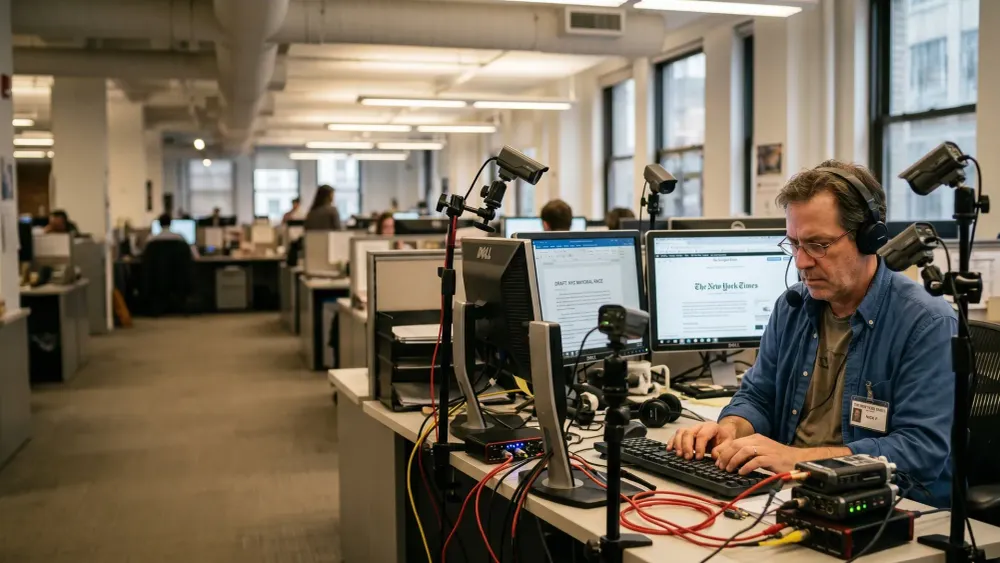
It's about something more immediate — whether management can use AI tools to watch how you work, score what you produce, and feed that data into your performance review without telling you that's what's happening.
That's the dispute the NewsGuild filed grievances and unfair labor practice charges over this month. Two unfair labor practice charges, one covering roughly 700 tech workers, one covering over 1,500 editorial and other staff. The core allegations: the Times is using AI tools to surveil union members' performance in violation of their contract, didn't notify the union when those tools were rolled out, and has refused to disclose information about its broader AI strategy — which federal labor law apparently requires them to do.
What the tools actually do
The two tools at the center of this are DX and Glean.
DX is an engineering productivity tracker. It measures developer output, generative AI usage, and efficiency metrics. The union's position is that data from DX is being applied to individual performance reviews and disciplinary actions — which is different from using it to understand team-level trends or identify where developers need support. Benjamin Harnett, chair of the Tech Guild's Generative AI committee and a staff software engineer at the Times, put it plainly: "Using AI to surveil our work violates our contract and creates a skewed, inaccurate picture of our members' work. Our work takes human judgment, problem-solving and skill that can't be accurately assessed by AI analysis and proxy metrics. It's the equivalent of setting an arbitrary story quota for journalists."
Glean is an internal search tool that indexes company documents, wikis, and communications. The union's concern there is that it could be used to monitor individual contributions — essentially a searchable record of everything you've typed internally.
The unions have also noted that some recent disciplinary notices appear to be AI-generated in format, which is its own thing to sit with.
None of this is confirmed in detail by the Times.
The company says it disagrees with the union's characterizations and will respond through the normal contractual process. But the pattern the union is describing — productivity metrics collected without full disclosure, fed into individual reviews, with workers finding out after the fact — is not a paranoid reading of the situation. It's what happens when a tool gets deployed for one stated purpose and then used for another.
The contradictions are structural, not accidental
The New York Times is simultaneously:
- Suing OpenAI and Microsoft for training AI models on Times content without permission
- Building its own in-house AI tools — Echo for content summarization, Cheatsheet for investigative reporters analyzing large datasets — some developed with companies in that same orbit
- Encouraging staff journalists to use AI for headline generation, research, and brainstorming
- Sending freelancers a strict reminder in May 2026 that generative AI is essentially banned for submitted work
- Publishing principles stating that journalists are always responsible for what they report, "however the report is created"
- Allegedly refusing to tell its own union how AI is being used to evaluate those same journalists
You could call this hypocrisy. I think it's something more structural than that.
What you're actually seeing is a large organization trying to adopt AI without having worked out a coherent governance framework first. The lawsuit protects their content as an asset. The in-house tools — plus approved external services like tools like GitHub Copilot — give them competitive capability. The freelancer ban limits liability. The staff guidelines give journalists enough runway to use AI productively. The performance tracking gives management data they want. Each decision makes local sense but produce organizational incoherence when combined. Together they produce a company that is simultaneously the plaintiff in a major AI copyright case, an AI tool builder, an AI tool restrictor, and — allegedly — an AI surveillance operator. All at once.
Managing editor Marc Lacey wrote to staffers in April that "AI technology is ceaselessly evolving — quickly — and we believe that this rapid change is precisely why we must remain flexible." That's a real argument. If you lock specific AI prohibitions into a multi-year union contract, you might find yourself contractually prevented from using tools that didn't exist when the contract was signed. The technology genuinely does move faster than contract cycles.
The problem is that "we need flexibility" is also the argument you'd make if you wanted to avoid accountability. Those two things are hard to distinguish from the outside, and apparently hard to distinguish from inside the building too, which is why the union is filing unfair labor practice charges instead of just taking management's word for it.
What this means for people who aren't in a union
Most freelancers, independent creators, and small operators reading this aren't in a position to file unfair labor practice charges. I'm not either. But the Times dispute is useful to watch because it's making visible a set of questions that will eventually land in front of everyone who works with or alongside AI tools.
The first question is about metrics. DX tracks developer output and AI usage. That kind of tool exists for lots of roles now, not just software engineers. If you work inside a company, or do contract work where a client has visibility into your process, there's a reasonable chance that some form of productivity tracking is already in place — or will be. The question of whether those metrics accurately represent your work is not abstract. Harnett's point about proxy metrics is worth keeping: a number that tracks how many commits you made, or how many AI queries you ran, or how many words you produced in a session, measures activity, not whether you solved the right problem.
The second question is about disclosure. The Times union's position is that management is legally required to tell them how AI is being used to evaluate workers. That's a labor law argument specific to unionized workplaces. But the underlying principle — that you should know when and how your performance is being assessed, and by what — seems like a reasonable expectation in any working relationship. It's part of what adopting AI actually means for your process. If you're a freelancer and a client starts using a tool to score your output, you probably want to know that.
The third question is about what gets protected. The Times Guild's demands include the ability for journalists to remove their bylines from AI-assisted stories, a share of revenue from licensing Times content for AI training, and protections against AI replacing workers. Those are contract demands, but they're also a list of concerns that any creative professional should probably think through for their own situation. Who owns the work? Who benefits when that work trains a model? What happens to your name when it's attached to something you didn't fully control?
The monitoring apparatus runs ahead of the replacement conversation
Isaac Aronow, an editor on the Times' Games section and member of the bargaining committee, said in February: "Newspaper management across the country is finding ways to use AI to fire journalists, lower the quality of the product and generally it's a huge, huge threat."
He also said, separately: "We need to get protections in our contract now before these AI companies get even bigger."
The second quote is the more important one. The union isn't waiting to see how the technology develops. They're trying to establish rules while there's still leverage to negotiate them. That's a different posture than most workers — unionized or not — are taking right now.
The standard creative professional response to AI in 2026 is still mostly "let's figure out how to use it well." Which is reasonable! I spend a lot of time thinking about that myself. But the Times dispute is a reminder that how AI gets used inside an organization isn't just a question of individual workflow. It's a governance question, and governance gets settled through negotiation or through unilateral decisions by whoever has the power to make them.
If you're not at the table for that negotiation — and most of us aren't — then the decisions get made without you, and you find out about them later, when the disciplinary notice shows up in a format that looks like it was generated by the same tools you were never told were watching you.
The monitoring infrastructure usually comes before the replacement conversation. The Times is just big enough that we can see both happening at the same time.
Generated Images
Seven variants below — three standard compositions, one documentary (foreground bokeh), and three dynamic-angle "spatial" compositions for parallax video. To request a fix on any one, add a checkbox under## Image Touch-upslike:- [ ] spatial-square: remove the random hand on the right
landscape — 1920×1080
