
// SYSTEM: DIGEST // LIVE
AI WORKFLOW
OPINION
TUTORIALS
ChatGPT
ChatGPT
William Smith
William
CONVERSATIONS WITH CODE

Google's AI Certificate Hit 635,000 Students. Here's What That Actually Means.

title: "Google's AI Certificate Hit 635,000 Students. Here's What That Actually Means." type: post revises_slug: reviewing-the-google-ai-professional-certification-from-coursera excerpt: "Tech giants aren't just teaching you their tools—they're credentialing you in them while setting the standard for what AI fluency looks like." tags: [AI, Opinion, Career, insights] transparency: 60 status: Approved

Eric Schmidt got booed at a graduation ceremony last week for cheerleading AI to students about to enter a job market that feels increasingly hostile to human workers. The timing couldn't be more perfect for talking about Google's AI Professional Certificate, which just crossed 635,000 enrolled students and is quietly reshaping how we think about AI education.

Google's AI Professional Certificate launched in February. A few months in—with the credential rolling out into actual job searches and the AI job market getting weirder by the day—what looked like just another big-tech course has revealed itself as something more interesting. This isn't just about one certificate program. It's about how tech giants are rebuilding education inside their own ecosystems—and what that means for the rest of us trying to figure out where we fit in an AI-driven economy.

The Numbers Tell a Story

Over 635,000 people enrolled in Google's AI Professional Certificate within weeks of its February launch. To put that in perspective: that's more people than live in most major cities, all trying to learn the same thing at the same time. Not AI engineering. Not machine learning theory. Just practical fluency with AI tools like Gemini, NotebookLM, and Google AI Studio.

The program costs $49 on Coursera if you knock it out in a month (which most people do—it's designed for 8-10 hours total, though some finish in four). Google developed the curriculum by analyzing job descriptions with partners like Walmart, Deloitte, and Verizon to figure out what employers actually want. The result is seven courses that walk you through building over 20 hands-on projects, including what Google calls "vibe coding"—building simple apps through conversational AI without writing traditional code.

Here's the kicker: Google gives you a three-month trial of their AI Pro tier when you enroll. You're not just learning about their tools. You're learning on their tools while they credential you in their tools. That's a closed loop that would make any business school professor weep with admiration.

The Brutal Truth About What This Actually Gets You

Let me be direct about something that the marketing materials dance around: this certificate will not land you an AI job on its own. As one reviewer put it bluntly, "This certificate isn't theoretical; you'll learn by building job-ready solutions you can put to work immediately." But it's also not going to make you an AI engineer or get you hired for a specialized AI role.

What it will do is legitimize the skills you claim to have, give you concrete projects to show interviewers, and—critically—build real fluency rather than surface-level familiarity. One learner told Udemy: "I was not aware of this Google tool [AI Studio], but immediately after taking the course, I put it to use. Within 24 hours, I had a functional, highly useful app for my law firm."

That's the sweet spot this certificate hits. It's a floor, not a ceiling. A way to signal baseline literacy and show that you've done the work, not just watched YouTube tutorials.

The Pedagogical Irony Nobody's Talking About

Here's what struck me as genuinely weird when I went through this program: Google teaches you about cutting-edge AI through traditional, human-led video lectures. Think about that for a second. You're learning about the future of human-computer collaboration from a talking head in a recorded video, not by actually collaborating with an AI.

Why wasn't this course taught by Gemini itself? Why not let the AI walk you through building with AI? The whole experience feels sanitized in a way that misses an opportunity to showcase the genuinely strange, machine-like potential of these tools. Instead, you get reassuring human voices explaining how to keep humans "in the loop."

I get why Google made this choice—it's less threatening, more familiar. But it also suggests they're not quite ready to let AI be weird yet, even in a course specifically about AI.

The Skills Gap That Everyone's Scrambling to Fill

Google's research with Ipsos found that 70% of managers believe an AI-trained workforce is critical, but only 14% of employees have received any formal AI training from their employers. That gap is real, and it's driving the demand for programs like this.

Over half of job postings requesting AI skills are now for roles outside traditional IT. Marketing managers who need to understand how AI affects campaign optimization. HR professionals dealing with AI-assisted resume screening. Content creators figuring out how to use these tools without losing their voice.

The certificate is designed for exactly these people—non-technical professionals who need to use AI tools effectively, not build them. And based on the enrollment numbers, Google found their market.

Why The Credential Economy Is Back (But Weirder)

For years, the narrative was that portfolios beat degrees, that self-taught beat certified. Now we're watching tech giants rebundle education into micro-credentials that carry weight specifically because they're attached to the tools themselves.

This isn't just about education—it's about ecosystem lock-in. When Google credentials you in Gemini, they're not just teaching you a skill. They're establishing their AI ecosystem as the default for this newly "AI-fluent" workforce and setting the standard for what practical AI competency looks like in a business context.

Microsoft, AWS, and others are doing the same thing. The company that makes the tool now controls the certification process for using it. That's a level of vertical integration that would have seemed impossible in the old world of education, but makes perfect sense in the current AI boom.

What This Means for People Actually Trying to Learn

The certificate serves a real purpose for people who need to prove baseline AI literacy quickly. One reviewer captured this perfectly: "The loudest lie in the creative industry is that your work speaks for itself... If you have two people who know exactly the same thing, but one has a badge from a tech giant like Google, the world tends to weigh that person a little more heavily."

That's honest about how hiring actually works. Sometimes you need the sticker for the suitcase, even if you already know the route.

But here's what the certificate can't do: it can't teach you to think critically about when and how to use AI in your specific context. It can't help you develop taste about what makes AI-assisted work good versus just efficient. And it definitely can't prepare you for the weird, uncomfortable, genuinely transformative ways these tools might change your industry.

That deeper fluency—the kind that lets you navigate uncertainty and build things that matter—comes from practice, community, and thinking through problems with other people who are wrestling with the same questions.

The Real Value Is in What Happens After

The most interesting part of Google's certificate might not be the certificate itself, but what it signals about the broader shift happening right now. 635,000 people enrolling in an AI literacy program in a matter of weeks suggests we're past the point of wondering whether AI will affect knowledge work. Now the question is how quickly people can develop the skills to use these tools thoughtfully.

The certificate is useful for what it is: a structured, Google-sanctioned introduction to their AI tools that gives you projects to show employers and a badge that carries some weight in hiring decisions. But it's also insufficient for anyone who wants to do more than just use AI—people who want to understand it, critique it, and shape how it develops.

That gap between "AI-literate" and "AI-capable" is still wide. And frankly, that's where the most interesting work is happening.

← Back to Digest

Google's AI Certificate Hit 635,000 Students. Here's What That Actually Means.

Google's AI Certificate Hit 635,000 Students. Here's What That Actually Means.
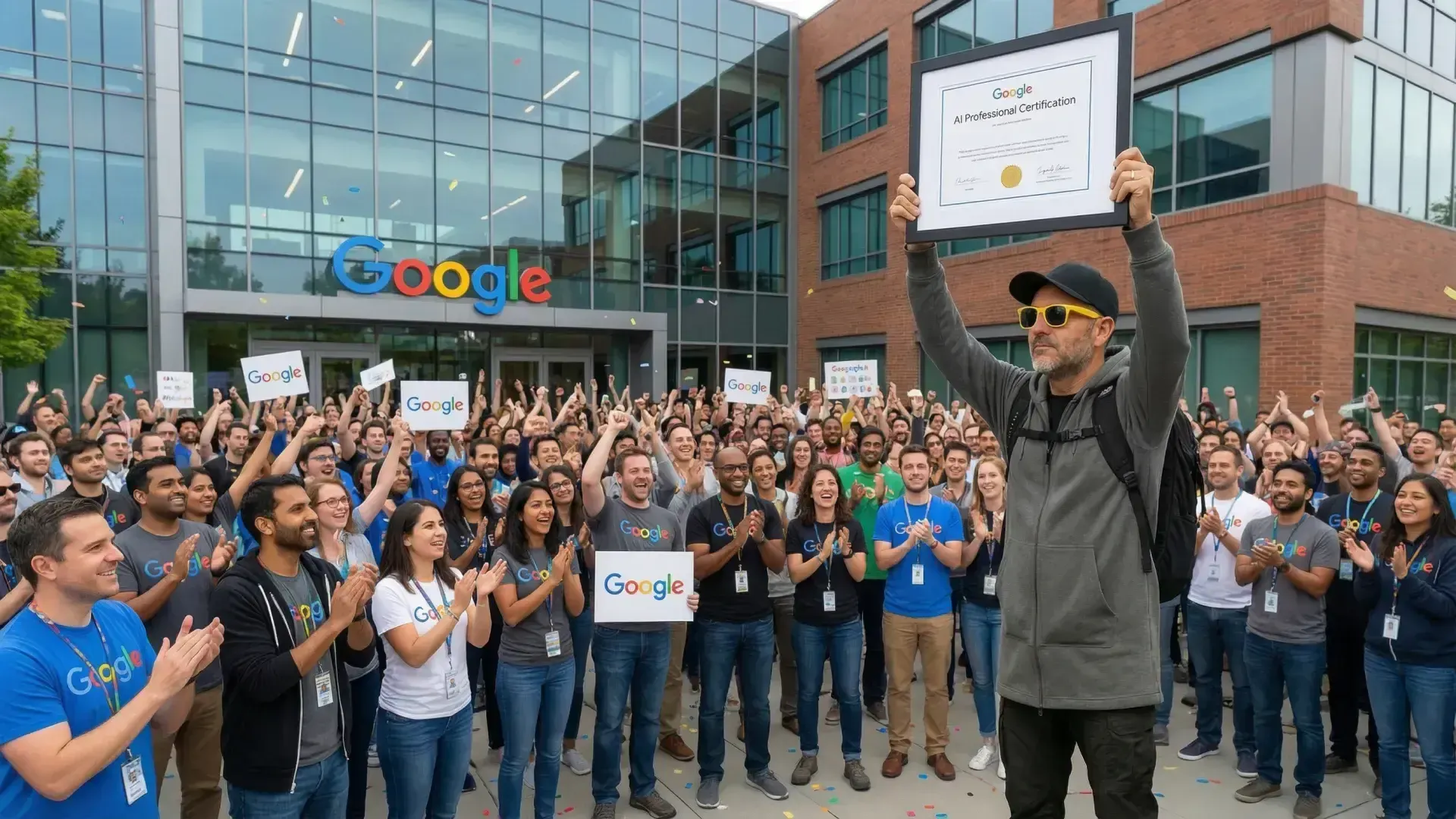
A celebratory crowd of Google employees gathered outside the company's glass and brick headquarters building.

title: "Google's AI Certificate Hit 635,000 Students. Here's What That Actually Means." type: post revises_slug: reviewing-the-google-ai-professional-certification-from-coursera excerpt: "Tech giants aren't just teaching you their tools—they're credentialing you in them while setting the standard for what AI fluency looks like." tags: [AI, Opinion, Career, insights] transparency: 60 status: Approved

Eric Schmidt got booed at a graduation ceremony last week for cheerleading AI to students about to enter a job market that feels increasingly hostile to human workers. The timing couldn't be more perfect for talking about Google's AI Professional Certificate, which just crossed 635,000 enrolled students and is quietly reshaping how we think about AI education.

Google's AI Professional Certificate launched in February. A few months in—with the credential rolling out into actual job searches and the AI job market getting weirder by the day—what looked like just another big-tech course has revealed itself as something more interesting. This isn't just about one certificate program. It's about how tech giants are rebuilding education inside their own ecosystems—and what that means for the rest of us trying to figure out where we fit in an AI-driven economy.

The Numbers Tell a Story

Over 635,000 people enrolled in Google's AI Professional Certificate within weeks of its February launch. To put that in perspective: that's more people than live in most major cities, all trying to learn the same thing at the same time. Not AI engineering. Not machine learning theory. Just practical fluency with AI tools like Gemini, NotebookLM, and Google AI Studio.

The program costs $49 on Coursera if you knock it out in a month (which most people do—it's designed for 8-10 hours total, though some finish in four). Google developed the curriculum by analyzing job descriptions with partners like Walmart, Deloitte, and Verizon to figure out what employers actually want. The result is seven courses that walk you through building over 20 hands-on projects, including what Google calls "vibe coding"—building simple apps through conversational AI without writing traditional code.

Here's the kicker: Google gives you a three-month trial of their AI Pro tier when you enroll. You're not just learning about their tools. You're learning on their tools while they credential you in their tools. That's a closed loop that would make any business school professor weep with admiration.

The Brutal Truth About What This Actually Gets You

Let me be direct about something that the marketing materials dance around: this certificate will not land you an AI job on its own. As one reviewer put it bluntly, "This certificate isn't theoretical; you'll learn by building job-ready solutions you can put to work immediately." But it's also not going to make you an AI engineer or get you hired for a specialized AI role.

What it will do is legitimize the skills you claim to have, give you concrete projects to show interviewers, and—critically—build real fluency rather than surface-level familiarity. One learner told Udemy: "I was not aware of this Google tool [AI Studio], but immediately after taking the course, I put it to use. Within 24 hours, I had a functional, highly useful app for my law firm."

That's the sweet spot this certificate hits. It's a floor, not a ceiling. A way to signal baseline literacy and show that you've done the work, not just watched YouTube tutorials.

The Pedagogical Irony Nobody's Talking About

Here's what struck me as genuinely weird when I went through this program: Google teaches you about cutting-edge AI through traditional, human-led video lectures. Think about that for a second. You're learning about the future of human-computer collaboration from a talking head in a recorded video, not by actually collaborating with an AI.

Why wasn't this course taught by Gemini itself? Why not let the AI walk you through building with AI? The whole experience feels sanitized in a way that misses an opportunity to showcase the genuinely strange, machine-like potential of these tools. Instead, you get reassuring human voices explaining how to keep humans "in the loop."

I get why Google made this choice—it's less threatening, more familiar. But it also suggests they're not quite ready to let AI be weird yet, even in a course specifically about AI.

The Skills Gap That Everyone's Scrambling to Fill

Google's research with Ipsos found that 70% of managers believe an AI-trained workforce is critical, but only 14% of employees have received any formal AI training from their employers. That gap is real, and it's driving the demand for programs like this.

Over half of job postings requesting AI skills are now for roles outside traditional IT. Marketing managers who need to understand how AI affects campaign optimization. HR professionals dealing with AI-assisted resume screening. Content creators figuring out how to use these tools without losing their voice.

The certificate is designed for exactly these people—non-technical professionals who need to use AI tools effectively, not build them. And based on the enrollment numbers, Google found their market.

Why The Credential Economy Is Back (But Weirder)

For years, the narrative was that portfolios beat degrees, that self-taught beat certified. Now we're watching tech giants rebundle education into micro-credentials that carry weight specifically because they're attached to the tools themselves.

This isn't just about education—it's about ecosystem lock-in. When Google credentials you in Gemini, they're not just teaching you a skill. They're establishing their AI ecosystem as the default for this newly "AI-fluent" workforce and setting the standard for what practical AI competency looks like in a business context.

Microsoft, AWS, and others are doing the same thing. The company that makes the tool now controls the certification process for using it. That's a level of vertical integration that would have seemed impossible in the old world of education, but makes perfect sense in the current AI boom.

What This Means for People Actually Trying to Learn

The certificate serves a real purpose for people who need to prove baseline AI literacy quickly. One reviewer captured this perfectly: "The loudest lie in the creative industry is that your work speaks for itself... If you have two people who know exactly the same thing, but one has a badge from a tech giant like Google, the world tends to weigh that person a little more heavily."

That's honest about how hiring actually works. Sometimes you need the sticker for the suitcase, even if you already know the route.

But here's what the certificate can't do: it can't teach you to think critically about when and how to use AI in your specific context. It can't help you develop taste about what makes AI-assisted work good versus just efficient. And it definitely can't prepare you for the weird, uncomfortable, genuinely transformative ways these tools might change your industry.

That deeper fluency—the kind that lets you navigate uncertainty and build things that matter—comes from practice, community, and thinking through problems with other people who are wrestling with the same questions.

The Real Value Is in What Happens After

The most interesting part of Google's certificate might not be the certificate itself, but what it signals about the broader shift happening right now. 635,000 people enrolling in an AI literacy program in a matter of weeks suggests we're past the point of wondering whether AI will affect knowledge work. Now the question is how quickly people can develop the skills to use these tools thoughtfully.

The certificate is useful for what it is: a structured, Google-sanctioned introduction to their AI tools that gives you projects to show employers and a badge that carries some weight in hiring decisions. But it's also insufficient for anyone who wants to do more than just use AI—people who want to understand it, critique it, and shape how it develops.

That gap between "AI-literate" and "AI-capable" is still wide. And frankly, that's where the most interesting work is happening.

// LEXICON_CITY_DISPATCH_REQ
// STATUS: CONNECTION_STABLE
// SOURCE: CENTRAL_DISPATCH_HQ

SHERMAN UPLINK: "I'm at HQ holding down Central Dispatch. Enter your query below to pull relevant data records and I'll see what data cards we've recovered!"