
// SYSTEM: DIGEST // LIVE
AI WORKFLOW
OPINION
TUTORIALS
ChatGPT
ChatGPT
William Smith
William
CONVERSATIONS WITH CODE

The Real Cost of Playing It Safe

Everyone's obsessed with polished output, but the messiest work teaches you the most.

I've been watching people tear apart beginners for sharing "imperfect" work, and it's getting exhausting.

Last week, someone posted their first AI-generated logo on Threads (and this happens every day, I could literally pull examples forever).

Within hours, the quote tweets rolled in: "This is why clients don't trust designers anymore." "AI slop flooding the market." "Learn actual design before you embarrass yourself."

I liked the post. Loved it, in fact. Because I love seeing people share what they are learning.

They tagged it as practice. They asked for feedback. They were transparent about their process. And instead of encouragement or constructive criticism, they got dragged.

The Perfectionist's Trap

We've created this weird culture where you're supposed to emerge fully formed.

"Don't share anything until it's portfolio-ready." "Don't ask questions that reveal your inexperience."

Basically, don't let anyone see you struggle. It's weakness.

That's bullshit, and it's holding everyone back.

The people talking shit? Most of them learned the same way.

Now we expect beginners to produce expert-level work on their first try, or at least keep their failures private until they're ready for the spotlight.

What We Actually Learn From

I've released plenty of work onto that makes me cringe now.

Early blog posts, presentations that were lame. Hell, Claude Code told me last week that my content pipeline was 60% good and 40% scar tissue.

You know what I learned from that work? Everything.

The failed presentation taught me how to structure an argument. The clunky blog posts showed me which ideas actually mattered to people. The messy code forced me to understand why clean code matters in the first place.

If I had waited until I was "ready" to share any of it, I'd still be waiting.

The Gatekeeper Problem

The people policing other people's learning process usually fall into one of two camps: insecure experts protecting their turf, or advanced beginners who just figured something out and want to pull up the ladder behind them.

Both groups are missing the point entirely.

When someone shares imperfect work, they're not claiming to be an expert. They're not trying to compete with you. They're doing the same thing you did when you were starting out: putting themselves out there and hoping to learn something.

The response to that shouldn't be ridicule. It should be recognition.

What Actually Helps

Instead of dunking on people's early attempts, try this:

Point out one thing that's working. Even if the overall execution is rough, there's usually something — a color choice, a concept direction, a problem they identified — worth acknowledging.

Ask about their process. "What were you trying to solve here?" often leads to more interesting conversations than "This sucks."

Share your own early work. Show them they're not alone in producing imperfect first attempts. Most people keep their learning journey private, which makes everyone else feel like they're the only ones struggling.

Suggest specific next steps. "Try adjusting the line spacing" is infinitely more helpful than "Learn typography."

The Real Value

Here's what the perfectionist crowd doesn't understand: messy work shared publicly creates more value than polished work kept private.

The beginner who posts their rough logo might inspire someone else to try. Their questions might surface useful resources. Their mistakes might help others avoid the same pitfalls.

Permission to Suck

We need more people willing to suck in public.

More first attempts shared without apology. More questions asked without shame. More experiments posted without disclaimers.

The internet already has enough polished content created by people pretending they never struggled. What it needs is more honest documentation of the learning process itself.

Your messy work is more valuable than you think. Not because it's perfect, but because it's real.

Share it anyway.

Generated Images

Seven variants below — three standard compositions, one documentary (foreground bokeh), and three dynamic-angle "spatial" compositions for parallax video. To request a fix on any one, add a checkbox under ## Image Touch-ups like: - [ ] spatial-square: remove the random hand on the right

landscape — 1920×1080

landscape
← Back to Digest

The Real Cost of Playing It Safe

Everyone's obsessed with polished output, but the messiest work teaches you the most.

The Real Cost of Playing It Safe
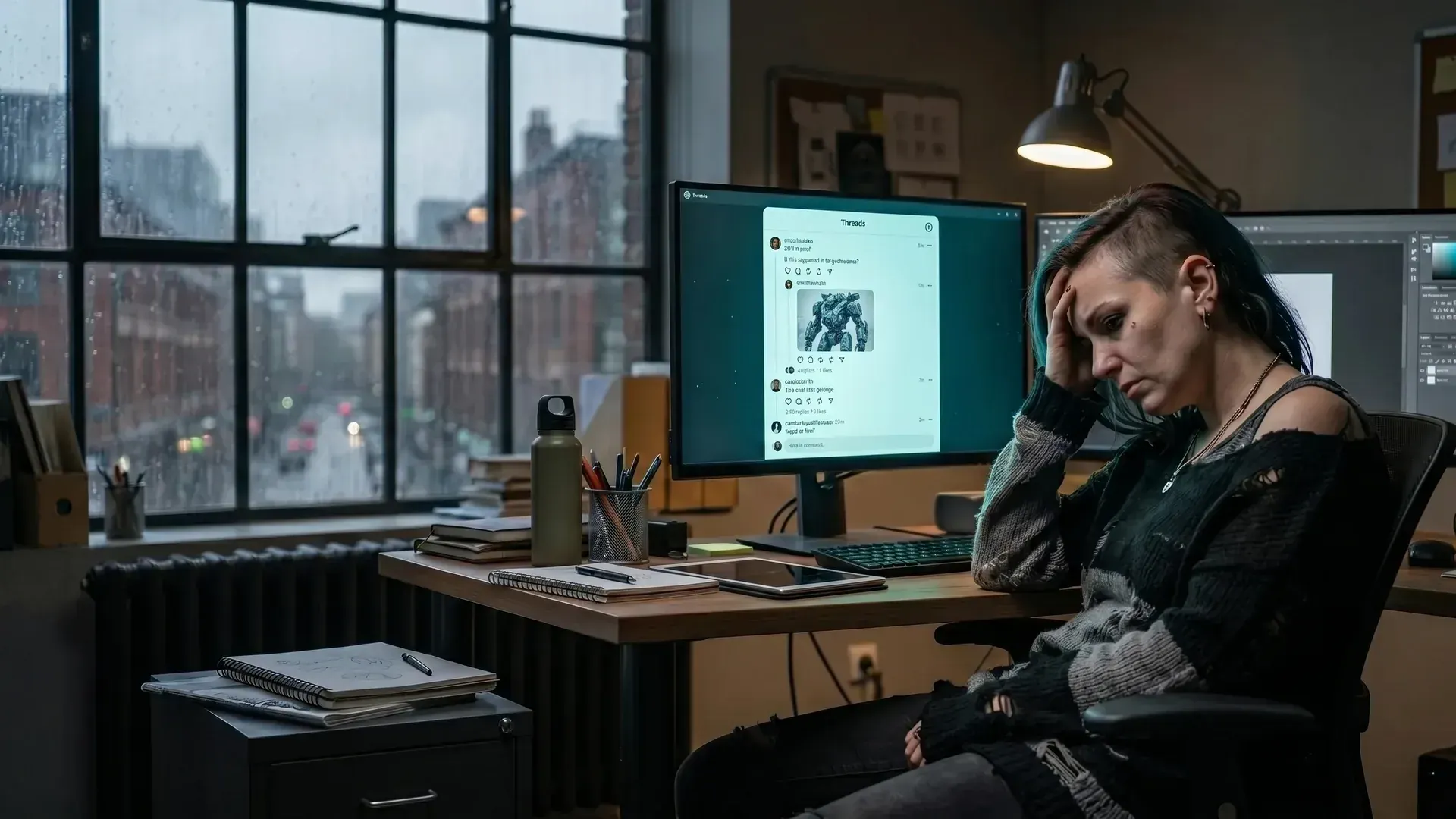
A mid-30s female designer, Tabitha, with an alternative style, sits slumped at her desktop computer in a dimly lit, lived-in workspace in Lexicon City.

I've been watching people tear apart beginners for sharing "imperfect" work, and it's getting exhausting.

Last week, someone posted their first AI-generated logo on Threads (and this happens every day, I could literally pull examples forever).

Within hours, the quote tweets rolled in: "This is why clients don't trust designers anymore." "AI slop flooding the market." "Learn actual design before you embarrass yourself."

I liked the post. Loved it, in fact. Because I love seeing people share what they are learning.

They tagged it as practice. They asked for feedback. They were transparent about their process. And instead of encouragement or constructive criticism, they got dragged.

The Perfectionist's Trap

We've created this weird culture where you're supposed to emerge fully formed.

"Don't share anything until it's portfolio-ready." "Don't ask questions that reveal your inexperience."

Basically, don't let anyone see you struggle. It's weakness.

That's bullshit, and it's holding everyone back.

The people talking shit? Most of them learned the same way.

Now we expect beginners to produce expert-level work on their first try, or at least keep their failures private until they're ready for the spotlight.

What We Actually Learn From

I've released plenty of work onto that makes me cringe now.

Early blog posts, presentations that were lame. Hell, Claude Code told me last week that my content pipeline was 60% good and 40% scar tissue.

You know what I learned from that work? Everything.

The failed presentation taught me how to structure an argument. The clunky blog posts showed me which ideas actually mattered to people. The messy code forced me to understand why clean code matters in the first place.

If I had waited until I was "ready" to share any of it, I'd still be waiting.

The Gatekeeper Problem

The people policing other people's learning process usually fall into one of two camps: insecure experts protecting their turf, or advanced beginners who just figured something out and want to pull up the ladder behind them.

Both groups are missing the point entirely.

When someone shares imperfect work, they're not claiming to be an expert. They're not trying to compete with you. They're doing the same thing you did when you were starting out: putting themselves out there and hoping to learn something.

The response to that shouldn't be ridicule. It should be recognition.

What Actually Helps

Instead of dunking on people's early attempts, try this:

Point out one thing that's working. Even if the overall execution is rough, there's usually something — a color choice, a concept direction, a problem they identified — worth acknowledging.

Ask about their process. "What were you trying to solve here?" often leads to more interesting conversations than "This sucks."

Share your own early work. Show them they're not alone in producing imperfect first attempts. Most people keep their learning journey private, which makes everyone else feel like they're the only ones struggling.

Suggest specific next steps. "Try adjusting the line spacing" is infinitely more helpful than "Learn typography."

The Real Value

Here's what the perfectionist crowd doesn't understand: messy work shared publicly creates more value than polished work kept private.

The beginner who posts their rough logo might inspire someone else to try. Their questions might surface useful resources. Their mistakes might help others avoid the same pitfalls.

Permission to Suck

We need more people willing to suck in public.

More first attempts shared without apology. More questions asked without shame. More experiments posted without disclaimers.

The internet already has enough polished content created by people pretending they never struggled. What it needs is more honest documentation of the learning process itself.

Your messy work is more valuable than you think. Not because it's perfect, but because it's real.

Share it anyway.

Generated Images

Seven variants below — three standard compositions, one documentary (foreground bokeh), and three dynamic-angle "spatial" compositions for parallax video. To request a fix on any one, add a checkbox under ## Image Touch-ups like: - [ ] spatial-square: remove the random hand on the right

landscape — 1920×1080

landscape
// LEXICON_CITY_DISPATCH_REQ
// STATUS: CONNECTION_STABLE
// SOURCE: CENTRAL_DISPATCH_HQ

SHERMAN UPLINK: "I'm at HQ holding down Central Dispatch. Enter your query below to pull relevant data records and I'll see what data cards we've recovered!"