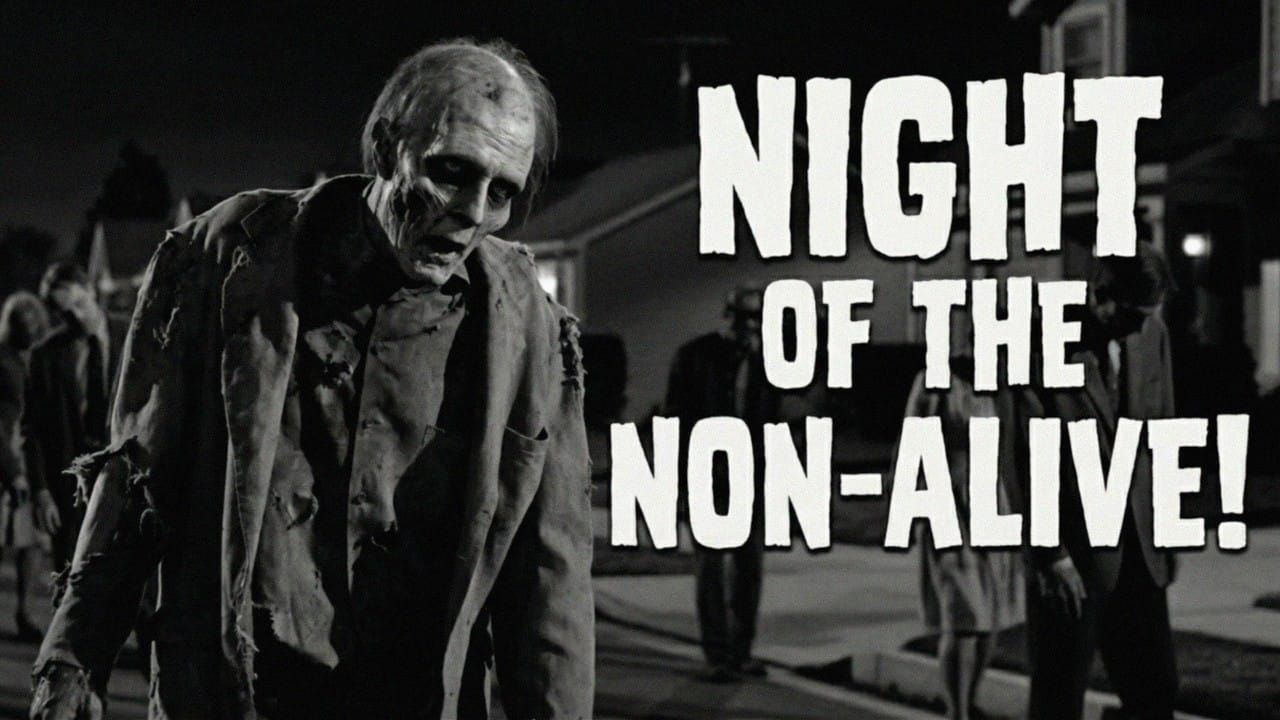

You scroll past a clip of a squat brown alien ranting about a government cover-up, shot like a 1997 public-access documentary, and it takes a second to clock that nobody filmed it. Then another clip rolls by — a reporter doing man-on-the-street interviews with aliens on a sidewalk. Same world. Same grainy broadcast look.
It's not a clip. It's a whole TV network.
That's the Monoverse, the running fiction behind Neural Viz's channel — a future Earth where humans have vanished and aliens called glurons make the kind of television we used to make. Mockumentaries, a cop show, a ghost-hunting parody, vox-pop street interviews. Near-weekly episodes, some running eight minutes, pulling hundreds of thousands to millions of views.
What makes it worth pulling apart isn't that it's AI. Lots of things are AI now. It's that it holds together — recurring characters you recognize, jokes that build across episodes, a world with its own rules. Most AI video is one cursed clip you watch once and forget. This is episodic television, made by one person.
That person is Josh Kerrigan, and the first thing worth knowing is that he was a filmmaker for over a decade before any of this. Film school, years of production work in LA, a TV pilot he's said he sold before going full-time on Neural Viz in early 2025. I bring it up now because it turns out to be the whole story, and we'll come back to it.
He built the world around what the tools can't do
Here's the part I keep thinking about. The AI horror artist Voidstomper — who I've written about before — built three million followers by leaning into the glitch. The melting faces and extra limbs are the point; the error is the art.
Kerrigan went the opposite direction. He studied what these models are bad at and designed a world specifically to hide it.
AI is good at talking heads, so the Monoverse is mostly people — well, aliens — talking to a camera. The uncanny valley is brutal on realistic humans, so his characters are bulbous cartoon glurons your brain never expects to look real in the first place. Clean 4K makes every rendering artifact scream, so everything is graded like a worn-out 20th-century broadcast: VHS noise, soft focus, a tape that's been copied one too many times.
The limitations are still there. He just built a set where they read as style. There's even a character whose long-vowel verbal tic — "Iiiiiiiii" — started as a software error he decided to keep.
The workflow looks like a writers' room, not a prompt box
This is the part people actually search for, so here's the honest version of how the episodes get made.
He starts with a full script — slug lines, action, dialogue, camera blocking, the whole format. Then he storyboards each shot and generates a still for every panel, mostly with Midjourney plus a few other image tools, holding lighting and sight lines consistent so the cuts don't fall apart later.
Then the step I didn't expect: he performs it. Kerrigan acts the lines out in front of his webcam, and tools like Runway's Act-One map his actual performance — the timing, the head turns, the delivery — onto the alien characters. Hedra handles lip-sync, which he's called the best tool for the job. Voices come from ElevenLabs, sometimes layered over his own. Then it all gets cut together in Premiere like any other edit.
His own numbers: roughly twelve hours and about a hundred bucks a month in subscriptions for a two-to-three-minute piece. No set, no crew, no permits. (The specific models shift constantly — what's stable is the shape of the pipeline: write, storyboard, generate, perform, voice, cut.)
The tools got cheap; the craft is still the expensive part
Which brings it back to that decade of filmmaking.
It's tempting to look at Neural Viz and credit the software, and the software is genuinely good now. But hand those same subscriptions to most of us and you don't get the Monoverse. You get a nice-looking clip with nothing underneath it. The writing, the blocking, the comic timing, knowing which take to keep — that's the ten-year part, and it's the part the AI doesn't do for you.
Kerrigan says it straight: "Everything I do within these tools is a skill set that's been built up over a decade plus." And: "I'm here to tell stories... they're not the end-all-be-all."
I think that's the most useful thing to take from him, especially if you're just starting and feeling behind. The tools got cheap. The craft is still what takes years — and the good news is craft is learnable, and now you can practice it on a hundred-dollar subscription instead of a hundred-thousand-dollar shoot. That part really is new, and honestly it's a better deal than the one I came up on.
So watch a few Monoverse episodes before you write off AI video as a novelty. Then go make the worst version of your own weird idea. The first one's always rough — mine sure was.