
The part of making things I've always liked least is telling people I made something.
I don't think that's unusual. A lot of creators feel it — you spend real time on an article or a video, and then you're supposed to spend more time packaging it into platform-specific promos and posting it everywhere and hoping the algorithm picks it up. That last part feels like a different job. One I never signed up for.
So that's what the distributor solves for.
One article goes live, and the system figures out what to post about it on Threads, LinkedIn (my personal profile and the company page), Instagram, and YouTube — without me having to think about it again.
This is deep dive #5 off the hub article on the AI system behind this site. If you haven't read that one yet, it's worth starting there — it maps the whole pipeline.
One article, four different voices
After an article goes live on Ghost (that's the platform I use to publish — think of it like WordPress, but way cooler and capable), a script kicks off automatically and writes platform-specific posts. Not one blurb that gets copy-pasted everywhere. Actual different posts, written to match how people actually read on each platform.
Threads gets a short, deadpan take. My personal LinkedIn gets something more considered — more context, more framing. Instagram is written in what I've been calling a "scout-log" style, which fits the visual-first nature of that platform. YouTube gets a whole other character thing I'll write about separately.
The point is that each platform gets something that feels native to it.
A Threads post written in LinkedIn voice reads like a press release. A LinkedIn post written in Threads voice reads like someone trying too hard. I've been on the receiving end of both, and neither one makes me want to engage.
Getting the voice right per platform is the part most people skip when they automate distribution. They automate the posting, but they copy-paste the same text everywhere — then wonder why engagement is flat.
The company page rule
Here's where it gets interesting.
The LinkedIn company page doesn't get a custom AI-written post. At all.
When the system queues something for the company page, it goes back and fetches the actual excerpt — the short summary paragraph — directly from the published article. It pairs that with the live link and posts it. No AI rewrite. No "here's what this article is about" summary. No added opinion. Just the excerpt and the link.
This was a deliberate fix, not how it started.
The original version was generating two different AI summaries of the same article — one for my personal LinkedIn, one for the company page. Both went out. Both were technically fine. But they were slightly different takes on the same piece, which looked strange. And more importantly, that company page post was doing work that had already been done. The article was reviewed before it published. The excerpt was already written. The company page doesn't need to pile an extra opinion on top.
So the rule became: re-fetch the live excerpt at publish time — not the draft version, the actual live text — and use that. One share per URL, ever. No rewrites.
A repost feed doesn't need an opinion bolted on.
Why deduplication matters more than it sounds
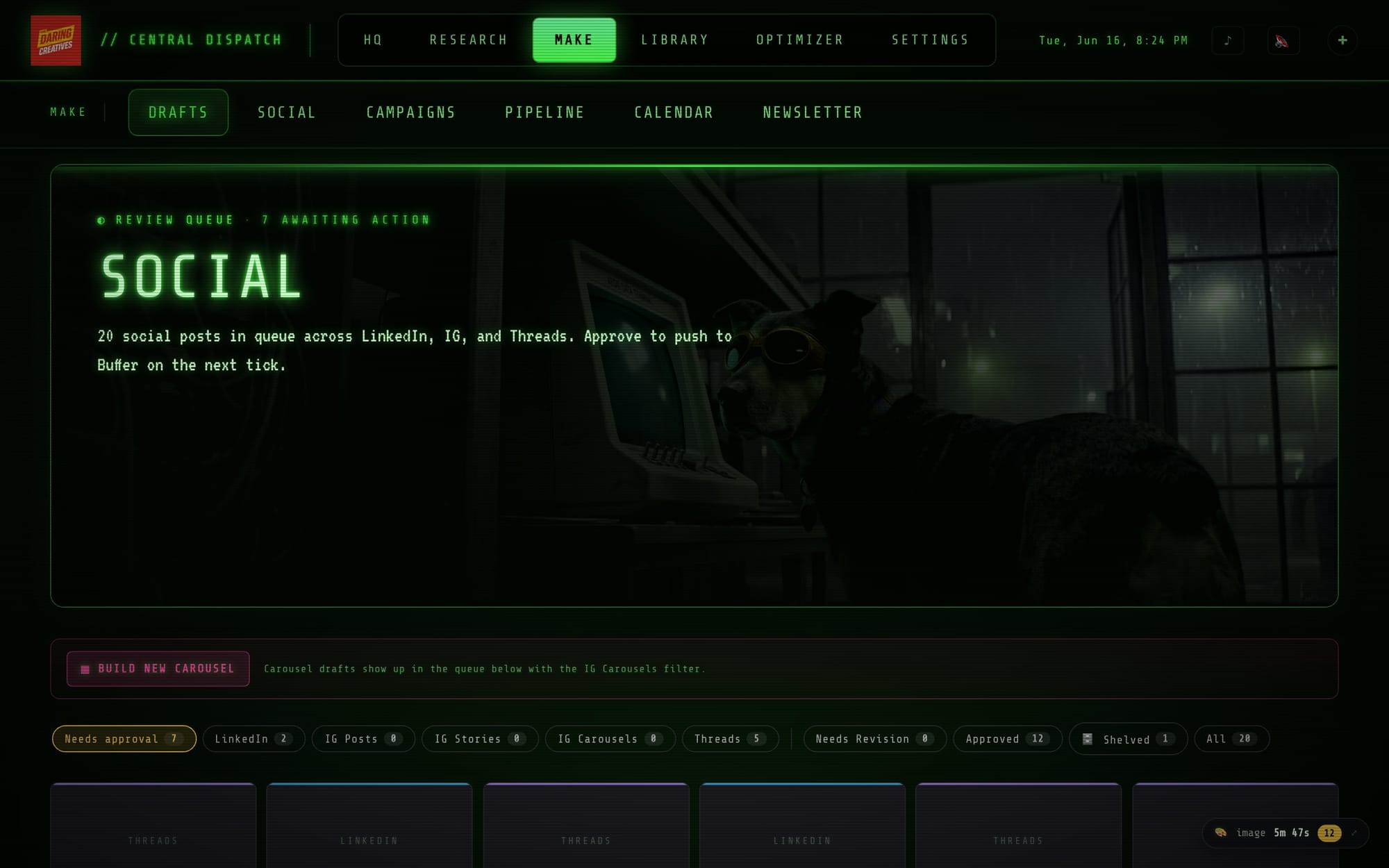
Before the system drafts anything new, it checks what it's already sent. It reads through recent posts, checks an archive of what's been posted, and looks at what's already sitting in the Buffer queue (Buffer is the scheduling tool that actually sends posts at the right time). Then it dedupes by URL — meaning the same article cannot get queued up twice, even if the text would be different.
This sounds like basic hygiene, and it is. But it took a while to get right.
Early on, the same article would keep surfacing in the social queue — not because of a bug exactly, but because different parts of the system could each independently decide an article was worth promoting. Without real dedup logic, you end up hammering one piece over and over while other articles never get touched.
I flagged this more than once before the rotation and dedup logic actually got enforced. I include that detail because it's the honest version of how these systems get built — you ship something, it misbehaves in a specific way, you fix it. It's not a clean architecture diagram from the start. If you want the fuller picture of how this pipeline actually gets built, that piece covers the publishing layer in more detail.
The carousel is its own thing
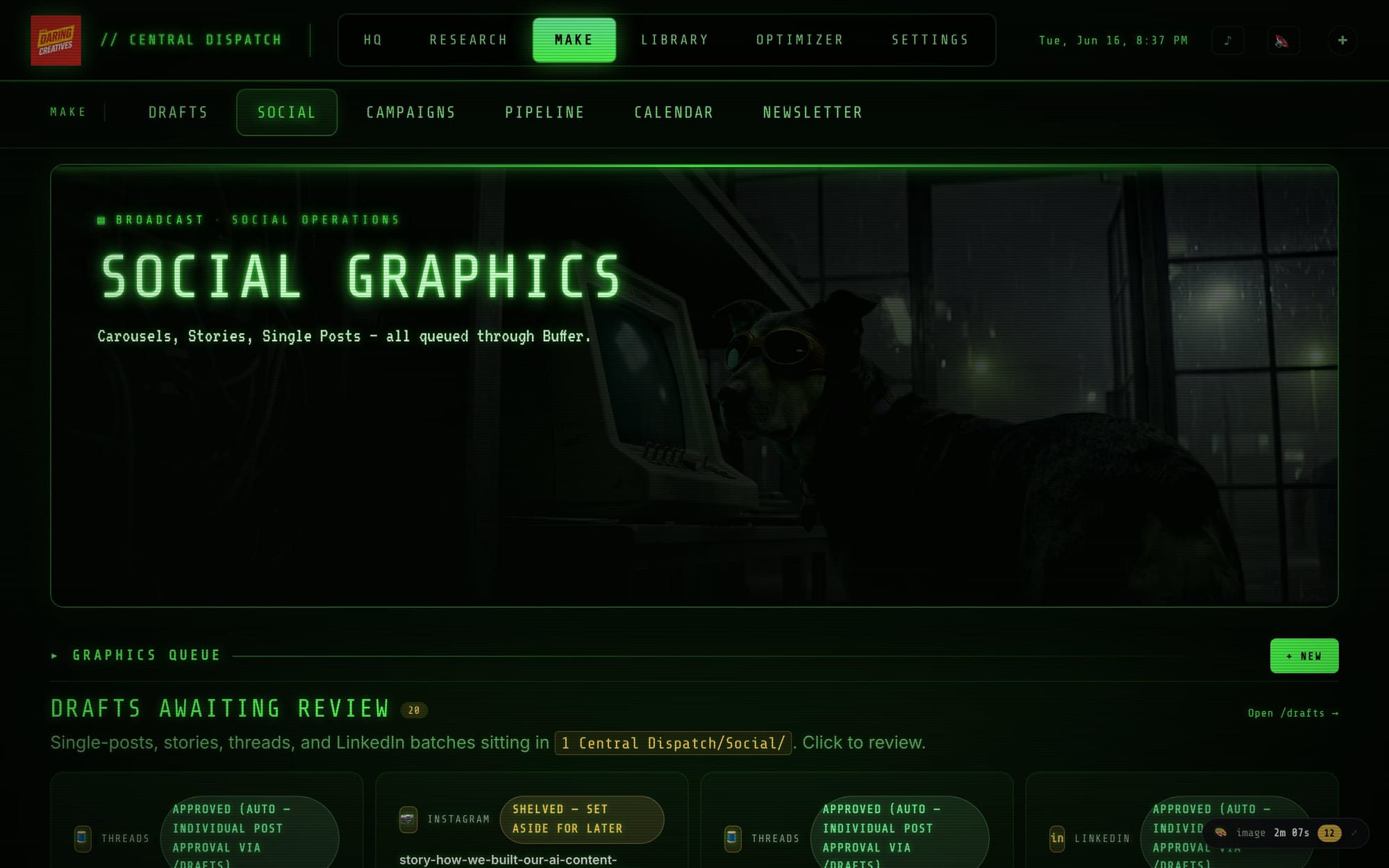
Instagram posts that use carousels — those are the swipeable multi-slide posts — are assembled slide by slide through a separate piece of logic. Each slide's text gets matched to an image from a library based on the character or scene described. Recently-used images get excluded so the same face doesn't show up in every post.
This is honestly the fiddliest part of the whole pipeline. Text-to-image matching for a carousel format requires enough structure in the image library that the matching is actually meaningful — you can't just pick randomly and hope it looks intentional. The rotation logic is there to keep the visual feed from going monotonous.
I don't have a strong opinion on whether this is better than generating images fresh each time — though AI image consistency across the feed is a problem I've written about separately. It's a tradeoff: library images have a known, consistent style; generated images could be more specific to each article. For now, the library approach is what's running.
The one place a transparency footer used to auto-append
My personal LinkedIn is the exception to almost everything else in the pipeline.
It gets a custom-drafted post. It needs my eyes before it goes anywhere. And for a while it was the only destination where a Transparency Protocol footer — a short note about how much of the post was me versus the AI — appended automatically at publish time. I've since turned that off.
No platform gets that auto-append anymore. If I want a transparency note somewhere, I add it by hand.
The reason personal LinkedIn gets the auto-append is that it's the most direct representation of me as a person with a professional voice — not a brand, not a character. The company page is a repost feed. Threads is short-form and casual. Instagram is visual-first. Personal LinkedIn is where someone reads a post and decides whether they trust the person writing it.
That distinction felt worth encoding into the system rather than relying on remembering to do it manually every time.
What this actually looks like from the outside
If you follow The Daring Creatives across platforms, you're seeing the output of this system — but it probably doesn't read like automation, or at least it's not supposed to.
The Threads post for an article sounds different from the LinkedIn post for the same article. The company page shares the excerpt and steps back. The carousel images rotate so the feed doesn't look like the same template on repeat.
None of this is magic. It's a set of rules that got written down after specific things went wrong. The company page rule exists because two different AI summaries of the same article looked bad. The dedup rule exists because I had to flag over-promotion more than once. The carousel rotation exists because a monotonous visual feed is a problem you notice only after it's already a problem.
The most interesting design decisions in this pipeline aren't the clever parts. They're the parts where I told the system to do less, or to stop doing something it was doing automatically.
If you're building an automated content workflow — or even just thinking about it — the question isn't only "what should the AI write?" It's also "where should it not write anything at all?" That second question is the one I wish I'd thought about sooner.